How Deep Should Mudroom Lockers Be
link desc
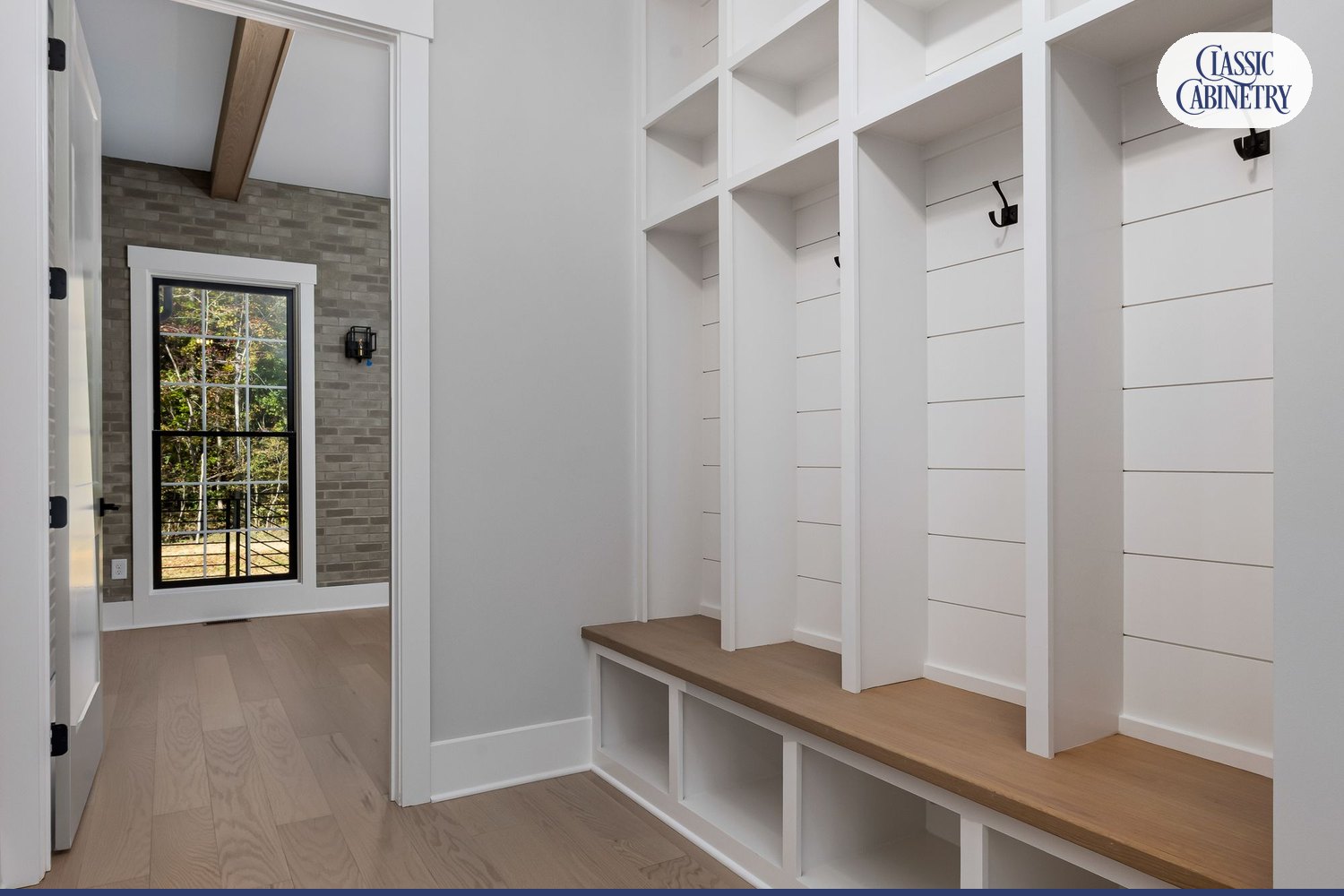


Mudroom lockers should be 18 inches deep for coats on hooks and backpacks, with 15 to 18 inches common in family layouts. Coats on hangers need 22 to 24 inches. Shoe cubbies run 12 to 15 inches deep. No building code sets locker depth, so these are planning ranges. The answer to how deep should mudroom lockers be depends on hooks, rods, and walkway space.
Key Takeaways
Mudroom lockers should be 18 inches deep when coats and backpacks hang on hooks. Entryway Storage calls 18 inches the most common planning depth for hook lockers. The guide notes that no building code defines locker depth. A 15-inch locker works in a tight hall, and a 12-inch locker holds light jackets only.
We build made-to-fit lockers to the depth a household's gear needs, so the box matches the hooks, bags, and walkway. The next section lists the typical depth for each locker type.
Typical mudroom lockers are 15 to 18 inches deep for hook storage. A cabinet manufacturer's size guide lists 18 to 24 inches for finished lockers. Freestanding locker units ship at 15 to 18 inches deep, based on the Entryway Storage review of published specifications.
The table below shows common depth by locker zone, using the Entryway Storage ranges.
| Locker Zone | Common Depth | What Fits |
|---|---|---|
| Slim hook locker | 12 to 14 inches | Light jackets, keys, and leashes |
| Hook locker | 15 to 18 inches | Coats and loaded backpacks |
| Rod locker | 22 to 24 inches | Coats on hangers behind doors |
| Shoe cubby | 12 to 15 inches | Sneakers, boots, and rain boots |
| Bench base | 18 to 22 inches | Seat and drawers below |
Each zone follows the gear it holds. The graphic below compares those zones, and the next section covers the deepest one.
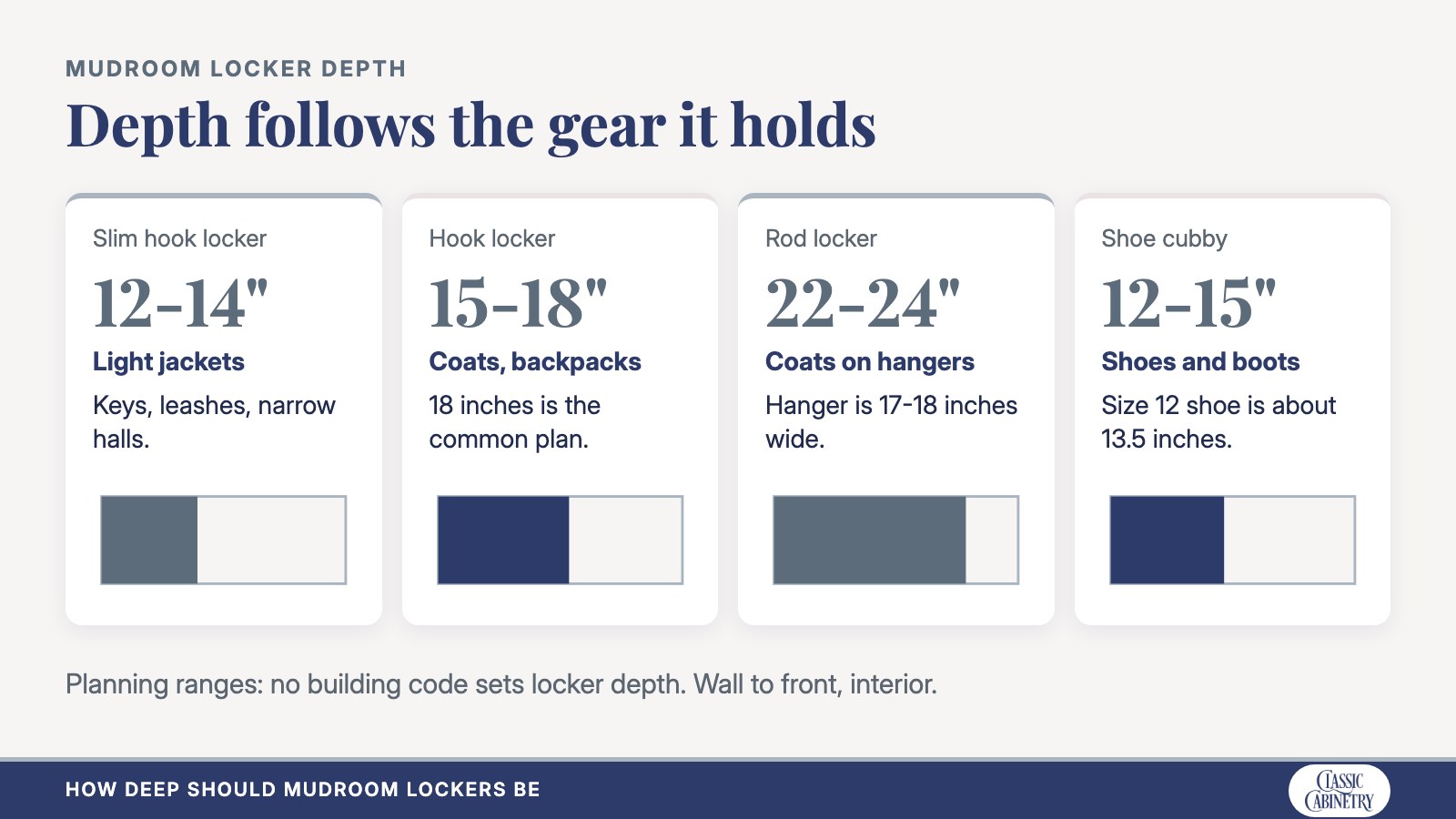
Freestanding units and custom lockers share the same depth bands, but a custom build can land on an exact figure. The cabinet types differ in custom versus stock sizing, which matters when a hall is a few inches short.
Mudroom lockers need to be 22 to 24 inches deep for coats on hangers. Entryway Storage says a standard hanger is 17 to 18 inches wide. A winter coat on it needs about 22 inches of clear depth. Plan 22 inches inside and 24 inches outside.
A 15-inch locker cannot hold a rod, because the hangers angle and the doors will not close. A pull-out valet rod is the one way to hang hangers in less than 20 inches. Hooks avoid the issue, since children use hooks and not hangers.
The same guide adds extra depth for bulky gear. A down parka needs 4 to 5 extra inches to dry, and a sports bag needs 6 to 8 inches. Shoes follow different numbers, covered next.
Mudroom cubbies are 12 to 15 inches deep for shoes. A men's size 12 shoe is about 12 inches long, per Entryway Storage. The heel and sole bring the footprint to about 13.5 inches. A 2025 custom millwork guide lists 12 to 16 inches for shoe shelves.
The question of how deep should mudroom cubbies be comes down to the longest boots in the house. Tall winter boots need 14 to 15 inches of depth and 16 to 18 inches of height. Include at least one tall section in each bay.
Pair the shoe zone with a plan for shoe storage so bags and boots do not compete for one shelf. Above the shoes, the bench sets the next depth.
Mudroom cabinets above a bench should be 12 to 14 inches deep when the bench is 18 to 22 inches deep. Entryway Storage calls this a stepped design, with a deep seat below and shallow uppers above. Cabinet Select lists 12 inches as the standard wall cabinet depth, so stock uppers fit the step.
The step keeps headroom for the person sitting. A bench built flush with 15-inch uppers leaves a useless ledge of about 3 inches. The guide asks for at least a 4-inch difference between bench and upper depth.
The ADA Standards give a public-building reference for bench size. Section 903.3 sets seats 20 to 24 inches deep, and Section 903.5 sets seat height at 17 to 19 inches. A home bench can run shallower, but the numbers show a comfortable seat.
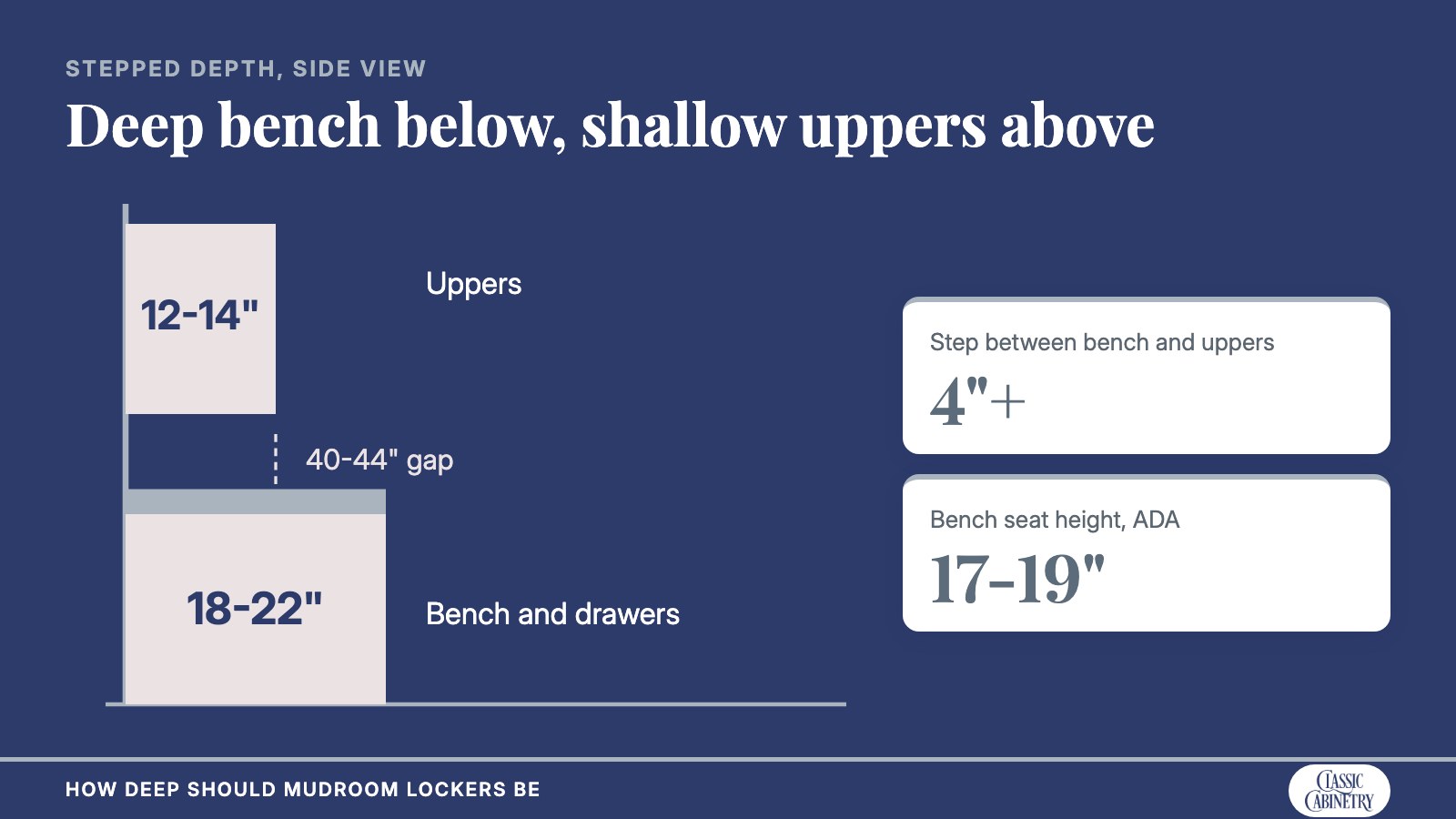
This side view shows the step between bench and uppers. A built-in bench storage layout adds drawers under the seat and keeps that profile. Depth is settled, so width comes next.
Mudroom lockers should be 15 to 18 inches wide for each adult. Entryway Storage calls a bay narrower than 15 inches too tight for shoulders and hanging backpacks side by side. A 2025 custom millwork guide plans 18 to 24 inches per person for a coat plus a bag.
The question of how wide should mudroom lockers be changes with the user. The table below shows the Entryway Storage minimum and common widths for each age group.
| User | Minimum Width | Common Width |
|---|---|---|
| Toddler | 10 inches | 12 inches |
| School-age child | 12 inches | 15 inches |
| Adult, hooks only | 15 inches | 18 inches |
| Adult, coat and bag | 18 inches | 21 to 24 inches |
Two children can share one 24-inch bay with a center divider shelf, per the same guide. Teens and adults need the wider columns. Families with children benefit from kid locker ideas that raise hooks as the child grows. Cubbies follow the same widths, covered next.
Mudroom cubbies are 12 to 18 inches wide, matching the bay they sit in. Entryway Storage lists 12 inches as the common child width and 15 to 18 inches for adults. Shoe cubbies use the same bay width, split by a shelf.
The question of how wide should mudroom cubbies be also depends on bins. Entryway Storage notes that storage bins follow kitchen sizing of 11 to 12 inches, so a 12-inch opening holds them flush. Assign one bay per household member, plus one guest bay.
Mudroom lockers should be 84 to 96 inches tall for full-height storage. Entryway Storage lists 72 inches as the minimum and 84 to 96 inches as the common range. A cabinet manufacturer's guide lists 72 to 84 inches for typical lockers.
The question of how tall are mudroom lockers has a simple tie to cabinet stock. Cabinet Select lists tall cabinets at 84, 90, and 96 inches. A custom build can run floor to ceiling in a taller room.
Height also sets the hook rows and the gap above the bench. Entryway Storage puts 40 to 44 inches between the bench top and the upper cabinet bottom. For custom locker cabinets, we set that gap from the tallest sitter and the tallest coat. The hooks come next.
Hooks for kids should sit at 42 to 54 inches above the floor. A 2025 custom millwork guide gives that range for children and 60 to 66 inches for adults. Hooks sit 6 to 12 inches apart so coats do not overlap and trap moisture.
The ADA Standards publish children's reach ranges by age for hooks and lockers. The table below lists the high and low reach for each age group.
| Age Group | Low Reach | High Reach |
|---|---|---|
| Ages 3 and 4 | 20 inches | 36 inches |
| Ages 5 through 8 | 18 inches | 40 inches |
| Ages 9 through 12 | 16 inches | 44 inches |
The ADA sets 15 to 48 inches for adult reach, and Section 803.5 puts shelves at 40 to 48 inches. These are public-building rules, so a home uses them as a reference. The graphic below pairs the child ranges with the adult row.
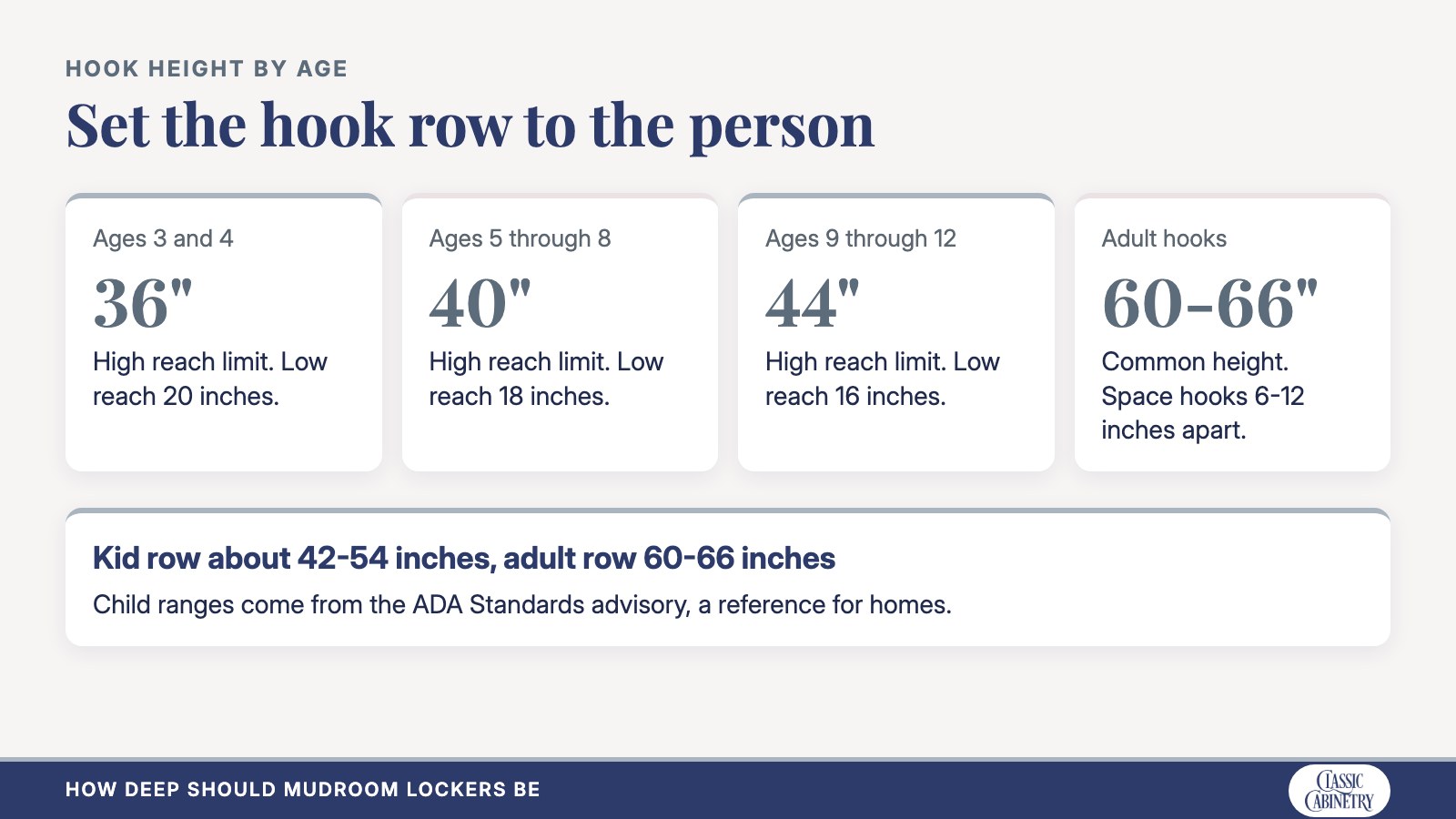
Use a slat or backer board so hooks can move up as the child grows. Strong hook hardware also holds heavy backpacks. Depth and height both affect the walkway, covered next.
Locker depth leaves the hallway width minus the depth, so a 60-inch hall with an 18-inch locker leaves 42 inches of path. Entryway Storage shows a 48-inch hall leaves only 30 inches, which is too tight. The ADA Standards set a 36-inch minimum clear width for walking surfaces.
Use these steps to check any depth against your hall.
The question of how deep should mudroom lockers be gets a short answer in a 48-inch hall. That hall calls for a slim 10 to 12 inch profile with hooks and open shelves. A tight room also benefits from a plan for a small entryway mudroom. Door style changes the usable depth too.
Yes, door style changes usable locker depth because inset doors cost about 0.75 inch of interior depth. Entryway Storage says overlay doors keep more room inside. An 18-inch locker with overlay doors and a 0.75-inch back panel leaves 17.25 inches usable.
An inset door drops that to 16.5 inches. A locker meant for hangers needs about 25 inches outside with inset doors, per the same guide. Compare the two styles in this guide to overlay doors and inset doors before you set the box depth.
Garage-side lockers should be 24 inches deep. Entryway Storage plans 24 inches deep and 24 to 30 inches wide per bay for gear. Sports households use that depth for hockey and lacrosse bags.
Open mudroom cubbies tolerate less depth than closed lockers. Entryway Storage says a backpack that sticks out 1 inch past a 12-inch frame is fine without a door. Closed lockers need an interior at least 1 inch deeper than the coats inside.
Yes, deep closed lockers trap moisture. Entryway Storage advises a 1-inch vent gap at the top and bottom for doors on lockers deeper than 18 inches. Pick moisture-safe materials for wet coats and boots.
Yes, anchor tall lockers to wall studs and follow the manufacturer and installer instructions. Check with your installer or local building department for the right fasteners. Households with young children should read about child-safe cabinets as well.
A family needs one bay per member plus one guest bay, per Entryway Storage. A family of four needs five bays. A shared entry drop zone holds keys and mail beside the bays.
No, 12 inches is enough only for light jackets on hooks. A standard hanger is 17 to 18 inches wide and must angle in a 12-inch space. A loaded backpack sticks out into the room.
Yes, 15 inches wide works for a school-age child or an adult with hooks only. Entryway Storage calls 15 inches the adult minimum. Adults with a coat and a bag need 18 inches or more.
Mudroom bench depth is 18 to 22 inches in the Entryway Storage ranges. The ADA Standards set public bench seats at 20 to 24 inches deep. A narrow hall can use a 16-inch perch.
A mudroom bench should be 17 to 19 inches tall. The ADA Standards use that range for bench seat height in Section 903.5. Entryway Storage lists 18 inches as the standard.
A shoe shelf under a bench should be 12 to 16 inches deep. A 12-inch shelf holds most pairs, and 16 inches holds boots. Pull-out trays suit benches deeper than 18 inches.
Mudroom hooks should sit 6 to 12 inches apart. Use the low end for children and the high end for winter coats. Wide spacing lets wet coats dry.
Classic Cabinetry builds custom mudroom lockers to the depth, width, and height each entryway needs. The answer to how deep should mudroom lockers be starts with a measured hall. We measure the hall, the gear, and the door swings first, and then we build the boxes to those numbers. Our mudroom locker builds serve homes in Huntsville and North Alabama.
To plan a locker wall that fits your family, call (256) 423-8727 and bring your hall measurements. A list of the bulkiest coats, bags, and boots helps us set depth, bay widths, and hook rows in one visit.
Families who want finished examples can browse the Classic Cabinetry projects before that visit.