.avif)


.avif)


.avif)
How to Design a Home Office and Guest Room Combo With Custom Cabinetry
link desc
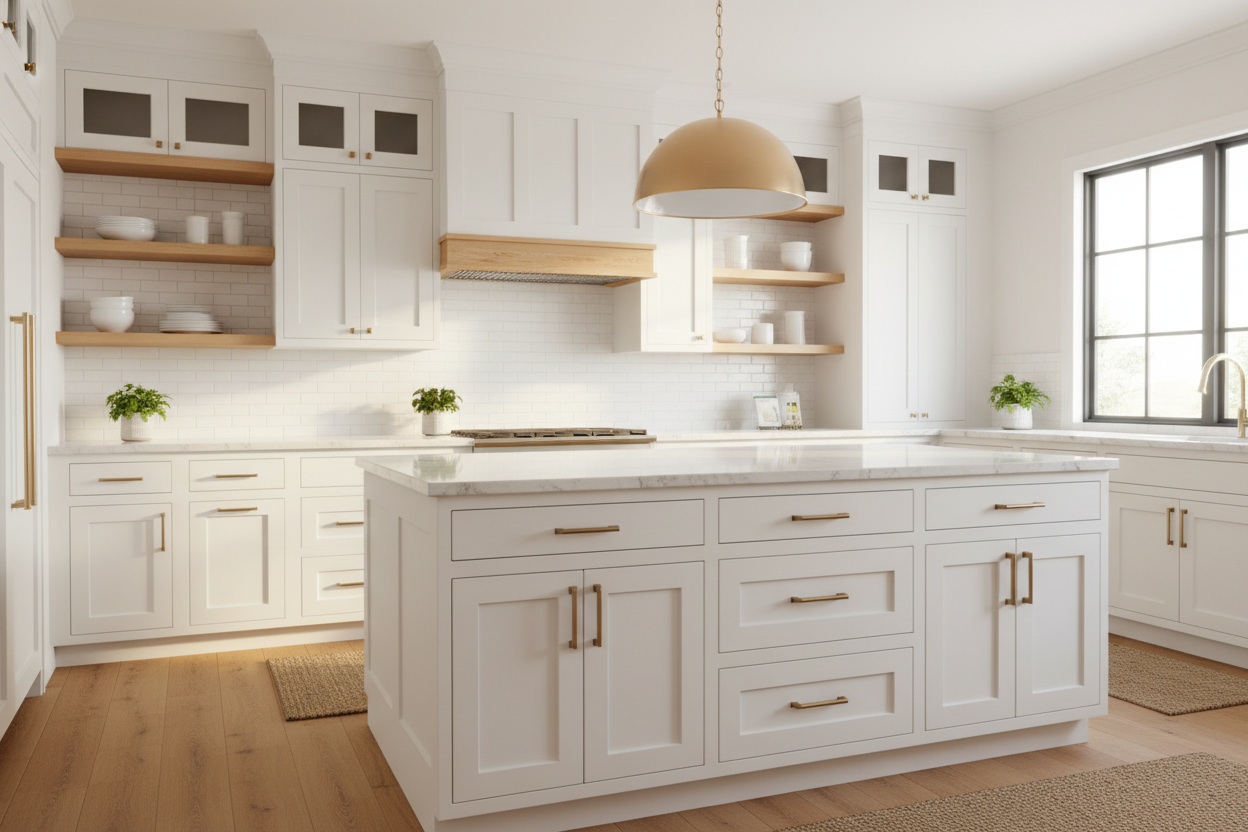


Wood cabinets last longer than white cabinets on finish life, and the two run close to even on style life as long as the white is a warm one. Those are two separate answers because "lasts longer" is really two separate questions: how long the finish survives daily use, and how long the look survives changing taste. Wood wins the first clearly. The second comes down to warm versus cool rather than wood versus white, and stark cool white is the only option in this comparison that loses on both counts. Below we work through both halves, starting with what the performance testing actually measures and finishing with how to decide for your own kitchen.
Between white cabinets and wood cabinets, wood lasts longer on finish life, while warm wood and warm white last about equally long on style life. Splitting the question that way is what makes it answerable. A painted door and a stained door age through completely different mechanisms, and they date through completely different ones again.
Finish life measures how long the surface holds up before it needs refinishing. Style life measures how long the look reads as current rather than as a specific decade. A kitchen can fail either test on its own. Painted cabinetry in perfect condition still looks dated if the white is the cool, clinical version that peaked in the 2010s, and a beautifully current wood tone still looks tired if the finish has worn through at the pulls.
Market direction has shifted toward wood, though not decisively. The 2026 U.S. Houzz Kitchen Trends Study, based on 1,780 renovating homeowners, found wood cabinetry chosen by 29 percent against 28 percent for white, the first time wood has led in nearly a decade. Wood rose six percentage points in a single year.
A single point of separation is not a mandate to choose one over the other. We build custom kitchen cabinets in both painted and stained finishes, and the right call depends far more on how a household lives than on which finish is currently ahead in a survey.
The cabinets that last the longest are solid hardwood boxes and doors with a catalyzed conversion varnish finish, built and tested to the ANSI/KCMA A161.1 standard. Construction quality outranks color by a wide margin, and unlike color, construction quality has a measurable standard behind it.
ANSI/KCMA A161.1 is the only performance and construction standard for kitchen and vanity cabinets in North America, administered by the Kitchen Cabinet Manufacturers Association and tested by independent third-party laboratories on production samples rather than prototypes. Certified cabinet doors are opened and closed 25,000 times without hinge failure or loss of alignment. Drawers complete 15,000 cycles under load. An installed wall cabinet carries a 500-pound static load without deformation, and shelves and bottoms are loaded at 15 pounds per square foot without excessive deflection.
Finish testing under the same standard is where the color question finally enters. Exposed surfaces face vinegar, lemon, orange and grape juice, ketchup, coffee, olive oil, and 100-proof alcohol for 24 hours, plus mustard for one hour, with no permitted discoloration, blistering, or film failure. Doors also sit in a hotbox at 120 degrees Fahrenheit and 70 percent relative humidity for 24 hours, and door edges face a standardized detergent solution for 4 to 24 hours depending on door type. Both painted and stained finishes can pass all of it, which is the point worth holding onto: neither color is inherently fragile.
Durability DimensionPainted White CabinetsStained Wood CabinetsVisible daily wearShows fingerprints, grease, and scuffs readily against a solid field of colorGrain variation camouflages the same marksJoint behavior over timeContinuous paint film spans the stile and rail joint and can show hairlines as the door movesStain moves with the joint; seasonal shifts stay largely invisibleHumidity responsePaint-grade MDF panels stay dimensionally stable; solid painted rails still moveSolid wood expands and contracts about 1% in width per 4% change in moisture contentCleanabilityMarks are obvious, so cleaning happens sooner; satin and semi-gloss wipe easilyMarks are hidden, so grime can build unnoticed on matte finishesSpot repairColor matching a cured paint film is difficult; touch-ups often read as patchesStain and topcoat blend into surrounding grain more forgivinglyFull refresh pathRepaint, typically after 15 to 20 years of normal useSand and refinish, and the same doors can later be painted if taste changesStyle-dating riskLow for warm whites, high for stark cool whitesLow for medium and light tones, higher for orange-toned stains
Sources: ANSI/KCMA A161.1 Performance and Construction Standard for Kitchen and Vanity Cabinets; USDA Forest Products Laboratory, Wood Handbook; 2026 U.S. Houzz Kitchen Trends Study (n=1,780); NKBA 2026 Kitchen Trends Report (634 design professionals).
Painted white cabinets last roughly 15 to 20 years before the finish needs repainting, assuming a quality catalyzed coating and normal household use. The boxes and doors underneath usually have decades left at that point. It is the film on the surface that reaches the end of its service life, not the cabinet.
Heat and moisture shorten that window. Doors nearest the range take the most abuse, since cooking throws grease and heat at the same panels every day, and a lower-grade coating can yellow noticeably in that zone well before the rest of the run shows any change. High-humidity kitchens compress the timeline further.
Refinishing a painted kitchen is a smaller project than replacement, which is why the distinction matters. Worn paint on sound boxes is a finish problem. Sagging shelves, failing hinges, delaminated ends, and doors that no longer close square are structural, and those are the conditions that mean it is time to replace your cabinets rather than recoat them.
A painted cabinet finish lasts longer when the door uses a dimensionally stable center panel, a catalyzed coating rather than a standard wall paint, and a sheen with enough resin content to be wiped clean. Those three choices decide most of the outcome, and all three happen before the cabinet is ever installed.
Center panel material is the least visible and most consequential of the three. A five-piece painted door has a center panel captured inside a frame of stiles and rails, and solid wood in that position expands and contracts with the seasons. Paint-grade medium-density fiberboard (MDF) does not move meaningfully, which is exactly why cabinet makers specify it for painted center panels while using solid hardwood for the frame that carries the hinges.
Movement at the frame joints is the other half of the story. Where two solid pieces meet at the corner of a painted door, a continuous paint film bridges the seam, and any seasonal shift in that joint can telegraph through as a fine hairline. Stained doors go through the same movement, but stain sits in the wood rather than across the joint, so the shift never becomes visible.
Coating chemistry finishes the job. Catalyzed conversion varnish and comparable factory-applied systems cure to a harder, more chemically resistant film than brush-applied wall paint, which is what allows a painted door to survive the 24-hour ketchup, coffee, and alcohol exposure panel in the KCMA testing. Selecting the right cabinet finishes at the design stage is a durability decision as much as an appearance one.
Wood cabinets hide wear better than white cabinets, because natural grain variation breaks up the surface and prevents any single scuff from reading as a defect. A painted door presents an unbroken field of one color, so every mark on it has a clean background to stand against.
Wear concentrates in predictable places, and both finishes take it in the same spots:
Every one of those points shows sooner on white. That visibility cuts both ways, though. A white kitchen tells you it needs cleaning, which means it usually gets cleaned. A wood kitchen hides the same buildup until it has been accumulating for months.
Species choice sharpens the effect further. Tight, closed-grain woods like maple present a smoother surface that shows less texture but also camouflages less, while open-grain woods like white oak break up light more aggressively and hide more. We spec both regularly in kitchen cabinetry, and the choice usually follows how hard the household actually runs the room.
Humidity affects wood cabinets more than painted ones in terms of measurable movement, though every cabinet with solid wood components responds to humidity regardless of what color it is finished. Paint does not stop wood from moving. It only changes what that movement looks like on the surface.
Wood is hygroscopic, meaning it exchanges moisture with surrounding air until the two reach equilibrium. The USDA Forest Products Laboratory establishes 6 to 8 percent moisture content as the range at which interior cabinetry stabilizes in a conditioned home at 30 to 50 percent relative humidity. Homes without humidity control commonly swing between 25 and 65 percent relative humidity across a year, which drives roughly a 6 percent change in the moisture content of the wood inside them.
Dimensional change follows directly from that. Flat-grain wood shifts about 1 percent in width for every 4 percent change in moisture content, so a 3-inch stile can move a detectable fraction across a season. On a stained door that movement disappears into the grain. On a painted door it can appear as a hairline at the joint, which is the same mechanism described above and the reason the two finishes age differently in the same room.
North Alabama summers put real pressure on that equation, which is why we build with hardwoods dried to interior moisture targets and specify protective finishes rather than treating humidity as an afterthought. The same logic drives material selection for humidity-resistant cabinets anywhere moisture runs high.
You can refinish wood cabinets and repaint white ones, but refinishing wood offers more paths forward than repainting paint does. That asymmetry is one of the strongest practical arguments in wood's favor over a twenty-year horizon.
A solid wood door can be sanded back and restained darker or lighter, sanded and clear-coated, or primed and painted, which gives it three futures instead of one. A painted door can be repainted, and if the substrate underneath is paint-grade MDF, stripping to bare wood for a stain finish is not an option at all. Choosing paint today quietly forecloses the stain option later.
Spot repair splits the same way. A scratch in a stained door can often be touched in with matching stain and a topcoat that blends into surrounding grain. A chip in a cured paint film is harder to disguise, since the eye reads any slight variation in a solid color field, and the honest fix is frequently refinishing the whole door rather than patching it.
Substrate is what determines which of those options stay open, so the decision belongs at the design table rather than in year fifteen. Weighing cabinet materials against how long you plan to keep the kitchen is the practical version of that conversation.
The cabinet finish that is easier to clean is a painted or stained surface in satin or semi-gloss, because sheen level governs cleanability far more than color does. A satin white door and a satin stained door wipe down almost identically. A matte version of either fights back.
Sheen comes from resin content, and resin is what makes a film smooth enough to release grease instead of holding it. Flat and matte coatings have a microscopically rougher surface that traps kitchen soil in a way a satin or semi-gloss film does not, which is why flat paint belongs on ceilings rather than on cabinet doors near a range.
Frequency matters more than product. Wiping high-contact points weekly with a mild solution keeps buildup from bonding to the film, and that habit extends the life of both finishes. Harsh degreasers, abrasive pads, and standing water at the sink cabinet do more damage over time than daily cooking does. A consistent cabinet maintenance routine is the cheapest durability upgrade available on any kitchen.
White cabinets are not out of style in 2026, though one particular version of white is fading while warmer versions continue to perform. Having settled how each finish holds up physically, the second meaning of "lasts longer" is whether the look itself survives, and that is a different analysis with different evidence.
The numbers show evolution rather than collapse. White was chosen by 28 percent of renovating homeowners in the 2026 Houzz study, and white and off-white together still account for 43 percent of remodels. The NKBA reports that 96 percent of design professionals continue to recommend neutral palettes as the foundation of kitchen design. White has not left; it has been joined.
What has changed is temperature. Cool, stark, blue-leaning whites that defined kitchens from roughly 2010 through 2022 are giving way to creamier, warmer whites with soft undertones that pair naturally with wood, stone, and warm metals. Choosing a warm white today is materially different from choosing the white that was standard a decade ago, even though both get called white.
The cabinet colors reading as outdated are stark cool-toned white and orange-toned honey oak stain, especially when paired with the door profiles and flooring of their original era. Both aged the same way, and neither aged because of the color alone.
Context did most of the damage. Honey oak of the 1990s looked dated less because it was wood and more because it arrived as a package: an orange-heavy stain, an ornate raised panel door, matching oak flooring, and matching oak trim throughout. Stark white of the 2010s arrived as its own package: a cool blue-white, cool gray countertops, gray subway tile, and chrome hardware. Strip either color out of its package and it stops looking like a decade.
Painted-market data confirms the movement without declaring anything dead. Painted cabinets overall fell from roughly 70 percent of the market to 52 percent according to Woodworking Network, driven largely by the return of natural wood finishes. That is a rebalancing, not an extinction.
The same aging pattern runs through the rest of the house on a slower clock, since vanities tend to follow kitchen trends by several years. Homeowners updating bathroom cabinets after a kitchen project usually find the two rooms have drifted apart in temperature more than in color.
Wood cabinets do not go out of style as a material, though specific stain tones and door profiles absolutely do. Wood is a material rather than a color, and that distinction is why it keeps returning while individual paint colors do not.
Application is what dates. Today's wood cabinetry uses cooler stains with the orange pulled out, flat or slim shaker door profiles instead of ornate raised panels, and matte to satin sheens instead of high gloss, and it gets paired with natural stone and warm metals rather than matching wood floors. Same species, same material, entirely different result.
Professional specification data supports the durability of the current direction. The NKBA 2026 Kitchen Trends Report, surveying 634 design professionals, found 59 percent identifying wood grain as a growing trend, with white oak specified by 51 percent. MasterBrand's annual report found that for the first time in nine consecutive years, white was not the top preferred cabinet finish, with light wood stains taking the top position. Three independent sources with different methods arriving at the same conclusion is a stronger signal than any one survey.
The cabinet colors in style for 2026 are medium and light wood tones, warm whites, creams, and soft off-whites, with white oak leading among species. Medium wood tones lead at 15 percent of renovating homeowners, light wood follows at 11 percent, and dark wood trails at 3 percent, according to the 2026 Houzz study.
Durability of the choice matters more than currency of it. Both leading directions, warm wood and warm white, share the same underlying property: they are warm neutrals, which is the category that has survived every cycle for decades. Picking inside that category is what buys style longevity, whichever side of it you land on. We build custom cabinetry across the full range and see the warm neutrals age best by a wide margin.
Anyone weighing specific shades rather than the broader direction will find more detail in our writeup on popular cabinet colors, which covers individual finishes rather than the durability question this post addresses.
At resale, warm white and warm wood hold value about equally well, and both outperform stark cool white. The useful axis for resale is the same warm-versus-cool split that governs style longevity, not the wood-versus-white split most buyers think they are choosing between.
Broad appeal is what drives the result. White has historically reached the widest buyer pool because it functions as a neutral canvas, and that advantage still holds for the warm version. Wood, particularly white oak, has moved from a niche preference to something buyers now read as a premium material, which has closed most of the gap that used to exist.
Buyer pools also vary by market, and Huntsville's mix of newer construction and older established neighborhoods means the safest choice differs by street rather than by trend report. Pulling a few comparable local listings before committing is more informative than any national survey, since storage quality and condition tend to influence what buyers pay more than finish color does. Well-built cabinetry supports home value largely through construction and function rather than through color selection.
You can mix white and wood cabinets in the same kitchen, and roughly one in four renovating homeowners now does exactly that. The two-finish kitchen has moved from a design flourish into a mainstream approach, and it solves a durability problem as neatly as it solves a style one.
The standard configuration puts white or warm off-white on the uppers and wood on the lowers or the island. Houzz data shows white leading upper cabinets at 40 percent and wood leading lowers at 37 percent in two-tone kitchens. The visual logic is that uppers read against the wall and benefit from lightness while lowers anchor the room, but the practical logic is stronger: base cabinets absorb nearly all the kicks, scuffs, and cleaning traffic in a kitchen, and wood hides that wear. Upper cabinets are rarely touched below the door pull.
Consistency is what keeps a two-finish kitchen from looking accidental. Use the same door profile in both finishes, keep hardware uniform across the room, and let the countertop tie the two colors together rather than introducing a third direction. Pairing a warm white upper run with black hardware is one reliable way to hold the two halves together visually.
You choose between white and wood cabinets by working through light, traffic, maintenance honesty, and temperature in that order, then letting the finish fall out of the answers. Both halves of the durability question feed into this sequence, since finish life and style life pull in slightly different directions and the sequence resolves them.
Working the list in order tends to produce a clear answer within a few steps, because light and traffic eliminate one option far more often than taste does.
The most durable wood species for cabinets are maple, hickory, and white oak, all of which are dense hardwoods that resist denting and hold a finish well. Maple offers a tight, consistent grain that takes stain and paint evenly. White oak brings an open grain with gray undertones that camouflages wear effectively. Hickory is the hardest of the three and shows the most natural color variation.
Paint-grade MDF is better for the center panels of painted cabinet doors, because it stays dimensionally stable and takes a smooth painted film without grain telegraphing through. Solid hardwood remains better for stiles, rails, and face frames, where the material has to carry hinge screws and resist impact. Most quality painted doors combine both materials for that reason.
White cabinets can yellow over time, most noticeably on doors near the range where heat and cooking grease concentrate. Lower-grade oil-based coatings yellow fastest. Catalyzed conversion varnish and modern waterborne systems resist ambering far better, which is one reason factory-applied cabinet finishes outperform on-site wall paint on painted cabinetry.
Cabinet sheen affects durability meaningfully, since higher-sheen finishes contain more resin and produce a smoother, more cleanable film. Satin and semi-gloss release grease and resist scrubbing better than flat or matte coatings, which have a rougher microscopic surface that holds kitchen soil. Matte finishes look excellent and simply require more attentive cleaning near cooking zones.
White cabinets are generally better for a small kitchen, because a light finish reflects more available light and reduces the visual weight of a full cabinet run. Small kitchens with strong natural light can carry wood successfully by staying in the light tones, such as white oak or natural maple, rather than reaching for dark stains that close the room in.
Custom cabinets generally last longer than stock cabinets, because construction specifications are set rather than inherited. Solid hardwood frames, plywood boxes, full-extension hardware, and catalyzed finishes can all be specified deliberately in a custom build, while stock lines fix those choices at a price point. The ANSI/KCMA A161.1 standard measures those construction qualities directly.
Cabinets should be wiped weekly at high-contact points and cleaned fully once a month to protect the finish. Weekly attention around pulls, the range wall, and the sink cabinet prevents grease from bonding into the film, which is what eventually forces refinishing. Mild soap and water outperform harsh degreasers, which strip protective topcoats over repeated use.
Wood lasts longer than white on finish life, and the margin is real: grain hides the wear that paint displays, stain moves with the door instead of spanning its joints, and a solid wood door can be refinished into three different futures while a painted one has one. On style life the answer flips to a tie, provided the white is a warm one. The finish that ages worst in this comparison is not wood or white in general but the cool, stark white of the last decade, which loses on both counts at once. Choose a warm neutral, a simple door profile, and a catalyzed finish, and either direction will still look deliberate in fifteen years.
We have been building painted and stained cabinetry from our Ardmore shop for more than four decades, and the kitchens that hold up best are almost never the ones that chased a trend. If you want to see both finishes side by side before deciding, Classic Cabinetry can walk you through samples in your own light.
A free estimate is a straightforward place to begin.