.avif)


.avif)


.avif)
How to Design a Home Office and Guest Room Combo With Custom Cabinetry
link desc


Last updated: November 2026.
White cabinets with black hardware still work in 2026 — but the design landscape around them has shifted. Matte black is no longer the default contrast pairing it was three years ago. It's now one option among several strong choices, including champagne bronze, aged brass, and the rapidly growing trend of mixed-metal cabinetry.
If you're styling white cabinets with black hardware in 2026, the short version is this:
The rest of this guide covers each of those decisions in detail, plus the questions homeowners across Huntsville, Madison, Decatur, Ardmore, and Athens ask us most often at the Classic Cabinetry showroom.
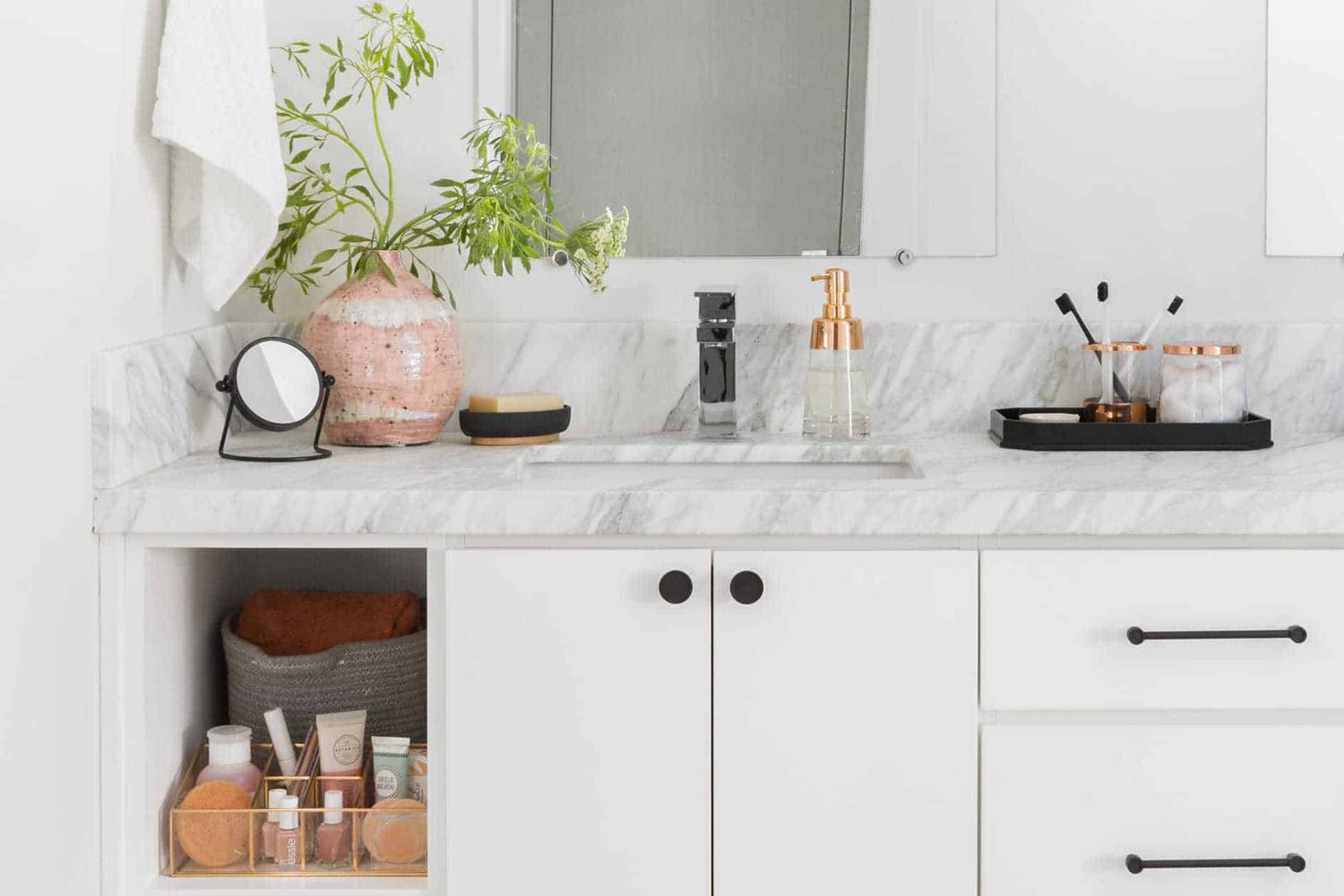
White cabinets with black hardware create the kind of high-contrast pairing that reads as intentional rather than trendy. The visual logic is simple: a light, reflective cabinet face against a dark, defined pull or knob gives the eye a clear focal point and makes the cabinetry geometry — door panels, drawer fronts, vertical seams — more readable.
Three reasons this combination keeps showing up in current kitchens:
Search interest for "white kitchen cabinets with black hardware" has been consistent for several years and shows no signs of dropping in 2026 — but the conversation around it has matured.
Yes — but it's no longer the default.
The honest 2026 picture: matte black hardware on white cabinets remains a strong, current choice. Sweeten's 2026 hardware report calls it out specifically as a finish that "grounds lighter kitchens without overwhelming the room." Kitchen Cabinet Kings' 2026 hardware trends guide lists matte black among the four best places to start when choosing finishes today.
At the same time, some trend-watchers are signaling a shift. RTA Cabinet Store's 2026 trends-to-avoid list suggests matte black "has had its day," recommending metallics instead. That doesn't mean matte black is dead — it means the design world has expanded beyond a single dominant pairing.
What that means practically: matte black is a safe and stylish choice in 2026 if you genuinely like the look. It's not the only correct answer anymore, but it isn't a mistake either. If you'd choose it on aesthetics alone, choose it. If you're choosing it because you think it's the only modern option, pause and look at warm metals too.
The kitchens we install across North Alabama tend to land in the same place: homeowners who love clean lines, dark accents, and high contrast choose matte black. Homeowners who want a softer or warmer kitchen pick brass, champagne bronze, or a mixed-metal combination. Both groups end up happy.
For white cabinets specifically, these are the finishes that are most in play in 2026, with honest tradeoffs for each:
| Finish | What It Does for White Cabinets | Best Style Match | Watch For |
|---|---|---|---|
| Matte Black | Creates crisp, high-contrast definition. Hides fingerprints well. | Modern, transitional, farmhouse | Can feel heavy in small kitchens; trend-watchers see it as past peak |
| Satin Nickel | Quiet, classic accent. Reads as neutral. | Traditional, transitional | Less visual statement; some find it dated |
| Champagne Bronze | Warm without yellow. Soft glow against white. | Transitional, modern farmhouse, classic | Pricier; finishes vary widely by manufacturer |
| Aged / Unlacquered Brass | Develops patina over time. Lived-in feel. | Farmhouse, classic, traditional | Patina is permanent — make sure you want it |
| Polished Nickel | Bright, reflective, slightly warm. | Traditional, transitional | Shows fingerprints; needs more cleaning |
| Mixed (Black + Brass) | Strongest current 2026 look. Anchors and warms at the same time. | Modern, transitional, designer-driven | Requires careful coordination; can look chaotic if done poorly |
If you're choosing right now and want a finish with the most longevity, the 2026 consensus across multiple design sources points to champagne bronze, aged brass, matte black, or polished nickel as the safest picks.
The biggest single shift in 2026 kitchen hardware is the move toward intentional mixed-metal pairings. Two-tone hardware combinations — black with brass, chrome with white, bronze with wood — appear in nearly every 2026 kitchen design publication we tracked researching this update.
For homeowners committed to black hardware, mixed metals offer a way to keep the contrast you want while warming the overall feel of the kitchen. A few combinations that work consistently:
The mistakes to avoid: pairing more than two metal finishes in one kitchen usually looks accidental, and mixing finish sheens (high-polished brass with brushed nickel, for example) reads as random rather than designed.
If you're doing a full kitchen remodel in North Alabama and want a mixed-metal scheme to feel intentional, plan it from the start. Hardware, lighting, and plumbing fixtures should be chosen together — not in three separate shopping trips.
Oversized pulls are one of the clearest 2026 trends. Across Kitchen Cabinet Kings, TheCoolist, and Sweeten's 2026 reports, the same theme repeats: pulls are getting longer, more substantial, and more sculptural. Tiny knobs on tall cabinets are increasingly read as outdated.
That doesn't mean every cabinet needs a 12-inch pull. It means proportion matters more than ever.
The principle of balance is the most common mistake we see in DIY kitchen hardware swaps. Oversized hardware overwhelms small cabinets; undersized hardware disappears against large doors. A simple guideline that works for most kitchens:
This is also where mixing knobs and pulls strategically pays off. Classic Cabinetry's design team typically recommends pulls on drawers and lower cabinets (where hands are gripping and pulling outward) and knobs on upper doors (where hands are pulling outward and downward in a smaller motion). For specific guidance on awkward configurations, see our guide to organizing a corner wall cabinet.
If matte black is your direction, the finish quality matters more than the shape. Cheap matte black hardware chips and rubs to silver underneath within a year or two of daily use. Quality matte black — typically solid brass with a powder-coated or PVD finish — holds its color through decades of opening and closing.
Matte black also resists fingerprints and water spots better than polished metals, which is why it remains a practical choice in working kitchens.
Even spacing is the difference between a kitchen that reads "designed" and one that reads "I put hardware on at the hardware store." For drawer stacks, vertically align pull centers. For runs of cabinetry with identical doors, all pulls should be installed at the same offset from the door edge.
Small detail, large impact. This is the single most common installation error in DIY hardware projects.
Mixing knob shapes within a single kitchen — when done deliberately — adds visual rhythm without creating chaos.
The most reliable pairing: round knobs on upper cabinets, linear pulls on lower drawers and doors. This works because the shapes serve different physical functions (pinching vs. gripping) and because the visual variation breaks up large cabinet runs.
When mixing shapes, finish should stay consistent. Black knobs + black pulls works. Black knobs + brass pulls doesn't — unless the kitchen as a whole has a clear mixed-metal strategy as discussed above.
Different cabinet types reward different hardware shapes:
The other major 2026 hardware trend is texture. Smooth, polished hardware is being joined by ribbed, knurled, hammered, and faceted finishes that add tactile depth even within a single finish color.
In a black-and-white kitchen, the contrast between finishes carries a lot of the visual weight. Matte black hardware against high-gloss white cabinetry creates the most graphic version of the look. Matte hardware against matte cabinetry reads softer and more subdued. Both work — the choice depends on whether you want the kitchen to feel sharp or quiet.
Knurled or ribbed pulls are appearing across 2026 design publications as a way to add interest without changing the finish color. A matte black knurled pull on a white cabinet reads as more designed and considered than a plain rectangular bar pull of the same finish.
Backsplash texture supports hardware choice. Herringbone marble, honed granite, zellige tile, and natural stone all complement black hardware against white cabinets without competing. Smooth, high-gloss subway tile pairs better with smooth, polished hardware; textured tile pairs better with textured hardware.
Farmhouse aesthetics have matured. The shiplap-everywhere version of farmhouse from the late 2010s has been replaced in 2026 by a quieter, more selective approach — and black hardware fits that quieter farmhouse very well.
For farmhouse-leaning kitchens, look for black hardware that suggests handwork without being overtly distressed:
Black hardware on white cabinets pairs especially well with natural materials elsewhere in the room: butcher-block islands, soapstone or marble counters, wide-plank wood floors, exposed wood beams. This is the architecture that lets farmhouse feel current rather than themed. If you're also choosing your cabinetry from scratch, the wood species you choose matters just as much as the hardware that goes on top.
The current evolution of farmhouse hardware uses traditional shapes — bin pulls, cup pulls, rounded knobs — in modern finishes. A bin pull in matte black reads as both classic (the shape) and current (the finish).
Hardware is one of the few elements of a kitchen that gets touched dozens of times a day. Selecting for ergonomics and durability isn't separate from selecting for style — it's part of the same decision.
Pulls should fit comfortably in a closed hand. Knobs should turn or pinch easily. Hardware that's too small forces fingertip use; hardware with sharp edges is unpleasant to grip wet or full-handed. Trying hardware in person — squeezing a pull, twisting a knob — is the difference between hardware you forget about and hardware you notice every day.
Larger pulls and easy-grip knobs accommodate every member of the household. This matters especially in kitchens used by older adults, children, or anyone with grip limitations. For homes designed with aging-in-place cabinetry in mind, oversized pulls do double duty: they're on-trend for 2026 and more accessible.
Solid metal hardware — stainless steel or solid brass with a quality black finish — outlasts hollow zinc or plated alternatives by years. The price difference between cheap and quality hardware on a typical kitchen is usually a few hundred dollars total; the durability difference can be a decade or more.
For homes across North Alabama, where humidity and temperature swings stress cabinet hardware harder than dry-climate kitchens, durable finishes are a practical priority, not a luxury.
The smallest details determine whether a kitchen reads as "designed" or "decorated." In 2026, design publications keep returning to the same theme: consistency across the room is what makes high-end kitchens look high-end.
Lighting and seating finishes should harmonize with cabinet hardware. That doesn't mean every metal in the room needs to be identical — but the relationships should feel deliberate. Matte black hardware can sit comfortably with matte black pendants, with brass pendants (the dominant 2026 mixed-metal move), or with iron or wood accents. It rarely sits well with chrome.
The standard plastic switch plate is one of the most common failures of an otherwise-cohesive kitchen design. Matte black switch plates and outlet covers are inexpensive and instantly elevate the rest of the room. Brass, brushed nickel, and unfinished metal versions are also widely available in 2026.
Faucets, pot fillers, light fixtures, hardware, switch plates, hood ranges, and even appliance handles all participate in the metal story of a kitchen. Mapping them out together — ideally during the design phase — prevents the "five different metals" effect that makes kitchens feel busy and unfinished.
A few patterns we're seeing in the 2026 kitchens being designed and installed across our showroom:
White cabinets with black hardware remain one of the most reliable kitchen pairings in 2026 — but the design conversation has expanded. Matte black is no longer the default; it's one strong option alongside warm brass, champagne bronze, mixed-metal combinations, and increasingly textured or oversized hardware.
The 2026 version of this look is more thoughtful and less formulaic than the 2022 version. Whether matte black is right for your kitchen depends on the rest of the room: the cabinetry style, the lighting plan, the metal finishes elsewhere, and the overall feel you want — sharp and modern, soft and warm, or something in between.
If you're planning a kitchen renovation in Huntsville, Madison, Decatur, Ardmore, or Athens, the team at Classic Cabinetry can walk you through the full hardware-and-finish decision in our showroom. We design and install custom kitchen cabinetry across North Alabama and South-Central Tennessee, and bringing the cabinet door, hardware, and lighting fixtures together in one place is the fastest way to find a combination that feels right — avoiding the common mistake of choosing each element separately and hoping they coordinate.
No — but they're no longer the default contrast finish for white cabinets. 2026 design publications consistently include matte black among the recommended finishes for white cabinetry, but warm metals like champagne bronze and aged brass have gained significant ground. Matte black remains a current, defensible choice for homeowners who genuinely prefer the high-contrast look.
Both work. Choose matte black if you want sharp, graphic contrast and a kitchen (or custom bathroom) that reads modern or transitional-modern. Choose champagne bronze if you want warmth, softness, and a space that reads transitional or transitional-traditional. Pull both finishes in your hand at a showroom before committing — the choice is usually obvious once you see them on your actual cabinet door samples.
Larger. The 2026 trend across multiple design publications is toward longer, more substantial pulls — 6 to 12 inches on standard cabinetry, with oversized 10-12 inch pulls increasingly common on tall pantry doors. The tiny 3-inch pulls that were common in the mid-2010s now read as undersized on most modern kitchens.
Yes — this is one of the strongest 2026 trends. Black cabinet hardware paired with warm brass lighting and a brass faucet creates a layered, designed look that warms the kitchen without losing the definition that black hardware provides. The key is making the mix look intentional: don't pair two random metals; commit to a clear black + brass scheme and carry it through faucets, lighting, and accessories.
Matte and satin black finishes hide fingerprints noticeably better than polished metals. This is one of the practical reasons matte black has been a popular kitchen choice for years. Polished or glossy black finishes show prints more readily and require more cleaning.
For everyday cleaning, wipe white cabinets with a microfiber cloth. The microfiber picks up dust and minor smudges without water or chemicals. For deeper cleaning, use a mild dish soap solution and avoid abrasive sponges that can dull the finish over time. Always dry painted or lacquered cabinet surfaces after cleaning — sitting water is the most common cause of finish damage. See our full cabinet maintenance guide for finish-specific care instructions.
Not exactly match, but coordinate. The metal finishes in a kitchen should feel like a deliberate family. Matching exactly is one valid approach (everything matte black, or everything brass). The 2026 mixed-metal approach is the other (black cabinet hardware + brass lighting + brass faucet). What doesn't work is three or four random finishes with no clear strategy.
Done well, yes. Two-tone kitchens with thoughtful mixed hardware (white uppers with sage or navy lower cabinets, black or brass hardware in matching or complementary finishes) consistently photograph well and appeal broadly. Done poorly — random color and finish combinations — the same approach can hurt resale. The "designed" version helps; the "experimental" version doesn't.
Quality solid-metal hardware with a quality finish (matte black PVD, real brass, real bronze) lasts essentially indefinitely with normal kitchen use. Cheap zinc-alloy or plated hardware can show wear, chipping, or finish loss within 1-3 years in a heavily used kitchen. The cost difference is usually a few hundred dollars across a full kitchen — small in the context of a renovation, significant in the context of how often you'll touch the hardware.
Classic Cabinetry's showroom in Ardmore, Alabama displays multiple white cabinet styles with various black hardware options, including matte black pulls and knobs from several manufacturers. You can also see our gallery of completed kitchen projects online before visiting. We're roughly 25 minutes north of Huntsville on I-65, and we serve homeowners across North Alabama and South-Central Tennessee. Call (256) 423-8727 to schedule a visit.
Ready to design a kitchen with white cabinets and black hardware that feels current rather than dated? Classic Cabinetry designs and installs custom cabinetry for homeowners across Huntsville, Madison, Decatur, Ardmore, Athens, and surrounding North Alabama and South-Central Tennessee. Visit our Ardmore showroom to see cabinet samples and hardware finishes side-by-side, or schedule a free in-home consultation — call (256) 423-8727 or request a quote online.
Related reading: How to use vertical space in your kitchen, transforming your kitchen with vaulted ceilings, and the design partners at Classic Cabinetry.