.png)


.png)




.png)

.png)


.png)
Electrical System Setup for Restaurant Kitchens
link desc
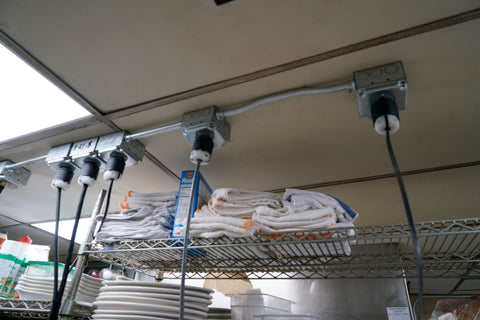


Electrical system setup for restaurant kitchens requires a dedicated circuit for every major fixed appliance, GFCI protection on nearly all receptacle outlets, approved wiring methods such as EMT conduit or MC cable, and a service size that has been calculated from a complete equipment inventory under NEC Article 220. This article covers what equipment every restaurant kitchen needs electrically, how circuits are assigned, what GFCI and GFI mean, wiring type rules, outlet count limits, and what you need to know before construction begins.
The equipment needed for a restaurant kitchen, from an electrical standpoint, falls into four main categories: high-voltage cooking equipment, continuous-duty refrigeration, water-using equipment, and general prep appliances. Each category has different voltage, amperage, and circuit requirements that must be built into the electrical plan before a single wire is run.
According to the U.S. Department of Energy's Commercial Buildings Energy Consumption Survey (CBECS), cooking accounts for approximately 40% of all end-use energy consumption in food service buildings, making it the single largest electrical category by far. Refrigeration accounts for the second largest share at 15%. These two categories alone represent more than half of your total electrical load, which is why getting the dedicated circuit plan right for cooking and refrigeration equipment is the foundation of every restaurant kitchen electrical setup.
Here is a breakdown of the major equipment categories and their typical electrical requirements. This is not an exhaustive list, and every kitchen is different. Always pull the nameplate specifications from your actual equipment before finalizing circuit sizing.
Cooking equipment: Commercial electric ranges typically require 208V to 240V and draw 40 to 60 amps. Convection ovens run on 208V to 240V and draw 20 to 50 amps depending on capacity. Commercial fryers draw 30 to 50 amps at 208V to 240V. Griddles and flat-top ranges draw 20 to 60 amps at 208V or 240V. Combi ovens, which are some of the most power-intensive pieces in a kitchen, draw 30 to 60 amps at 208V to 240V three-phase. Each of these requires its own dedicated circuit sized at 125% of its continuous load rating per NEC Article 210.
Refrigeration: Walk-in coolers and freezers operate on 208V to 240V and draw 2 to 6 kW continuously. Reach-in refrigerators typically run on 120V dedicated 20-amp circuits. Ice machines draw 120V to 208V depending on size and output capacity. Each refrigeration unit must be on its own dedicated circuit to handle motor startup surges cleanly.
Water-using equipment: Commercial dishwashers draw 20 to 30 amps and high-temperature models with booster heaters can exceed 100 amps at 208V to 240V. A standalone booster water heater for a dishwasher is itself a large load requiring a dedicated circuit. Three-compartment sinks, when heated electrically, add additional load. All of this equipment in a wet zone requires GFCI protection under the 2023 NEC. For more on commercial dishwasher installation requirements beyond the electrical side, see our post on dishwasher requirements for commercial kitchens.
Prep equipment: Commercial mixers, food processors, meat slicers, and blenders typically operate on 120V and draw 5 to 20 amps depending on motor size. These are served by general-purpose 20-amp countertop circuits, though heavy-duty spiral mixers requiring 208V/240V need dedicated circuits of their own.
A comprehensive commercial kitchen electrical plan starts with a full equipment schedule that lists every piece of equipment by voltage, amperage, phase, and whether the load is continuous or intermittent. Without that list, the electrician has nothing to work from and the circuit layout is guesswork. In the North Alabama kitchens we work on, we always ask clients to have this list ready before the first design meeting so the cabinetry layout and the electrical plan can be developed together from day one.
The electrical circuit requirements for a restaurant kitchen are governed by NEC Article 210 for branch circuits, NEC Article 220 for feeder and service calculations, and NEC 220.56 for commercial kitchen equipment demand factors. Every major fixed appliance must be on a dedicated individual circuit. Circuits serving continuous loads must be sized at no less than 125% of the load's rated amperage. Small appliance countertop circuits must be at minimum 20-amp circuits, and at least two are required by code.
A deep fryer alone uses approximately 18,000 kWh per year, according to electrical requirements resources from industrial kitchen operators. That is more than the average U.S. household's entire annual electricity use of approximately 12,000 kWh. This single data point explains why dedicated circuits for cooking equipment are non-negotiable. Sharing a circuit between a commercial fryer and any other appliance is an overload waiting to happen.
According to Kitchenall's commercial kitchen electrical guide, large equipment like industrial ovens and mixers may require anywhere from 20 to 50 amps depending on size and function, and it is critical to match amperage needs with dedicated circuits to avoid tripped breakers or overheated wires. Exceeding 80% of circuit capacity on a continuous basis is a code violation and a fire risk.
The 80% rule for electrical circuits means that a circuit breaker should carry no more than 80% of its rated amperage on a continuous basis. A 20-amp breaker should not be continuously loaded beyond 16 amps. A 50-amp breaker should not exceed 40 amps continuously. This rule is drawn from NEC Article 210.19(A) and 215.3, which require continuous loads to be sized so the circuit operates at no more than 80% of its rated capacity.
The 80% rule exists because circuit breakers are rated for their full amperage under intermittent conditions, not hours of sustained operation. When cooking equipment runs continuously through a long dinner service, it generates heat in the circuit wiring. An 80% operating limit gives the circuit the thermal margin it needs to handle that heat safely without degrading the insulation or tripping the breaker.
In practical terms, the 80% rule and the 125% continuous load sizing rule are two ways of expressing the same requirement. You size the circuit at 125% of the load's rated current, which means the circuit operates at 80% of its rated capacity. Both the NEC standard and real-world electrical contractors use these two descriptions interchangeably depending on whether you are looking at it from the circuit's perspective or the load's perspective.
The 125% rule in electrical work means that branch circuit conductors and overcurrent protective devices for continuous loads must be rated at no less than 125% of the continuous load's full-load amperage. This requirement appears in NEC Article 210.19(A) for branch circuit conductor sizing and NEC Article 215.3 for feeder conductor sizing. A commercial oven drawing 40 amps continuously must be served by a circuit rated for at least 50 amps. A fryer drawing 30 amps continuously needs a 37.5-amp circuit, which rounds up to a 40-amp circuit with appropriate wire gauge.
The NEC code for commercial kitchen equipment is primarily covered in NEC Section 220.56 for load calculations and NEC Article 210 for individual circuit requirements. NEC 220.56 governs how a licensed electrician calculates the total feeder and service demand load for the kitchen, while Article 210 sets the rules for sizing each individual circuit serving a specific piece of equipment.
NEC 220.56 allows demand factors to be applied to the total connected kitchen equipment load because not all equipment runs at full capacity at the same time. The demand factor for six or more pieces of qualifying equipment is 65%, meaning you multiply the total connected kW load by 0.65 to get the preliminary demand figure. The final service load can never be less than the sum of the two largest individual equipment loads, regardless of the demand factor result. This safeguard prevents dangerously undersized service panels even when the demand factor calculation produces a low number.
This code framework applies to commercial electric cooking equipment, dishwasher booster heaters, water heaters, and other fastened-in-place equipment rated at 1/4 horsepower or greater, or 500 watts or greater. HVAC and ventilation loads are calculated separately under NEC Articles 440 and 220.60 and are not included in the kitchen equipment demand factor calculation. Our blog post on power load planning for commercial kitchens covers the full NEC 220.56 calculation process with examples in detail.
Yes, outlets in a commercial kitchen need to be GFCI protected. The 2023 NEC Section 210.8(B) requires GFCI protection for all receptacles in non-dwelling unit kitchens supplied by single-phase branch circuits rated 150 volts to ground or less and 50 amps or less, and three-phase branch circuits rated 150 volts to ground and 100 amps or less. The practical effect, as the IAEI Magazine analysis of the 2023 NEC confirms, is that nearly all commercial kitchen receptacles must be GFCI-protected.
The 2023 NEC also extended GFCI requirements under Section 210.8(D) to cover cord-and-plug connected appliances including microwave ovens, wall-mounted ovens, electric ranges, and dishwashers. This means even appliances that are not hardwired but are plugged into outlets now require GFCI protection at the branch circuit or outlet level.
GFCI devices trip in as little as 1/40th of a second when they detect a current imbalance as small as 4 to 6 milliamps, according to the Electrical Safety Foundation International (ESFI). This speed is fast enough to prevent a fatal shock in most scenarios. The ESFI reports that the widespread adoption of GFCI protection has contributed to more than an 80% reduction in household electrocutions since these devices were first introduced. In a commercial kitchen where wet floors, steam, and water-contact surfaces are constant, GFCI protection is one of the most important safety features in the entire electrical system.
No, there is no meaningful functional difference between a GFI and a GFCI. Both terms describe the same type of protective device. GFI stands for Ground Fault Interrupter, while GFCI stands for Ground Fault Circuit Interrupter. The difference is purely in the name. GFI was the older, informal term commonly used by field electricians to describe individual outlet-level protection devices. GFCI is the more precise modern term used in the NEC, which covers both outlet-type receptacles with test and reset buttons and circuit breaker-type devices installed in the electrical panel that protect an entire circuit.
The term GFCI is preferred today because it more accurately reflects the scope of protection: the device monitors the entire circuit, not just the one outlet, and trips the whole circuit when it detects a ground fault. Whether the device is called GFI or GFCI by an electrician or inspector, it performs the same function and provides the same personnel protection. In a commercial kitchen, GFCI protection is typically provided through a combination of GFCI receptacles at individual outlet locations and GFCI breakers at the panel for dedicated circuits serving fixed equipment.
You cannot use Romex (NM cable, or non-metallic sheathed cable) in most restaurant kitchen applications for two main reasons. First, NEC 334.12(A)(2) prohibits NM cable above suspended ceilings in non-dwelling occupancies, which covers virtually all commercial kitchen ceilings. Second, the physical environment of a restaurant kitchen, with its heat, moisture, steam, cleaning chemicals, and mechanical activity, is not suitable for the plastic sheath of NM cable over the long term. EMT conduit or MC cable (metal-clad cable) is required by most jurisdictions and most local inspectors for commercial kitchen wiring.
The question of whether Romex is legal in a commercial building at all depends heavily on the local Authority Having Jurisdiction (AHJ). The NEC does not universally prohibit NM cable in all commercial occupancies, and some lower-occupancy buildings with wood-frame construction in specific jurisdictions have permitted it in concealed wall cavities. But for restaurant kitchens specifically, the combination of NEC 334.12(A)(2) and standard local practice makes EMT conduit the correct and expected wiring method in virtually all cases.
Most inspectors will reject Romex in a restaurant kitchen, regardless of whether the specific NEC section technically permits it, because commercial kitchen environments are classified as damp or wet locations, and NM cable is not rated for damp or wet use. NM cable's plastic sheath absorbs moisture over time, degrades under repeated exposure to grease vapor and cleaning chemicals, and provides minimal physical protection against impact from the constant movement of heavy equipment, carts, and cookware. Professional electrical contractors with commercial kitchen experience use EMT conduit with THHN conductors as the standard because it can be cleaned, survives the environment, and is easy to trace and modify when equipment layouts change. If you are in the planning stage of a new kitchen installation, our post on adding a commercial kitchen to your property covers what approvals come before the electrical inspection.
Technically the NEC permits NM cable inside conduit in certain applications, but it is not recommended for restaurant kitchens. Running Romex inside conduit traps heat, which requires the ampacity of the wire to be derated. In most commercial kitchen applications, this means you would need to upsize the wire inside the conduit to compensate for the derating, at which point using standard THHN conductors directly in the conduit is simpler, cleaner, and more code-defensible. Most commercial kitchen electricians never use this hybrid approach because it adds complexity without any practical benefit.
You can run lights and outlets on the same circuit in certain parts of a restaurant, but it is not the best practice for a working kitchen. In the kitchen itself, lighting should be on its own dedicated lighting circuit so a tripped outlet circuit does not kill the lights mid-service. NEC Article 210 permits lights and general-purpose receptacles to share a 20-amp circuit in commercial occupancies, but professionally designed kitchens separate them for operational safety. A kitchen running at full service with zero visibility because a circuit tripped is a serious hazard for staff.
The general standard for commercial kitchens is 15-amp circuits for general lighting and 20-amp circuits for outlets. In the dining room and non-kitchen areas, lights and outlets can share circuits more practically. In the kitchen, the rule of thumb among commercial electricians is to keep circuits separate so that a tripped outlet circuit never takes out lighting, and vice versa. This is especially important near cooking equipment where a circuit fault could happen at exactly the moment when staff need the most visibility.
How many outlets you can put on a kitchen circuit depends on the expected load on that circuit. The NEC does not specify a hard limit on outlet count, but the 80% rule governs the total load. For a 20-amp, 120V circuit, the maximum continuous load is 16 amps (2,400 watts x 80% = 1,920 watts). Using the NEC's standard planning figure of 180 VA per outlet yoke for commercial load calculations per NEC 220.14, a 20-amp circuit can support up to 10 general-purpose outlets before reaching the 80% load ceiling.
In a commercial kitchen, however, the 10-outlet figure is a ceiling for general-purpose outlets serving light-duty prep equipment. Countertop areas serving slicers, mixers, blenders, and food processors should have one dedicated 20-amp circuit for every 6 to 8 feet of counter run so that no single circuit is overloaded when multiple pieces of prep equipment run at the same time. High-draw appliances like large commercial mixers drawing 20 amps or more should be on their own dedicated circuits regardless of the general outlet count math.
A good commercial kitchen cabinetry plan accounts for outlet placement during the design phase. When cabinet locations are finalized before the electrical rough-in, your electrician can position outlet boxes directly behind or above prep stations, eliminating the need for extension cords and keeping circuit homerun lengths efficient.
A well-designed restaurant kitchen electrical layout assigns each major load to a dedicated circuit, groups general-purpose outlets into zone-based circuits that follow the kitchen's operational flow, and places the electrical panel or subpanel as close to the cooking zone as possible to minimize voltage drop on long homerun runs.
The following table summarizes the typical circuit requirements for common restaurant kitchen equipment. These are planning references, not code specifications. Always verify actual nameplate ratings before finalizing circuit sizes.
EquipmentTypical VoltageTypical DrawCircuit Size (125% Rule)GFCI RequiredCommercial Electric Range208V/240V40–60A50–70A dedicatedYes (2023 NEC)Convection Oven208V/240V20–50A25–60A dedicatedYesCommercial Fryer208V/240V30–50A40–60A dedicatedYesCombi Oven (3-phase)208V 3-phase30–60A40–75A dedicatedYesCommercial Dishwasher208V/240V20–30A+30–40A dedicatedYesDishwasher Booster Heater208V/240VUp to 100APer nameplate, dedicatedYesWalk-in Cooler/Freezer208V/240V2–6kW continuousPer nameplate, dedicatedYesReach-in Refrigerator120V5–15A20A dedicatedYesCountertop Small Appliances120V12–15A20A, max 10 outlets/circuitYesHeavy-Duty Spiral Mixer208V/240V15–20A+Dedicated circuitYes
Sources: Kitchenall Commercial Kitchen Electrical Requirements Guide; NEC Article 210.19(A) 125% continuous load rule; IAEI Magazine 2023 NEC GFCI analysis; Phoenix Phase Converters commercial kitchen power guide; NEC Section 220.56.
The wiring type used for a restaurant kitchen is EMT (electrical metallic tubing) conduit with THHN conductors in the vast majority of professional commercial kitchen installations. EMT conduit provides physical protection for the wires inside, can be cleaned along with the rest of the kitchen, is easy to modify when equipment layouts change, and meets inspection requirements in virtually every U.S. jurisdiction.
MC cable (metal-clad cable) is the second most common commercial kitchen wiring method and is used in some jurisdictions where EMT is not required. MC cable has an interlocked metal armor jacket that provides reasonable physical protection, though it is harder to trace and modify than EMT conduit. Most experienced commercial kitchen electricians, as noted in industry contractor forums, prefer EMT conduit and recommend always oversizing conduit runs to accommodate additional circuits when equipment changes in the future.
Surface-mounted conduit in the kitchen must be mounted away from the wall so that the back side of the conduit can be reached for cleaning. Health inspectors look at surface-mounted conduit as a potential harborage point for pests and a grease trap if it is mounted flush against the wall. Mounting conduit on stand-off brackets keeps it cleanable and keeps inspections clean. For related code requirements on surfaces and materials in commercial kitchens, our post on stainless steel requirements in commercial kitchens covers the surface standards that inspectors check at the same time as the electrical rough-in.
Yes, you can use PVC conduit in certain commercial building applications, but Schedule 80 PVC is the correct grade for commercial use, and it is not the preferred choice in most restaurant kitchens. Schedule 80 PVC conduit provides adequate physical protection for wiring in dry areas and light-traffic commercial spaces, but in the kitchen, metal conduit is strongly preferred because PVC cannot be subjected to the high heat near cooking equipment without risk of deformation, it does not provide the same level of physical impact protection, and most local inspectors in commercial kitchen applications prefer metal conduit.
For wiring runs outside the kitchen proper, such as in mechanical rooms, storage areas, or above drop ceilings in administrative spaces, Schedule 80 PVC can be appropriate. Always confirm with your local AHJ which conduit types are acceptable for each area of your specific project.
The 6/12 rule for outlets in a commercial kitchen is a commonly followed installation practice in which countertop outlets are spaced no more than 6 feet apart horizontally, with each outlet positioned no more than 12 inches above the countertop surface. The NEC's formal requirement for commercial countertop receptacles is that no point along the wall line should be more than 24 inches from an outlet, and receptacles must not be mounted face-up in commercial wet areas. The 6/12 practice is more conservative and is the standard followed in most professionally designed commercial kitchens to eliminate the need for extension cords anywhere along the prep line. Always verify spacing and height requirements with your local Authority Having Jurisdiction before installation.
You need 20-amp outlets for restaurant kitchen countertop circuits. NEC Article 210 requires small appliance branch circuits to be rated at 20 amps, and commercial kitchen equipment draws too much current for 15-amp circuits to handle safely on a sustained basis. Most portable commercial appliances draw 12 to 15 amps when running, which puts them at or above a 15-amp circuit's safe 80% continuous load limit of 12 amps. All countertop receptacle circuits in a restaurant kitchen should be 20-amp circuits, with each circuit loaded to no more than 80% of capacity at any time during service.
The electrical circuit requirements for commercial kitchens include a dedicated individual circuit for every major fixed appliance sized at 125% of its continuous load rating per NEC Article 210, at least two 20-amp small appliance branch circuits for countertop areas, GFCI protection on all applicable receptacles per NEC 210.8(B), approved wiring methods (typically EMT conduit or MC cable), and a service size calculated from the full equipment load per NEC Article 220 including the demand factors in NEC Table 220.56. HVAC and ventilation loads are calculated separately and added to the kitchen equipment total to determine the final service entrance size. All plans must be reviewed and approved by the local Authority Having Jurisdiction before any electrical work begins.
You cannot use Romex (NM cable) in most commercial kitchen applications because NEC 334.12(A)(2) prohibits NM cable above suspended ceilings in non-dwelling occupancies, and the wet, high-heat commercial kitchen environment exceeds what NM cable's plastic sheath is designed to handle. Most local jurisdictions require EMT conduit or MC cable in commercial kitchens, and inspectors routinely reject NM cable in these spaces regardless of NEC technicalities about building type. Commercial kitchen wiring runs must be protected from physical damage, cleanable, and compatible with the long-term operating environment. EMT conduit meets all three requirements. NM cable does not.
No, there is no functional difference between a GFI and a GFCI in a commercial kitchen. Both terms describe the same personnel protection device. GFI (Ground Fault Interrupter) is an older, informal term, while GFCI (Ground Fault Circuit Interrupter) is the current standard term used in the NEC and by most inspectors. GFCI more accurately reflects that the device protects the entire circuit, not just a single outlet. A GFCI receptacle is the outlet-level version with test and reset buttons; a GFCI breaker is the panel-level version that protects all outlets on a circuit. The 2023 NEC requires both types in different applications throughout a commercial kitchen.
The kitchen cabinetry layout directly affects electrical planning because it determines the exact location of every prep station, every piece of equipment, and every countertop outlet position before the walls are closed. When cabinetry is designed in coordination with the electrical plan, your electrician knows exactly where outlet boxes need to land, where conduit homerun paths need to run, and where the panel needs to be positioned for the shortest circuit lengths. Waiting until after cabinetry is installed to plan electrical is one of the most common and costly mistakes in commercial kitchen build-outs. It leads to surface-mounted conduit runs, awkward outlet placement, and sometimes having to tear out finished work to add circuits that were overlooked.
A solid cabinet maintenance plan also keeps the interior of overhead and base cabinets accessible for the periodic electrical inspections that good commercial kitchens schedule annually.
We work with our commercial cabinetry clients to coordinate the layout and electrical plan from the very start of the design process.
Using 14 gauge wire on a 20-amp circuit is a code violation and a serious fire hazard. NEC Table 310.15(B)(16) specifies that 14 AWG copper wire has an ampacity of only 15 amps at the standard 60°C temperature rating used for circuit sizing. A 20-amp breaker protecting a 14 gauge wire will not trip until current reaches 20 amps, which is 33% above the wire's rated capacity. The wire overheats before the breaker responds, and that heat can ignite insulation and framing. All 20-amp circuits in a commercial kitchen must use 12 AWG copper wire at minimum. Dedicated circuits for cooking equipment typically require much larger wire gauges based on the nameplate rating and the 125% continuous load rule.
Setting up the electrical system for a restaurant kitchen is a technical process that touches every part of the build. Every piece of cooking equipment, every refrigeration unit, and every outlet position is an electrical decision that must be made before the first wire is run. Getting these decisions right means a kitchen that passes inspection, runs at full capacity from day one, and gives your team a safe, reliable working environment.
According to the U.S. Energy Information Administration, food service buildings account for only 1% of total commercial floor space in the United States but more than 5% of all commercial building energy consumption. That intensity requires an electrical system that is planned with the same care you bring to your menu and your kitchen layout. At Classic Cabinetry, we coordinate our commercial kitchen cabinetry designs with the electrical plan from the start.
If you are planning a restaurant kitchen build-out or renovation, get in touch with us for a free estimate and let's make sure the layout and electrical work together from day one.