.avif)


.avif)


.avif)
How to Design a Home Office and Guest Room Combo With Custom Cabinetry
link desc


The right vanity turns a cramped bathroom into a space that feels open, organized, and surprisingly functional. A small bathroom is typically anything under 50 square feet, according to Badeloft, and the most common layout is 5 by 8 feet (40 square feet). In a room that tight, every inch the vanity takes up or gives back changes how the bathroom feels. According to the NKBA 2026 Bath Trends Report, wood-faced vanities (62%) have overtaken painted vanities (53%) in popularity, and floating designs are growing 15% to 20% year over year according to NextDAY Cabinets. According to the 2025 Houzz Bathroom Trends Study, 78% of homeowners choose soft-close drawers and 75% choose soft-close doors regardless of vanity size. This article covers the best vanity ideas for small bathrooms, with practical tips on size, style, storage, and cost to help you choose a vanity that maximizes every square foot.
The best small bathroom vanity ideas focus on reducing the vanity's visual and physical footprint while maximizing the storage inside it. Here are the designs that work hardest in tight bathrooms.
A floating vanity mounts to the wall with no contact with the floor. The open space underneath makes the bathroom look larger by exposing more floor area. According to Homedit, compact vanities that are wall-mounted keep circulation clear and draw attention away from narrow footprints. Light bounces off the floor beneath the vanity, which further enhances the sense of openness.
Floating vanities also make floor cleaning easy because there is nothing to reach around. In a 5-by-8-foot bathroom where every surface collects moisture, that accessibility matters. According to the NKBA 2026 Bath Trends Report, 93% of designers consider natural light important in bathrooms, and a floating vanity maximizes that light by keeping the lower portion of the room unobstructed. We install custom bathroom vanities at whatever height works best for the homeowner, which is one of the biggest advantages of going wall-mounted over freestanding.
Standard vanities are 21 to 24 inches deep. In a small bathroom, switching to a narrow-depth vanity of 18 to 20 inches gives you 3 to 6 inches of extra floor space in the walkway. That may not sound like much, but in a 5-foot-wide room, those inches are the difference between bumping into the toilet every morning and moving comfortably. According to Living Spaces, choosing a vanity with a narrow depth, typically in the 20-inch to 30-inch range, optimizes a small space or powder room.
Narrow-depth vanities work best with vessel sinks or integrated sink tops that do not require the full 21-inch depth of a standard undermount basin. A slim-profile vanity with full-extension drawers can still hold everything you need; you just lose a few inches of depth per drawer, which most people never notice.
Corner vanities fit into the 90-degree angle where two walls meet, turning dead space into functional storage. According to Ashley Winn Design, corners are often dead zones in rectangular rooms, and a standard vanity might block the door or walkway. A corner vanity maximizes every inch of the floor plan without interrupting traffic flow.
Corner vanities work especially well in powder rooms and half baths where the toilet and door are close together. They are available in triangular and D-shaped configurations. A custom corner vanity built to the exact dimensions of your space eliminates the gaps and awkward proportions that prefab corner units often leave behind.
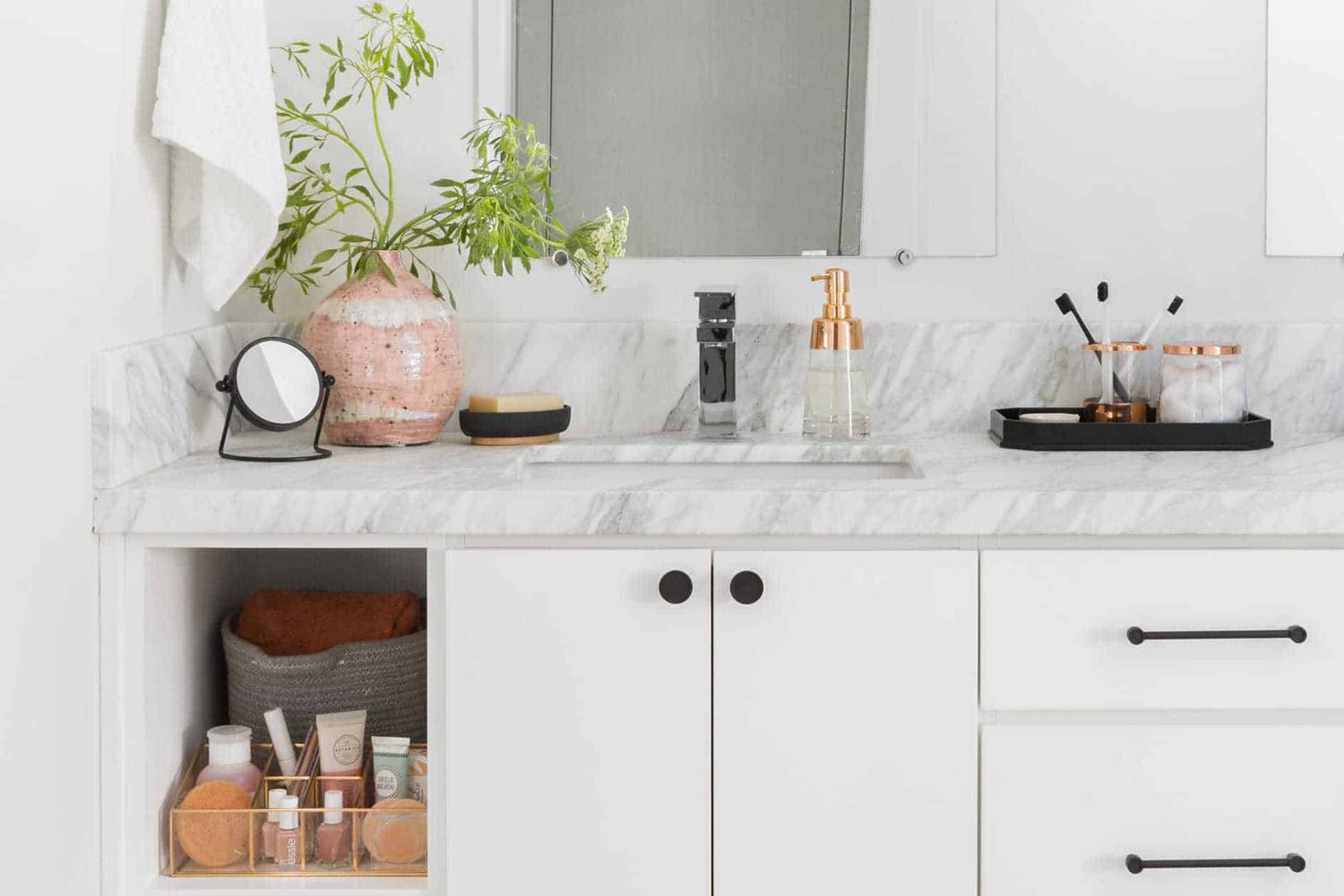
An open-shelf vanity replaces closed doors with one or two open shelves below the countertop. This design reduces visual weight and makes the room feel less closed-in. Baskets, bins, and rolled towels keep the shelves organized without needing doors. Open-shelf vanities work best in guest bathrooms and powder rooms where you are storing less and displaying more.
The trade-off is that everything on the shelves is visible, which means you need to keep it tidy. For primary bathrooms where you store hair tools, medications, and cleaning supplies, a combination vanity with one open shelf and one closed section gives you the best of both worlds.
A pedestal sink takes up the least floor space of any option, but it offers zero storage. Pairing a pedestal sink with a narrow wall-mounted cabinet or a wall-mounted storage unit on one side gives you the openness of a pedestal with the function of a vanity. This approach works especially well in very small half baths under 25 square feet where a full vanity would overwhelm the room.
Vanity TypeWidth RangeDepthCost RangeBest ForFloating Vanity24 to 36 inches18 to 22 inches$500 to $3,000Modern small baths, visual spaceNarrow-Depth Cabinet24 to 30 inches16 to 20 inches$300 to $1,500Tight walkways, half bathsCorner Vanity20 to 36 inches (diagonal)Varies$400 to $2,000Dead corner space, powder roomsOpen-Shelf Vanity24 to 48 inches18 to 22 inches$300 to $1,800Guest baths, light storageCustom Wall-to-WallBuilt to fitBuilt to fit$1,500 to $5,000+Maximizing every inch
Sources: WELLFOR, Living Spaces, HomeAdvisor, Modland, Angi, Ashley Winn Design
What makes a bathroom look cheap is a vanity that does not fit the space properly, visible particle board edges, mismatched hardware, poor lighting, and cluttered countertops. In a small bathroom, these problems are amplified because everything is in your direct line of sight. A too-small vanity floating in the middle of a wall looks awkward. A too-large vanity crammed into a tight room blocks movement and makes the space feel suffocating.
According to the NKBA 2026 Bath Trends Report, homeowners are moving toward concealed storage, clean surfaces, and spa-like simplicity. Visible clutter, exposed pipes, and dated fixtures all work against that direction. According to Badeloft, swapping a bulky vanity for a floating one can open up floor space, and replacing outdated brass fixtures with modern finishes like brushed nickel or matte black elevates the entire room's feel, even if the footprint does not change.
The fix in a small bathroom is a vanity that fits the wall width precisely, with the right depth for the walkway and enough interior storage to keep the countertop clear. A custom vanity eliminates the gap between the vanity and the wall, the gap at the top, and the awkward proportions that prefab units always leave in non-standard rooms. Choosing the right hardware finish ties the whole room together and makes even a modest bathroom feel intentional.
The hottest bathroom trend in 2026 is the shift toward wood-faced vanities, warm neutral colors, and wellness-inspired design. According to the NKBA 2026 Bath Trends Report, wood-faced vanities (62%) have overtaken painted vanities (53%). Off-white leads the color palette at 58%, followed by light brown and tan at 54%, and white trailing at 40%.
According to the 2024 Houzz Bathroom Trends Study, wood overtook white as the most popular vanity color, captured by 26% of upgrades versus 22% for white. Nearly 74% of homeowners choosing wood vanities opted for solid wood, according to the 2025 Houzz Bathroom Trends Study. Floating vanities are growing 15% to 20% annually according to NextDAY Cabinets, and furniture-style vanities that look like standalone pieces rather than built-in boxes are replacing generic designs.
According to the NKBA, matte (54%), brushed (51%), and satin (46%) hardware finishes have overtaken polished (39%). These softer finishes pair especially well with the warm, natural tones trending in vanity design. Exploring different cabinet finishes helps you choose a look that feels current without chasing a short-lived trend.
Maximizing storage in a small bathroom vanity requires using every inch of interior space strategically. Standard vanities waste volume with fixed shelves and awkward plumbing cutouts. Smart design eliminates that waste.
Full-extension drawers let you reach items at the very back without digging. Stacked drawers are more efficient than a single open cabinet behind doors, because drawers keep items visible and organized rather than piled up. According to Living Spaces, look for cabinetry with full-extension drawers, adjustable shelving, and thoughtful cutouts around plumbing. These features keep the countertop clean and calm.
Door-mounted organizers add storage to the inside of cabinet doors for brushes, hair tools, and small bottles. Pull-out trays below the sink work around the plumbing and create usable space that would otherwise be dead. Tiered drawer inserts with compartments for makeup, razors, and medications keep everything sorted.
Above the vanity, a recessed medicine cabinet built into the wall between studs adds 3.5 inches of storage depth without taking any floor or wall space. Pair that with a custom vanity designed around your plumbing, and you can nearly double the usable storage in a small bathroom compared to a standard prefab unit.
The colors that make a small bathroom look bigger are light, warm tones like off-white, cream, light gray, and soft warm wood. Light colors reflect more light and make walls feel farther away. According to the NKBA 2026 Bath Trends Report, 96% of designers identified neutrals as the dominant bath palette. Off-white leads at 58%, and light brown/tan sits at 54%.
Carrying the same color or tone from the walls to the vanity to the tile creates a seamless look that tricks the eye into seeing the room as one continuous space. According to Homedit, small bathrooms benefit from continuous surfaces and a consistent material palette because visual breaks make a room feel smaller. Matching the vanity color to the wall color is one of the most effective ways to make a compact bathroom feel larger.
Dark vanities can work in small bathrooms if the walls and floor stay light. A warm wood or navy vanity against white walls creates contrast and depth without closing the room in. The key is keeping the dominant surfaces (walls, floor, ceiling) light and using the vanity or accent features for warmth and color. Pairing the vanity with the right color choice makes the room feel intentional and balanced.
A small bathroom vanity costs $100 to $5,000 depending on whether you choose prefab, semi-custom, or fully custom. According to WELLFOR, basic single-sink vanities run $100 to $300, mid-range vanities with better finishes and soft-close hardware cost $300 to $1,200, and high-end or custom vanities range from $1,200 to $5,000 or more.
According to HomeAdvisor, the average cost to install a bathroom vanity ranges from $300 to $2,200, with most homeowners spending about $1,500 when the vanity, countertop, and labor are combined. Custom vanities cost more because they are built to your exact measurements, which eliminates gaps, maximizes storage, and creates the polished, built-in look that prefab units cannot match.
According to USA Cabinet Store, a 50% tariff on imported bathroom vanities took effect in October 2025, pushing vanity costs up 20% to 28% compared to 2024. Domestically produced vanities are not subject to these tariffs. Choosing a domestic cabinet maker helps avoid tariff-related price swings and often means shorter lead times. Understanding the best vanity materials helps you balance cost with durability in a high-moisture environment.
Yes, a small bathroom remodel adds home value and delivers one of the strongest ROIs of any interior project. According to the 2025 Zonda Cost vs. Value Report, a mid-range bathroom remodel recoups approximately 74% to 80% of its cost at resale. According to Badeloft, a $7,500 remodel in a 5-by-8-foot bathroom that added a modern vanity, walk-in shower, and energy-efficient lighting could increase the home's asking price by $10,000 or more in competitive markets.
According to the NKBA, the recommended spending guideline is 5% to 10% of your home's value for a primary bathroom remodel and 3% to 5% for a secondary bathroom. For a $300,000 home, that puts a secondary bath update at $9,000 to $15,000, which is more than enough to replace the vanity, refresh the tile, upgrade fixtures, and add proper lighting. Families here in North Alabama consistently see small bathroom updates pay off in both daily comfort and stronger offers at listing time.
The best size vanity for a small bathroom is 24 to 30 inches wide and 18 to 20 inches deep. According to Living Spaces, a vanity with a narrow depth in the 20-inch to 30-inch range optimizes small spaces and powder rooms. A 24-inch vanity fits comfortably in most half baths, while a 30-inch vanity works well in standard 5-by-8-foot full bathrooms where the walkway needs at least 21 inches of clearance.
Yes, floating vanities are one of the best choices for small bathrooms because they expose the floor beneath the unit, making the room feel larger. According to The Coolist, pale stone tiles, warm wood vanities, and clean fixtures work together to make even compact bathrooms feel calm and open. The wall-mounted design also makes floor cleaning easier in tight spaces where reaching behind a freestanding vanity is difficult.
The most popular vanity color in 2026 is natural wood tone. According to the 2024 Houzz Bathroom Trends Study, wood overtook white as the most popular vanity color at 26% versus 22%. According to the NKBA 2026 Bath Trends Report, off-white leads the broader palette at 58%, with light brown/tan at 54%. Warm, natural tones are the strongest direction for both kitchens and bathrooms. Staying current with the latest cabinet trends helps you pick a finish that works across both spaces.
You can make a small bathroom look more expensive by choosing a properly fitted vanity with no gaps, adding soft-close drawers, installing under-vanity LED lighting, using quartz or marble-look countertops, and switching to matte or brushed hardware finishes. According to the NKBA 2026 Bath Trends Report, matte and brushed finishes read as more premium than polished, and well-designed cabinetry creates a spa-like, organized impression even in a compact space.
No, a 24-inch vanity is not too small for a bathroom. It is the standard size for half baths, powder rooms, and compact full baths. A 24-inch vanity with a single basin provides enough counter space for daily essentials and enough cabinet volume for toiletries and cleaning supplies when the interior is organized with drawers and door-mounted racks.
What you should avoid in a small bathroom vanity is a bulky freestanding unit that blocks the walkway, a vanity deeper than 22 inches in rooms under 40 square feet, dark colors on all surfaces, ornate detailing that adds visual clutter, and a single open shelf with no enclosed storage. These choices make small bathrooms feel smaller and less functional. Keep the design clean, the depth slim, and the door style simple.
Yes, a custom vanity is specifically designed to fit non-standard bathrooms. Prefab vanities come in fixed widths (24, 30, 36, 48 inches) that often leave gaps or do not fit at all in bathrooms with angled walls, offset plumbing, or unusual dimensions. A custom bathroom cabinet is built to your exact measurements, filling the space completely and maximizing every inch of storage.
A small bathroom does not need a small amount of style or storage. The right vanity, whether floating, narrow-depth, corner, or custom wall-to-wall, transforms how the room looks, feels, and functions every single day. Floating designs make the room feel bigger. Narrow depths open up the walkway. Custom builds fill every inch without gaps or wasted space. Pair the vanity with warm finishes, clean hardware, and smart interior storage, and even the smallest bathroom becomes a space you actually enjoy using.
If you are looking for a vanity that fits your bathroom perfectly, Classic Cabinetry designs and builds custom vanities for bathrooms of every size. Call us at (256) 423-8727 to schedule a free consultation.