.avif)


.avif)


.avif)
Open Shelving vs. Built-In Bookshelves, Which Adds More Value?
link desc
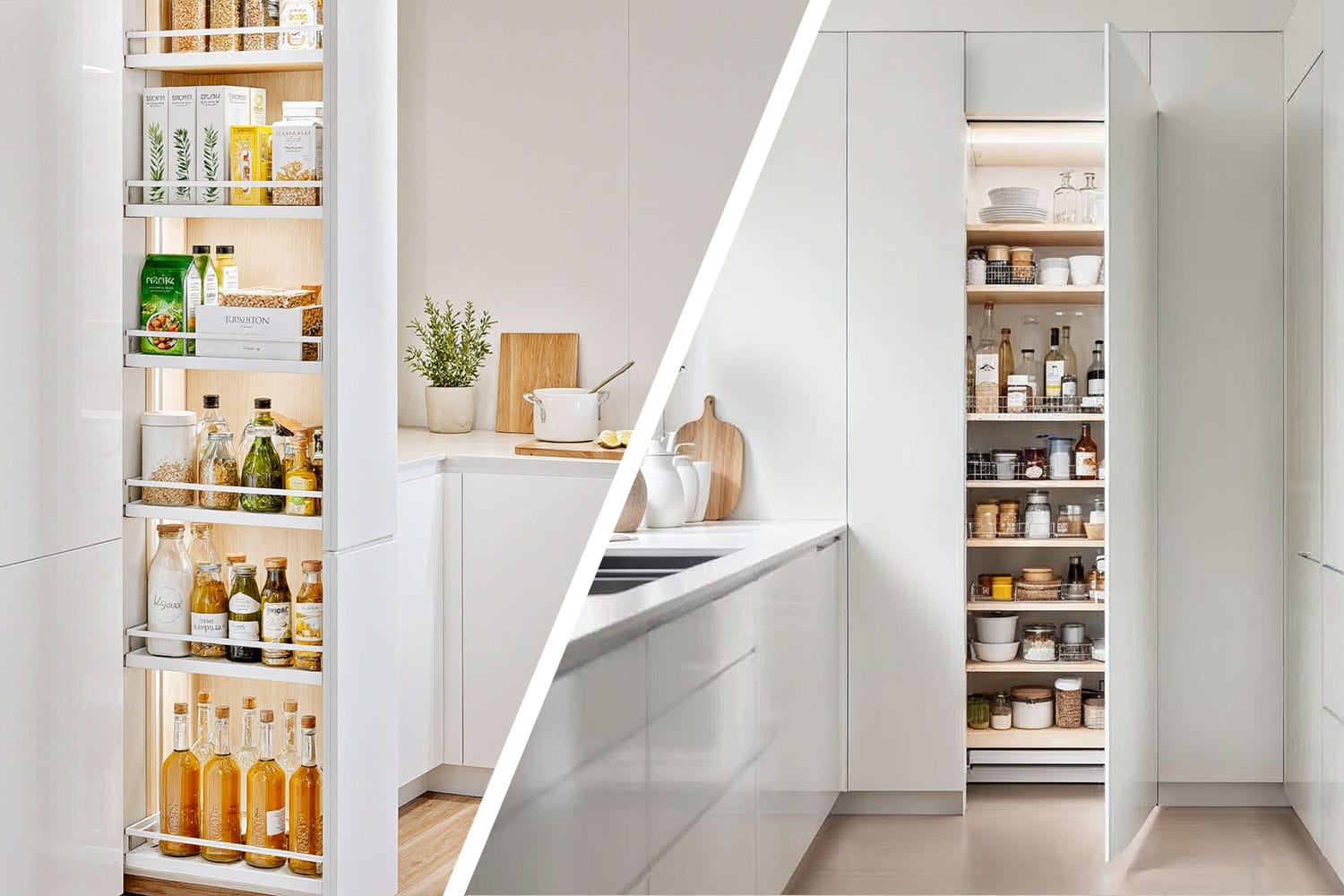


Pull-out drawers are generally better for a pantry because they bring items all the way out into the light, stopping food from getting lost or expiring in the back. Fixed shelves cost less, have no moving parts to maintain, and work perfectly well in shallow pantries where everything is already visible from the doorway. The right answer for most homeowners is a combination of both: pull-out drawers in deep lower cabinets where reaching is difficult, and fixed shelves at eye level and above where items are easy to see and grab. According to the Natural Resources Defense Council, the average American family of four throws out approximately $1,500 worth of food per year, and a significant portion of that waste comes from items forgotten in the back of deep pantry shelves. A well-designed pantry layout reduces that waste by making every item visible and accessible. This blog compares pull-out drawers and fixed shelves across cost, visibility, weight capacity, depth requirements, and maintenance so you can build a pantry that works the way you actually cook and shop.
Pull-out drawers are shelf-like trays mounted on ball-bearing drawer slides that glide forward on tracks, bringing the entire contents of the shelf out to the front edge of the cabinet so you can see and reach every item without bending or stretching into the back. Pull-out drawers in a custom pantry solve the single biggest problem with traditional shelving: the dead zone at the back of a deep cabinet where cans, boxes, and jars disappear for months.
Full-extension pull-out slides bring the tray 100% of the way out of the cabinet, which means the back of the tray sits at the front edge of the cabinet opening when fully extended. Some slides offer overtravel, extending the tray an additional inch beyond the cabinet face for even better access. The slides operate on steel ball bearings that produce smooth, quiet gliding action under heavy loads. Quality full-extension ball-bearing slides rated for pantry use carry 100 to 155 pounds per pair, according to specifications from Accuride and Knape & Vogt (KV), two of the most widely used commercial slide manufacturers. Heavy-duty models support 300 to 400 pounds per pair for pantries that store bulk items, small appliances, or cast iron cookware.
The visibility advantage is the primary reason pull-out drawers outperform fixed shelves in deep pantries. When a fixed shelf is 24 inches deep, the back 8 to 10 inches become a shadow zone where items get pushed behind newer purchases and forgotten. Pull-out drawers eliminate that shadow zone entirely because every item rides forward into full view. According to the USDA, 30 to 40 percent of the entire U.S. food supply is wasted, and household-level waste accounts for 43% of that total, according to Earth.Org. Forgotten pantry items are a direct contributor. The advantages of pull-out pantry shelves extend beyond convenience into measurable food cost savings.
The advantages of fixed shelves in a pantry are lower cost, zero maintenance, higher weight capacity, simpler installation, and no moving parts that can wear out or require repair. Fixed shelves are stationary platforms mounted directly to the pantry wall, cabinet frame, or adjustable shelf pins. They have no slides, no tracks, and no bearings. A fixed shelf costs $40 to $80 per unit installed, according to data from ArrangeWise, compared to $180 to $350 per unit for a pull-out drawer with quality hardware. That cost difference adds up quickly across a full pantry system. A 5-shelf fixed pantry system runs $800 to $1,200 total, while a 5-shelf pull-out system runs $2,200 to $2,800.
Fixed shelves also support significantly more weight. A properly mounted fixed shelf on adjustable pins or dado-joint supports can hold 800+ pounds without concern, according to ArrangeWise. Pull-out slides are rated for 100 to 400 pounds depending on the hardware grade. For storing heavy bulk items like 25-pound bags of flour, cases of canned goods, or large stand mixers, fixed shelves handle the load without any risk of slide failure or track wear.
Maintenance is another advantage of fixed shelves. Pull-out drawer slides need periodic lubrication to maintain smooth operation, especially in kitchens where grease, flour dust, and humidity accumulate on the tracks. Fixed shelves need nothing. They stay in position, support weight, and require only occasional wiping. In humid climates like North Alabama, where seasonal moisture can cause metal hardware to stick or corrode if neglected, the zero-maintenance characteristic of fixed shelves is a practical benefit. Understanding how to add space to kitchen cabinets often starts with evaluating which shelves need to slide and which ones simply need to hold more.
Yes, pull-out pantry shelves are worth the extra cost in pantries deeper than 16 to 18 inches, in lower cabinets where bending and reaching is uncomfortable, and in households where small items routinely get lost toward the back of shelves. The cost gap between pull-out and fixed shelving is real. A full pull-out pantry system costs roughly $1,000 to $1,600 more than an equivalent fixed-shelf system, based on the ArrangeWise data cited above. Whether that premium delivers value depends on your pantry's depth, how frequently you cook, and how many people use the space.
The food waste math is the strongest financial argument for pull-outs. If a family of four wastes $1,500 of food per year, according to the NRDC, and even 10 to 15 percent of that waste comes from forgotten pantry items, the pull-out system pays for itself within 5 to 8 years through reduced food waste alone. A family that cooks daily and shops in bulk stands to save more than a household that eats out frequently and keeps a minimal pantry. The access benefit compounds over time because pull-out drawers make it physically easier to rotate stock, check expiration dates, and see at a glance what needs to be used before the next grocery run.
The comparison table below puts pull-out drawers and fixed shelves side by side across the six factors that matter most when choosing pantry shelving.
FactorPull-Out DrawersFixed ShelvesCost Per Shelf (installed)$180 - $350$40 - $80VisibilityExcellent (full contents visible)Limited (back items hidden in deep pantries)Weight Capacity100 - 400 lbs (depends on slide rating)800+ lbsBest Pantry Depth18 inches and deeperUnder 18 inches (shallow)MaintenancePeriodic lubrication of slidesNoneLifespan15 - 20 years (quality ball-bearing slides)Lifetime of the cabinet
The table makes the tradeoff clear: pull-out drawers win on visibility and accessibility; fixed shelves win on cost, weight capacity, and maintenance. Neither option is universally better. The right choice depends on where in the pantry each shelf sits, how deep that section is, and what you plan to store on it. That is why most well-designed custom pantries use a combination of both, with pull-outs where they earn their cost and fixed shelves where they do the job for less, according to data from ArrangeWise and SpaceManager Closets.
A pantry needs to be at least 16 to 18 inches deep for pull-out shelves to add meaningful value, because at shallower depths everything on the shelf is already within easy reach and a pull-out mechanism adds cost without improving access. According to SpaceManager Closets, pull-out shelves start earning their keep once a pantry or cabinet exceeds 16 to 18 inches of depth. In shallower spaces, fixed shelves deliver the same functionality for a fraction of the cost.
At 24 inches deep, which is the standard depth for most base cabinets and many reach-in pantry closets, the back 6 to 8 inches of a fixed shelf becomes genuinely difficult to access. Items stored in that zone require reaching past foreground items, moving things out of the way, and sometimes bending or kneeling to see what is available. A pull-out drawer at 24-inch depth brings the full contents forward with a single motion, eliminating the reaching, bending, and guesswork. At 30 inches deep, which is common in walk-in pantry shelving built against back walls, pull-out drawers are almost essential for the lower shelves because the back third of the shelf is effectively invisible and unreachable without removing items from the front.
Measuring your pantry's actual depth before deciding is critical. The depth you experience when using the pantry is not always the depth listed on the cabinet specification. Face frames, door clearance, and wall irregularities can reduce the usable depth by 1 to 2 inches. A custom pantry designed with your actual measurements ensures that every pull-out shelf and fixed shelf is sized for the real space, not a generic standard.
The best shelving for a walk-in pantry is mostly fixed perimeter shelving with pull-out drawers in corners and on lower levels, while the best shelving for a reach-in pantry is pull-out drawers throughout, because a reach-in pantry is accessed only from the front and has no way to walk around to the back. The pantry type determines how much of the shelf depth is accessible without mechanical assistance, which directly determines the pull-out vs. fixed ratio.
In a walk-in pantry, you can step inside and see the full face of shelves on two or three walls. Eye-level shelves on the side walls are fully visible and reachable without pull-outs. Lower shelves, corner shelves, and any shelving on the back wall deeper than 18 inches benefit from pull-out drawers because bending down and reaching into a deep lower shelf is the access problem that pull-outs solve most effectively. The upper shelves in a walk-in pantry are better served by fixed shelving because the items stored there are typically lightweight, infrequently accessed, and not worth the hardware cost of a pull-out mechanism. The same zoning logic applies to mudroom cabinetry, where daily-grab items belong at arm's reach and seasonal storage goes up high.
In a reach-in pantry, which functions like a single-door closet with shelves on the back wall and possibly one side wall, every shelf is accessed from the front. The deeper the reach-in pantry, the more pull-out drawers improve usability. A 24-inch-deep reach-in pantry with five shelves benefits from pull-outs on the lower three shelves and fixed shelves on the upper two. A 30-inch-deep reach-in pantry benefits from pull-outs on every shelf except the very top. Learning how to use vertical space in the kitchen applies directly to pantry design, because the same principles of frequency-based zoning work in both spaces.
Yes, you can and should mix pull-out and fixed shelving in the same pantry, because most well-designed pantries use both types in a zoned layout where each shelf type is placed where it performs best. The "mix of both" approach is the consensus recommendation across the custom storage industry, including data from SpaceManager Closets and ArrangeWise, both of which design hundreds of custom pantries per year. The key is zoning: assigning each section of the pantry a specific role based on what it stores and how often those items are accessed.
A practical zoning plan for a standard pantry follows this pattern:
This zoned approach puts the premium hardware where it earns its cost and uses affordable fixed shelves everywhere else. The result is a pantry that functions like a pull-out system at the critical access points but stays within budget by avoiding pull-out hardware in zones that do not need it. Choosing the right cabinet hardware for each zone is what makes the mixed approach work smoothly over years of daily use.
Yes, you can add pull-out shelves to an existing pantry if the cabinet boxes are deep enough (at least 16 inches), the side panels are sturdy enough to support slide mounting, and the face frame or cabinet opening provides clearance for the tray to extend fully. Retrofitting pull-out shelves into existing cabinetry is one of the most common pantry upgrades homeowners request, and it does not require a full cabinet replacement in most cases.
The retrofit process involves removing the existing fixed shelf, mounting slide hardware to the interior side panels of the cabinet, and installing a new pull-out tray that rides on the slides. The slides attach with screws driven into the cabinet side panels, which need to be at least 1/2-inch thick plywood or solid wood to hold the fasteners under load. Particle board side panels can hold slide hardware initially but may lose holding strength over time, especially under heavier loads. If the existing cabinet construction is particleboard, a full cabinet replacement delivers a more reliable long-term result than a retrofit.
A professional installer can evaluate whether your existing pantry is a candidate for retrofit or whether a new custom pantry cabinet is the better investment. The evaluation takes into account the cabinet material, the side panel thickness, the face frame dimensions, and whether the existing shelving can be removed without compromising the cabinet's structural integrity. We see both situations regularly across kitchen cabinet projects and standalone pantry upgrades.
The most common pantry design mistakes to avoid are using the same shelf type everywhere, ignoring depth when choosing between pull-out and fixed shelves, spacing shelves too far apart, skipping adjustable shelf pins, and failing to account for the items you actually store. Each of these mistakes produces a pantry that looks organized on day one and stops working within a few months because the layout does not match how the household actually shops, cooks, and stores food.
According to a study cited by RTS, more than 80% of Americans discard perfectly edible food because they misunderstand expiration labels. A pantry that makes every item visible reduces the chance of discarding food that is still safe to eat, which ties pantry design directly to food cost savings. Maintaining your cabinets properly extends the life of both pull-out hardware and the cabinet structure itself, keeping the pantry functional for decades.
The best type of shelving for a pantry is a combination of pull-out drawers and fixed shelves, placed according to a zoning plan based on shelf depth and frequency of access. Pull-out drawers perform best in deep lower cabinets and corners where visibility is limited. Fixed shelves perform best at eye level and above where items are already easy to see and reach. Most custom pantry designers recommend this mixed approach because it balances cost, function, and accessibility more effectively than using a single shelf type throughout.
Pull-out pantry shelves hold 75 to 155 pounds per pair on standard full-extension ball-bearing slides, and 300 to 400 pounds per pair on heavy-duty models rated for commercial or high-capacity residential use, according to specifications from Accuride and Knape & Vogt. Fixed shelves support 800+ pounds without concern. For pantries that store heavy items like bulk flour, canned goods, or cast iron cookware, fixed shelves on the lower levels handle the weight more reliably than pull-out slides.
Quality pull-out pantry shelves with full-extension ball-bearing slides last 15 to 20 years with periodic maintenance, according to ArrangeWise. Budget slides under $100 per pair can start binding or sticking within 5 to 7 years, especially in kitchens where grease and humidity accumulate on the tracks. Investing in mid-range to premium slides from brands like Accuride, Blum, or Knape & Vogt extends the lifespan and reduces the maintenance frequency significantly.
Pull-out pantry shelves cost $180 to $350 per unit installed, while fixed shelves cost $40 to $80 per unit installed, according to data from ArrangeWise. A full 5-shelf pull-out pantry system runs $2,200 to $2,800 total, compared to $800 to $1,200 for an equivalent fixed-shelf system. The cost difference of $1,000 to $1,600 is significant, which is why the zoned approach of mixing both types delivers the best value for most households.
The best shelving for a butler's pantry is fixed open shelving for display items like glassware, serveware, and coffee stations, paired with one or two pull-out drawers for trays, linens, or small appliances that benefit from concealed storage. Butler's pantries are typically smaller and more visible than walk-in kitchen pantries, so the shelving needs to balance aesthetics with function. Fixed open shelves showcase curated items while pull-out drawers hide the utilitarian pieces that do not need to be on display. A laundry room benefits from the same pull-out and fixed combination, with pull-outs for detergent and supplies and fixed shelves for folded linens.
Pull-out drawers and fixed shelves each solve different problems in a pantry. Pull-outs win on visibility and accessibility in deep cabinets and lower zones where reaching and bending make fixed shelves impractical. Fixed shelves win on cost, weight capacity, and maintenance in shallow spaces and upper zones where items are already easy to see and grab. The most functional pantries use both, placed intentionally according to a zoning plan that matches each shelf type to the section of the pantry where it performs best. That zoned approach delivers the benefits of pull-out access where it matters most while keeping the total cost reasonable by using fixed shelves everywhere else.
If you are ready to design a pantry that fits how your household actually shops and cooks, Classic Cabinetry builds custom pantry solutions with over 44 years of craftsmanship behind every project. Call us at (256) 423-8727 to schedule a free consultation.