How Much Does a Custom Mudroom Cost?
link desc


A custom mudroom costs between $6,500 and $18,000, with a national average of about $12,000, according to HomeAdvisor cost data. The final price depends heavily on whether you renovate an existing space inside your home or build a brand-new addition. Below, we break down mudroom cost by project scope and square footage, the cheapest way to add a mudroom, what custom lockers and cabinets cost, the factors that move cabinetry prices, the other costs in a mudroom project, and how to budget, plus the value and timeline you can expect.
Mudrooms rank high on buyer wish lists. The National Association of Home Builders (NAHB) found in its What Home Buyers Really Want survey that 59% of millennial buyers want a mudroom, placing it among the top 10 specialty rooms.
A custom mudroom costs $6,500 to $18,000 for most projects, with a national average of about $12,000, and the project scope is the single biggest factor in where your price lands. Converting a hallway, closet, porch, or corner of the garage reuses walls, floors, and a roof that already exist. Building a new addition requires a foundation, framing, roofing, and exterior siding, which multiplies the cost.
National cost data from U.S. News and Angi breaks the price down by project scope:
Storage is where the money goes inside every one of these scopes. Lockers, benches, and cubbies are often the most expensive component of a mudroom, and custom mudroom cabinetry is the part of the project that decides how well the room actually works every day.
A mudroom costs $50 to $100 per square foot to remodel an existing space and $100 to $300 per square foot to build as a new addition, according to HomeAdvisor. The gap between those two ranges reflects structural work. A remodel pays for finishes and storage, while an addition pays for finishes, storage, and the building shell around them.
Mudrooms stay small, which keeps the per-square-foot math manageable. HomeAdvisor notes that a 6-by-6-foot mudroom fits most households, and a 36-square-foot space at remodel rates lands far below the national average for a full addition. Square footage scales flooring, paint, and lighting costs, while the length of the storage wall scales the cabinetry cost.
The cheapest way to add a mudroom is converting an existing space, such as a closet, back hallway, porch, laundry room, or corner of the garage, instead of building a new addition. Conversions skip the foundation, framing, and roofing that make additions expensive. U.S. News reports that a closet conversion usually costs no more than $4,500, and a basic porch enclosure starts around $2,500.
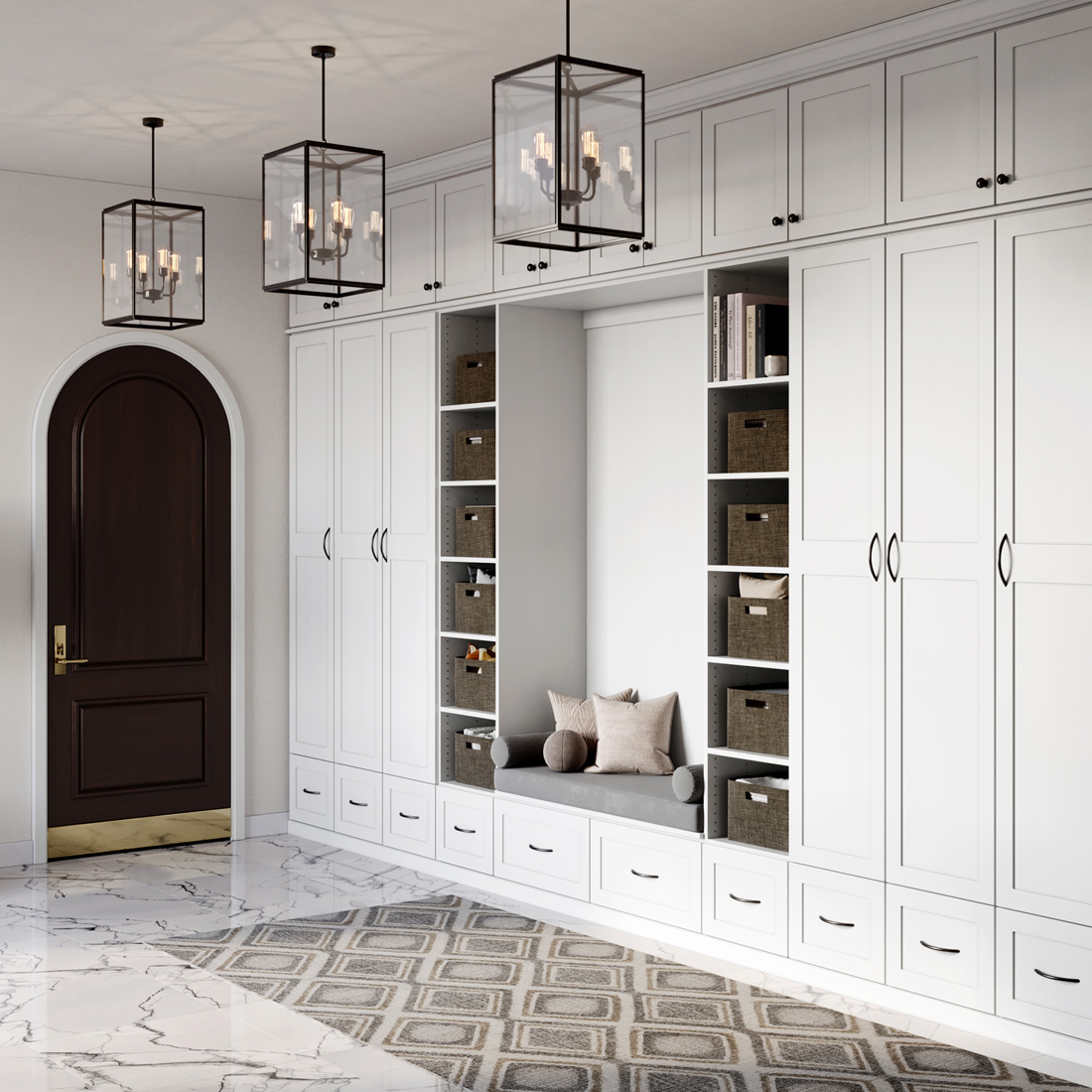
Small spaces still hold a lot of storage. A wall of small mudroom cabinets with a bench, hooks, and upper cubbies turns an entry hallway into a working drop zone without moving a single wall. That storage wall becomes the main expense in a conversion, which makes cabinetry the next cost to understand.
Custom mudroom lockers and cabinets cost $500 to $1,200 per linear foot, according to U.S. News, and a complete custom locker wall ranges from $3,000 to $30,000, according to custom cabinet maker Cypress Designs. Linear-foot pricing measures the length of the storage wall, so a 6-foot run of lockers costs about half as much as a 12-foot run with the same features.
Retail programs sit at the lower end of that spectrum. Home Depot lists its installed custom mudroom at about $3,500, including materials and labor, built from engineered wood with thermofoil construction. Custom solid wood mudroom lockers scale higher because the material, joinery, and finish all step up.
Open lockers cost less than closed lockers because open lockers skip doors, hinges, and the extra finishing that doors require. HomeAdvisor reports that closed lockers cost $2,000 or more. Closed lockers hide clutter completely, while open lockers keep coats and bags within one reach and let damp gear air out.
Mudroom benches cost $200 to over $2,000 for a custom-built bench, according to U.S. News. Bench price climbs with length, solid wood tops, cushions, and the storage built underneath, such as shoe cubbies, lift-up lids, or pull-out drawers.
Custom lockers cost more than stock lockers, and custom lockers fit the exact wall, ceiling height, and family size of your home. HomeAdvisor puts prefab mudroom lockers at $310 to $2,750 or more. Stock units come in fixed widths, so an odd-sized wall often ends up with gaps or filler panels that hold nothing.
The real comparison is cost over time. Whether to buy or build depends on how long you plan to stay and how hard the mudroom works. A mudroom takes wet boots, heavy backpacks, and daily door slams, and that daily wear exposes the gap between particleboard and solid wood quickly.
The cost of mudroom cabinetry is driven by the length of the storage wall, the material, the ratio of doors and drawers to open cubbies, the finish, the hardware, and the level of design detail. Each factor moves the linear-foot price up or down.
Cabinet type shapes the starting point. The difference between stock or semi-custom and fully custom cabinetry comes down to how much of the size, material, and layout you control.
Finish choice shapes how the mudroom wears. Durable cabinet finishes resist scuffs from boots and bags, which matters more in a mudroom than in almost any other room.
Hardware choice shapes how the mudroom works. Heavy-duty hooks carry wet winter coats, and the right cabinet hardware ties the locker wall to the style of the rest of the home.
The other costs that go into a mudroom are flooring, plumbing for a sink or pet-washing station, electrical work, paint, and a new door when the entry changes. These costs sit outside the cabinetry and depend on how much the room changes.
Flooring takes the hardest hit in a mudroom. HomeAdvisor puts mudroom flooring at $3 to $25 per square foot, and porcelain and ceramic tile lead the list because both are durable, water-resistant, and easy to clean. Hardwood and cork absorb water, which shortens their lifespan in an entry that sees wet boots every day.
Water features add the biggest jumps. A built-in dog-wash station runs $2,000 to $3,000, according to HomeAdvisor, and custom tile or glass pushes that number higher. A utility sink or pet station also calls for a licensed plumber to run water and drain lines.
Moisture affects the cabinetry as much as the floor. Humid North Alabama summers combine with rain-soaked gear to keep mudroom air damp, and moisture-resistant materials keep locker boxes and bench tops from swelling over time.
Yes, you can build a mudroom yourself to save money, and a DIY build using stock cabinetry, basic lumber, and wall hooks can drop the total cost dramatically. Home blog The Grit and Polish converted a back hallway into a mudroom for $1,752 in total, with stock lockers making up $1,298 of that budget. Angi estimates that a DIY mudroom saves between $1,000 and $7,000 in labor.
DIY savings come with trade-offs. Stock lockers limit the layout to fixed sizes, self-installation takes time and tools, and lower-grade materials wear faster under daily mudroom use. Labor is also only part of the story, since materials and craftsmanship are a large reason cabinets cost more when they are built to last.
You budget for a custom mudroom by choosing the project scope first, measuring the storage wall, deciding on open or closed storage, picking materials and finishes, and setting aside room for flooring, electrical, and plumbing. Following that order keeps the biggest cost decisions at the front of the plan.
Careful planning also avoids expensive rework. The most common planning mistakes with built-ins, like skipped measurements and forgotten outlets, cost far more to fix after installation than before.
Yes, a mudroom adds value to a house because buyers actively look for organized entry storage, and a well-built mudroom makes a home more appealing to them. The NAHB What Home Buyers Really Want survey ranks the mudroom among the top 10 specialty rooms, wanted by 59% of millennial buyers.
Quality decides how much value the mudroom adds. Built-in lockers and benches read as a permanent feature of the home, while freestanding storage leaves with the seller. Durable custom storage also protects the rest of the house, since keeping mud, water, and grit at the door preserves floors and carpets in the main living areas.
It takes about 4 to 6 weeks to build custom mudroom cabinetry from design approval through installation, though more complex projects take longer. Most of that time goes into design and building in the shop, so the entry stays usable until installation day. For comparison, Home Depot quotes about 5 to 7 weeks from consultation to installation for its mudroom program.
Our process starts with a one-on-one consultation and precise measurements, followed by a free 3D design consultation that shows every locker, bench, and cubby before construction begins. Our Ardmore shop then builds each piece from moisture-resistant woods with scratch-resistant finishes.
Installation day brings the plan to life. Every set of handcrafted mudroom cabinets we build is delivered and installed by our own team and backed by a lifetime craftsmanship warranty.
Yes, a mudroom is worth it for households with kids, pets, or active outdoor routines, because a mudroom gives every coat, shoe, and bag a set place at the door. The NAHB reports that 59% of millennial buyers want a mudroom, which adds resale appeal on top of daily convenience.
A mudroom should be about 6 by 6 feet for most households, according to HomeAdvisor. Larger families or homes with pets benefit from more length along the storage wall, since each additional locker needs its own section.
The best flooring for a mudroom is porcelain or ceramic tile, because both are durable, water-resistant, and easy to clean. HomeAdvisor puts mudroom flooring at $3 to $25 per square foot and advises avoiding water-absorbing materials like hardwood and cork.
The cheapest way to add an addition to a house is converting or finishing an existing space, such as a garage, basement, attic, or porch, instead of building new square footage. Conversions avoid the high costs of pouring a new foundation and building a new roof, which is why Angi puts converted mudrooms at $3,000 to $10,000 compared with $18,000 to $36,000 for a new structure.
You need a permit to build a mudroom when the project adds square footage, moves walls, or adds plumbing or electrical work. A storage-only conversion with built-in lockers and a bench usually does not need one, but local building rules set the final requirement.
Yes, a laundry room can double as a mudroom, especially when the laundry room sits next to a back or garage entry. Adding lockers, a bench, and hooks alongside laundry room cabinetry creates one hardworking space for dirty clothes and outdoor gear.
A custom mudroom costs $6,500 to $18,000 for most projects, with a national average near $12,000. Converting existing space keeps the total low, while new additions and premium storage push it higher. Inside any mudroom, the lockers, benches, and cabinets are the biggest investment, and material, wall length, and open or closed storage decide where that investment lands.
At Classic Cabinetry, we design and build mudroom storage that fits your entry, your family, and your daily routine.
Reach out for a free estimate, and we will help you plan a mudroom that keeps the mess at the door.