.avif)


.avif)


.avif)
How to Design a Home Office and Guest Room Combo With Custom Cabinetry
link desc
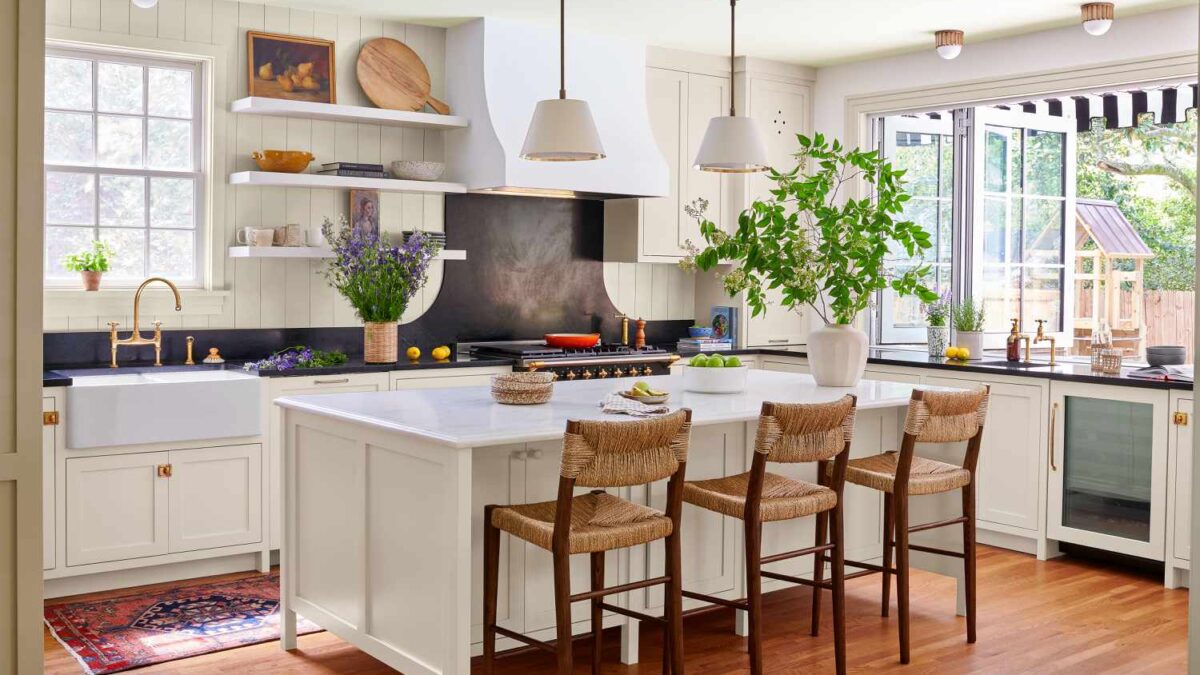


Custom kitchen cabinets last up to 50 years, according to the National Association of Home Builders Study of Life Expectancy of Home Components. That single number hides something more useful, though. A cabinet is not one object with one lifespan. It is three separate systems running on three separate clocks: the hardware wears out first, the finish second, and the box itself last, often decades apart. Knowing which clock is running out tells you whether you need a screwdriver, a refinisher, or a new kitchen. Below we cover why published lifespans disagree so widely, how long each of the three parts actually lasts, what shortens all three, and how to read the cabinets you already have.
Custom kitchen cabinets last up to 50 years, and often longer when the boxes are solid and the finish gets refreshed once along the way. The NAHB Study of Life Expectancy of Home Components puts kitchen cabinets at up to 50 years, medicine cabinets at 20 or more years, and garage and laundry cabinets at 100 or more years.
Those figures land differently once you compare them to the rest of the kitchen. The same NAHB study gives dishwashers and microwave ovens 9 years, trash compactors 6 years, gas ranges 15 years, and carpet 8 to 10 years. Cabinetry outlives every appliance it surrounds, usually several times over, which is why the cabinets are the part of a kitchen worth building properly.
Building properly is the qualifier that carries all the weight in that sentence. The NAHB study notes directly that life expectancy is greatly affected by the quality of maintenance, and its figures assume first-owner use. A 50-year cabinet is a well-built cabinet that was installed level, kept dry, and cleaned without abrasives.
All three of those conditions start at the shop rather than in the house. We build handcrafted kitchen cabinets with the 50-year horizon as the design assumption, because a cabinet built to survive one owner and a cabinet built to survive three are not the same cabinet.
Published cabinet lifespans disagree because different sources are measuring different things: some measure the finish, some measure the whole cabinet, and some measure how long owners keep cabinets before remodeling by choice. Read three articles on this question and you will find 15 to 20 years, 15 to 30 years, and 30 to 50 years, all stated confidently.
None of those ranges is wrong. They answer different questions. A painted finish reaching the end of its service life at 15 to 20 years is a real event, and so is a plywood box still sound at 45. Quoting the finish figure as the cabinet figure is what produces the confusion.
Owner choice accounts for most of the rest. The 2026 U.S. Houzz Kitchen Trends Study, based on 1,780 renovating homeowners, found 38 percent citing kitchen deterioration or dysfunction as a renovation trigger while 41 percent cited dissatisfaction with the old style. More kitchens get replaced for looking dated than for falling apart, and the NAHB study makes the same point, noting that changing consumer preferences result in products being replaced long before the end of their practical life expectancy.
Preference-driven replacement is worth separating from failure, because the two call for different decisions. Cabinets that no longer suit a household are a design question. Cabinets that no longer function are a construction question, and construction questions have answers you can inspect.
The part that wears out first on a kitchen cabinet is the hardware, followed by the finish, with the cabinet box outlasting both by a wide margin. Separating those three clocks is the most useful thing a homeowner can do with this question, because each one fails differently, shows different symptoms, and costs a different amount of disruption to address.
Hardware takes the most cycles and the most abuse. Hinges and slides absorb every open and close, and they carry the full weight of doors and loaded drawers while doing it. When a door will not stay aligned or a drawer sticks after adjustment, the hardware clock has run out rather than the cabinet.
The finish is next, and it fails from the surface inward. Grease, heat, water, and hand oils break down a coating gradually at the points that get touched, which is why wear shows at pulls and beside the range long before it shows on a door nobody opens.
The box is last and it fails only from moisture or structural overload. A plywood carcass that stays dry and level has no mechanism for wearing out, which is the reason cabinet boxes routinely survive multiple finishes and multiple sets of hardware.
Cabinet SystemTypical Service LifeHow It ShowsReplaceable on Its Own?Governing Test or ReferenceHardware (hinges, slides, pulls)20 to 30 yearsDoors drift out of alignment, drawers stick or drop, hinges loosen repeatedlyYes, without touching the cabinetANSI/KCMA A161.1: 25,000 door cycles, 15,000 drawer cycles under loadFinish (paint or stain and topcoat)15 to 20 years for paint, longer for stainWear through at pulls, yellowing near the range, dull or chalky surfaceYes, by refinishing in place or off siteANSI/KCMA A161.1: 24-hour chemical exposure panel, 120°F hotbox at 70% humidityBox (carcass, shelves, face frame)Up to 50 years for quality constructionSwollen or delaminated panels, sagging shelves, boxes pulling from the wallNo, this is replacement territoryNAHB life expectancy data; ANSI/KCMA A161.1 500 lb load testFor comparison: kitchen appliances6 to 15 yearsMechanical or electronic failureYesNAHB: dishwashers and microwaves 9 years, ranges 15 years, compactors 6 years
Sources: NAHB, Study of Life Expectancy of Home Components; ANSI/KCMA A161.1 Performance and Construction Standard for Kitchen and Vanity Cabinets; USDA Forest Products Laboratory, Wood Handbook; 2026 U.S. Houzz Kitchen Trends Study (n=1,780).
Cabinet hinges and drawer slides last 20 to 30 years in normal household use, and they can be replaced without disturbing the cabinet. Hardware is the shortest clock in the cabinet and also the cheapest one to reset, which is a favorable combination.
Cycle testing puts real numbers behind the estimate. ANSI/KCMA A161.1, the performance and construction standard for kitchen and vanity cabinets, opens and closes certified doors 25,000 times without permitting hinge failure or loss of alignment, and runs drawers through 15,000 cycles under load. Testing is performed by independent third-party laboratories on production-run samples pulled during unannounced plant visits rather than on prototypes.
Those counts translate differently by location. A trash pull-out or the drawer beside the dishwasher can reach 25,000 cycles in well under a decade, while a corner upper cabinet may never get there. Uneven wear across a single kitchen is normal, and it is why hardware gets replaced selectively rather than all at once.
Cycle rating is the specification to check, since a hinge rated for 100,000 openings behaves nothing like an entry-level one in the same opening. The differences between cabinet hinges show up most clearly in the doors that get used hardest.
A cabinet finish lasts 15 to 20 years for a quality painted coating and longer for a stained finish with a catalyzed topcoat. The finish is the second clock, and it is the one most often mistaken for the lifespan of the cabinet itself.
Certification testing shows how much a good coating is built to take. Under ANSI/KCMA A161.1, exposed surfaces face vinegar, lemon, orange and grape juice, ketchup, coffee, olive oil, and 100-proof alcohol for 24 hours plus mustard for one hour, with no permitted discoloration or film failure. Doors also sit in a hotbox at 120 degrees Fahrenheit and 70 percent relative humidity for 24 hours, and door edges face a standardized detergent solution for 4 to 24 hours depending on door type.
Real kitchens apply the same loads more slowly and in the same few places. Heat and grease concentrate on the doors flanking the range, water collects at the sink cabinet, and hand oils land at every pull, so the finish reaches the end of its life in zones rather than uniformly.
Stain outlasts paint in this respect because it sits in the wood rather than as a film across it, so wear blends into grain instead of standing out against a solid color. Selecting between cabinet finishes is therefore a durability decision as much as an appearance one.
Cabinet boxes last up to 50 years in plywood or solid wood construction, 20 to 30 years in MDF, and 10 to 20 years in particleboard. The box is the longest clock and the only one whose failure means replacement rather than repair.
Substrate explains the entire spread. Plywood resists swelling because its cross-laminated plies restrain movement in both directions, and solid wood can be sanded and refinished repeatedly. Medium-density fiberboard is dimensionally stable and takes paint beautifully, but it absorbs water at exposed edges and swells permanently when it does. Particleboard fails fastest for the same reason, and swelling in either material cannot be reversed.
Location inside the kitchen matters as much as material. The sink cabinet and the run beside the dishwasher take more moisture than the rest of the kitchen combined, which is why those boxes fail first even when the whole kitchen was built at once from the same material.
Older Alabama homes tend to demonstrate this clearly. Cabinets pulled out of kitchens built in the 1970s and 1980s are frequently sound everywhere except under the sink, where a slow supply-line leak took out one box while the other twenty stayed serviceable. Choosing cabinet materials with that pattern in mind is what pushes a kitchen toward the top of the range rather than the middle.
Custom cabinets last longer than stock cabinets, typically 25 to 40 or more years against 10 to 15 years for builder-grade stock. The gap comes from specification rather than from craftsmanship mystique, since a custom build lets every durability variable be chosen rather than inherited.
Stock lines fix those variables at a price point. Box material, back panel thickness, drawer construction, hinge grade, and finish system are all decided before anyone knows which kitchen the cabinet is going into, and the decisions that get made are the ones that hit the target price. Semi-custom lines sit between the two at roughly 15 to 25 years, because they open some specifications and leave others fixed.
Fit contributes as well, and it is easy to overlook. A stock run installed with filler strips leaves gaps that collect moisture and dust at exactly the seams where a scribed custom panel would have sealed tight against the wall. The differences between stock cabinets and custom work compound over decades rather than showing up on install day.
What makes custom cabinets last longer is plywood box construction, dovetailed drawer boxes, glue-and-screw assembly, full-height backs, and hardware rated for daily cycling. Each of those is a specification that can be verified rather than a claim that has to be trusted.
Joinery carries the load over time. A dovetailed drawer box interlocks mechanically and stays square under weight, while a stapled butt joint relies on fasteners that work loose with every cycle. Glue-and-screw assembly on the carcass does the same job for the box, holding the cabinet square rather than letting it rack under load.
Full-height backs are the least visible item on the list and one of the most consequential. A cabinet with a full back panel resists twisting and anchors securely to studs across its whole height, which is what keeps a loaded upper cabinet from pulling away from the wall. Certification testing loads installed wall cabinets to 500 pounds and shelves to 15 pounds per square foot without permitting deformation.
Material choice sits underneath all of it. Building with solid wood cabinetry for doors and face frames keeps the refinishing option open decades later, which is the difference between a cabinet that can be renewed and one that can only be replaced.
Humidity affects how long cabinets last more than any other environmental factor, because wood exchanges moisture with the surrounding air continuously and changes dimension as it does. Every cabinet in a house is quietly moving with the seasons.
The mechanism is measurable. The USDA Forest Products Laboratory establishes 6 to 8 percent moisture content as the range at which interior cabinetry stabilizes in a conditioned home at 30 to 50 percent relative humidity. Homes without humidity control commonly swing between 25 and 65 percent relative humidity across a year, producing roughly a 6 percent change in the moisture content of the wood inside them, and flat-grain wood changes about 1 percent in width for every 4 percent change in moisture content.
Repeated movement is what loosens joints, opens hairlines in painted door frames, and shifts doors out of alignment over decades. Keeping indoor humidity in the 30 to 50 percent band is the single most effective thing a homeowner can do for cabinet longevity, and running the range hood while cooking handles the short-term spikes.
Huntsville summers make that band harder to hold than it sounds, which is why we build with hardwoods dried to interior moisture targets and specify protective finishes rather than treating humidity as someone else's problem. The same reasoning governs moisture-resistant cabinets anywhere the air runs damp.
Installation affects how long cabinets last enough to undo the advantage of premium construction entirely. A cabinet hung out of level carries stress it was never designed to carry, and it carries that stress every day for as long as it hangs there.
Four things have to be right. Cabinets must be level, plumb, securely anchored into framing, and evenly supported across their span. Miss any one and the consequences accumulate: doors drift out of reveal, drawers bind on one side, face frames rack, and fasteners work loose under repeated loading.
Anchoring is where shortcuts do the most damage. An upper cabinet fastened into drywall rather than studs will hold until it is loaded, and a loaded upper cabinet pulling away from a wall is a structural problem rather than a cosmetic one. Certification load testing assumes correct anchoring; nothing in the standard compensates for skipping it.
Scribing to real walls is the other half of a durable install, since no wall in any house is truly flat. Planning for that in advance is part of why cabinet installation deserves the same attention as the cabinet itself.
The signs it is time to replace kitchen cabinets are swollen or delaminated panels, boxes pulling away from the wall, sagging shelves that no longer hold level, and a layout that no longer works for the household. Everything short of those is usually a repair rather than a replacement, and the difference comes down to which clock has run out.
Reading the symptoms tells you which system is asking for attention:
The first four items on that list are fixable without new cabinets. The last four generally are not, and the last one is the reason plenty of perfectly sound kitchens get replaced anyway. A closer look at the signs of wear worth watching helps separate the two categories before any decision gets made.
You should reface kitchen cabinets when the boxes are sound and the layout works, and replace them when the boxes have failed or the layout does not fit how you use the kitchen. That test resolves most cases in about a minute, because it asks only about the box and the floor plan.
Refacing keeps the existing boxes and replaces doors, drawer fronts, and exposed surfaces, which typically extends useful life by another 10 to 20 years. It works because the box is the longest clock, so a sound carcass has plenty of service life left when the finish and doors have reached the end of theirs.
Replacement makes more sense when the box is the problem or when the layout is. No amount of new door fronts fixes a swollen sink base, and none of them adds the drawer bank a household actually needs. Houzz data shows 84 percent of renovating homeowners upgrade cabinets, with 68 percent replacing all of them and 27 percent choosing partial replacement, which suggests plenty of kitchens are candidates for a mixed approach.
Repairability is what makes the choice available in the first place. A solid wood door can be sanded and refinished more than once, while a painted composite panel that has swollen cannot be brought back, and that asymmetry is worth knowing before the original cabinets are ordered rather than after.
You make kitchen cabinets last longer by controlling humidity, cleaning gently, addressing leaks immediately, and maintaining hardware on a schedule. None of it is difficult, and the NAHB study states directly that life expectancy is greatly affected by maintenance quality.
A simple routine covers nearly all of it:
Consistency matters more than product selection in every one of those steps. A regular cabinet maintenance habit is the least expensive way to move a kitchen from the middle of the lifespan range toward the top of it.
Custom cabinets are worth the money for households planning to stay in the home long term, because the durability and repairability advantages compound over decades rather than showing up immediately. Over a short holding period the case is weaker, and it is honest to say so.
The long-term math rests on three things. Custom construction reaches the top of the lifespan range rather than the middle. A solid wood door can be refinished repeatedly, which resets the finish clock without touching the box. And a cabinet built to the measured wall avoids the filler gaps and dead corners that a stock run leaves behind, which means more usable storage from the same footprint for the life of the kitchen.
Resale evidence supports the storage argument rather than the finish argument. NAHB buyer research rates garage storage as essential or desirable to 81 percent of buyers, and storage features consistently rank near the top of what buyers want. Cost vs. Value data published by Zonda shows minor kitchen remodels recouping roughly 113 percent of cost nationally against about 31 percent for major upscale remodels, which favors targeted quality over maximum scope.
Where a custom cabinet build earns its keep most clearly is in kitchens with odd walls, tall ceilings, or storage problems no catalog size solves.
Anyone weighing the decision primarily around resale rather than around living in the house will find the tradeoffs laid out further in our writeup on cabinetry and home value.
The most durable cabinet material is furniture-grade plywood for boxes paired with solid hardwood for doors and face frames. Plywood resists swelling and sagging better than composite panels because its cross-laminated plies restrain movement in two directions. Solid hardwood carries hinge screws, resists impact, and can be refinished repeatedly rather than only once.
Kitchen cabinets should be replaced when the boxes fail or the layout no longer works, which for quality construction may never happen within a single ownership. NAHB life expectancy data puts kitchen cabinets at up to 50 years. In practice most kitchens are updated every 20 to 30 years, more often for style reasons than structural ones.
Old cabinet boxes can be reused when they are square, dry, securely anchored, and free of swelling or delamination. Reusing sound boxes is exactly what refacing does, and it typically extends useful life by another 10 to 20 years. Boxes with water damage, racked frames, or sagging shelf supports are not candidates, since the damage is structural rather than cosmetic.
Bathroom cabinets generally do not last as long as kitchen cabinets, because they face constant humidity in a small enclosed room with less ventilation. NAHB life expectancy data assigns medicine cabinets 20 or more years against up to 50 for kitchen cabinets. Moisture-resistant substrates, a sealed toe kick, and an exhaust fan that actually runs narrow the gap considerably.
Custom cabinets typically take 8 to 14 weeks from approved design to installation, with most full kitchens landing in the 10 to 12 week range. The sequence includes measuring, design and selections, engineering and field verification, shop drawing approval, production and finishing, then delivery and install. Finish cure time is the phase least worth compressing, since a rushed coating shortens the finish clock from day one.
A lifetime warranty does not mean cabinets last forever, and it typically covers craftsmanship and construction defects rather than normal wear, moisture damage, or finish aging. Hardware often carries a separate manufacturer warranty. Reading which of the three cabinet systems a warranty actually covers is more informative than reading the length of its term.
Cabinets do not need to be replaced when selling a home if the boxes are sound and the finish still presents well. Refacing, refinishing, or new hardware addresses appearance at a fraction of the disruption of replacement. Cost vs. Value data published by Zonda consistently shows smaller, focused kitchen updates recouping a far higher share of cost than full renovations.
Custom kitchen cabinets last up to 50 years, and the number holds when the box is plywood or solid wood, the install is level and anchored into framing, indoor humidity stays between 30 and 50 percent, and the finish gets refreshed once along the way. Stop treating the cabinet as one object with one expiration date. The hardware runs out at 20 to 30 years and gets swapped in an afternoon, the finish at 15 to 20 and gets renewed without touching the box, and the box itself outlives every appliance in the room. When something goes wrong, identify which clock ran out before deciding what to spend.
We have been building cabinetry from our Ardmore shop for more than four decades, which means we occasionally get to see our own work still in service in kitchens that have been through two owners and three sets of appliances. If you are trying to decide whether your cabinets have life left in them, Classic Cabinetry is glad to take a look and tell you honestly.
A free estimate is a simple place to start.