.avif)


.avif)


.avif)
Bathroom Vanity Storage Ideas to Keep Counters Clutter-Free
link desc


Keep your bathroom counters clutter-free by using vertical space, drawer organizers, under-sink pull-out systems, and custom vanity cabinets that give every item a dedicated home. The average American bathroom holds 47 individual products competing for space across roughly 40 square feet, according to a 2024 National Kitchen and Bath Association (NKBA) analysis. Most of those products end up on the counter because the vanity beneath them is poorly organized or too small to hold everything the household uses daily. Bathroom storage ranks as the number one reason homeowners renovate their bathrooms, according to the same NKBA survey, yet 71% of homeowners who added storage during a remodel reported that clutter returned within six months. The problem is not a lack of storage space. The problem is a lack of storage strategy. This guide covers under-sink organization, drawer systems, countertop solutions, vanity sizing, materials, small-bathroom strategies, and the latest storage trends so you can build a bathroom that stays organized long after the renovation is finished.
Organize under a bathroom vanity sink by installing pull-out baskets, tiered shelving that works around the plumbing, and modular bins that separate cleaning supplies from personal care products. The space beneath the sink is the largest single storage zone inside a standard vanity, yet most homeowners leave it as one open cavity where bottles, boxes, and bags pile on top of each other until nothing is visible or accessible.
Pull-out baskets mounted on drawer slides transform this wasted space into an organized system. Pull-out baskets glide forward on tracks, bringing every item to the front of the cabinet so nothing gets lost behind the drain pipe. Tiered pull-out shelves add a second level of storage above the baskets, doubling the usable area inside the same cabinet box. U-shaped shelves and drawers wrap around the sink's plumbing pipes rather than blocking off that space entirely. A U-shaped pull-out drawer uses the full width of the cabinet while leaving a cutout channel for the P-trap and water supply lines.
Modular bins work well for grouping items by category. One bin holds cleaning supplies. Another holds backup toiletries. A third holds hair tools. Labeling each bin prevents the contents from mixing back together over time. Clear bins add visibility, letting you see at a glance when a product is running low. When selecting under-sink organizers for bathroom cabinets, choose water-resistant materials like coated wire, stainless steel, or BPA-free plastic that handle the occasional drip or spill beneath the sink without corroding or warping.
Keep bathroom vanity drawers organized by dividing the interior into dedicated zones for skincare, haircare, oral care, and grooming tools using adjustable dividers, acrylic trays, or bamboo inserts. A vanity drawer without dividers becomes a junk drawer within weeks. Items shift every time the drawer opens and closes, and smaller products like bobby pins, hair ties, and cotton swabs end up scattered across the bottom.
Adjustable dividers create custom-width compartments that fit the specific items you store. Skincare products like moisturizer, serum, and sunscreen stand upright in one compartment. Hair tools like brushes, combs, and clips sit in another. Oral care items like toothpaste, floss, and mouthwash occupy a third section. Acrylic trays provide a rigid, transparent framework that holds containers in place and makes the contents visible from above. Bamboo inserts add a natural, warm look while resisting moisture better than untreated wood.
Custom vanity drawers take organization further with built-in features that stock drawers cannot match. Integrated electrical outlets inside a top drawer let you charge an electric toothbrush or store a hair dryer while it cools without draping the cord over the counter. Velvet-lined jewelry compartments protect delicate pieces from scratching. Drawer-mounted hair tool holders keep curling irons and flat irons contained and upright, even while still warm. These built-in features eliminate the need for countertop holders and charging stations that contribute to surface clutter. We design these integrated drawer systems into every custom bathroom storage project because they solve the specific daily-use problems that generic organizers leave unaddressed.
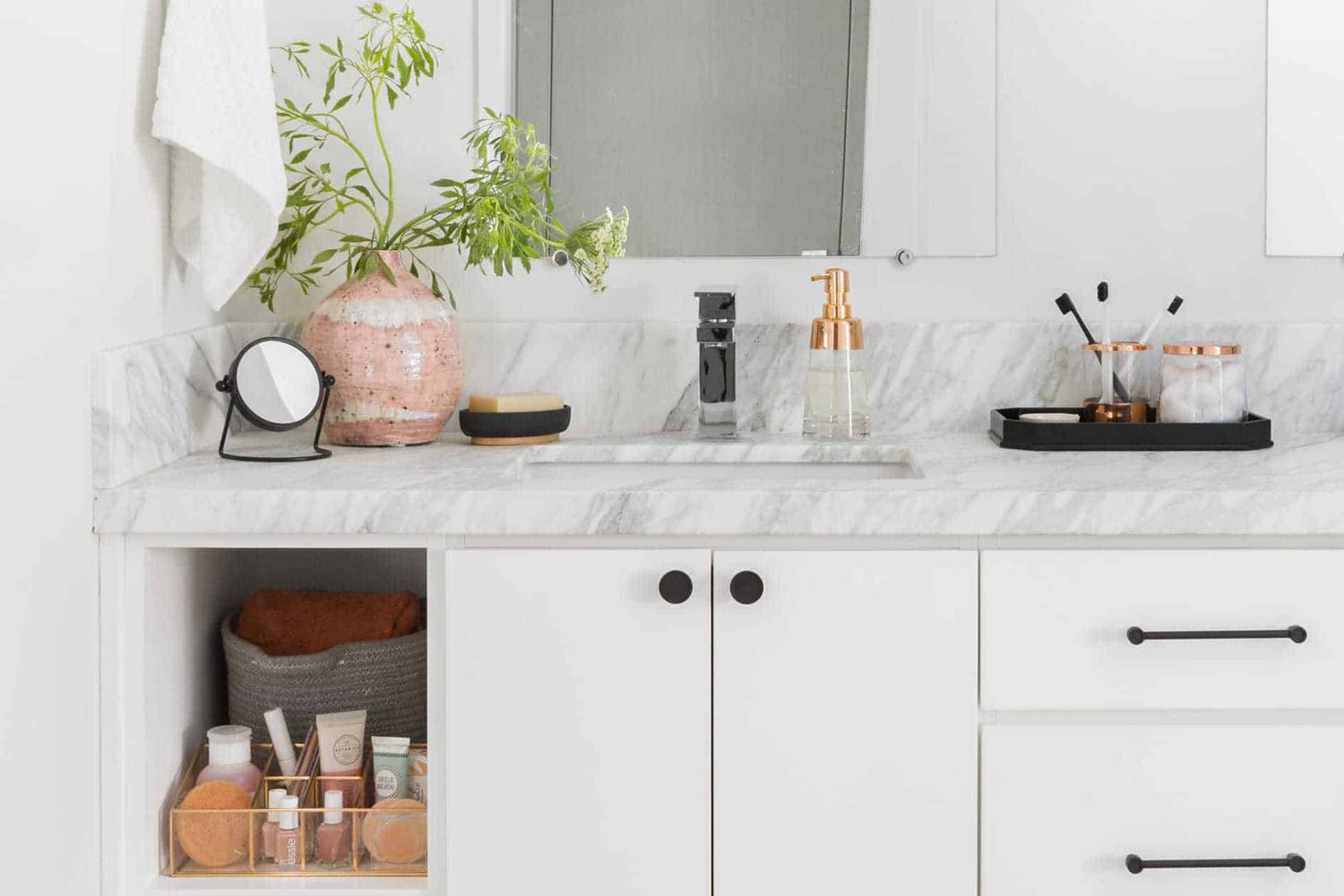
Keep no more than two to four functional or decorative items on a bathroom counter to maintain a clutter-free surface. According to Bull Run Kitchen and Bath survey data, 68% of homeowners feel their bathroom countertops are cluttered, and the primary cause is keeping too many daily-use products on the surface instead of inside the vanity.
The items that earn a permanent spot on the counter are the ones you use at least twice a day and that serve a hygiene or functional purpose. A soap dispenser is essential. A hand towel holder keeps the counter dry. A toothbrush holder or small cup keeps oral care accessible. Beyond those basics, everything else performs better inside a drawer or behind a cabinet door. Makeup, skincare bottles, hair products, medications, and cotton rounds all belong inside the vanity where they stay protected from humidity, dust, and accidental spills.
A decorative tray provides a visual boundary for the items that remain on the counter. The tray groups the soap dispenser, a small plant, and one or two other items into a contained zone that reads as intentional rather than scattered. The tray also makes cleaning easier because you lift one tray instead of moving six individual items to wipe the counter. This simple containment strategy keeps the counter looking organized even on busy mornings when time is short.
The best organizer for a bathroom countertop is a tiered stand, a decorative tray, or a set of glass canisters that groups daily essentials into a compact, visually cohesive arrangement. The right countertop organizer keeps items accessible without spreading them across the entire surface.
Tiered stands use vertical space on the counter itself by stacking two or three levels of shelving in a small footprint. Tiered stands hold daily lotions, perfumes, and small containers without spreading them flat across the counter. Glass canisters with lids store cotton balls, cotton swabs, and bath salts while keeping them visible and protected from moisture. Woven baskets in seagrass or bamboo add texture and warmth while concealing items like washcloths, hand towels, or travel-sized bottles that do not need to be visible.
Organizer TypeBest ForMaterial OptionsStyle FitDecorative TrayGrouping 3-5 small items into one zoneMarble, ceramic, wood, acrylicModern, transitional, traditionalTiered StandVertical stacking on limited counter spaceMetal, acrylic, bambooModern, farmhouseGlass CanistersCotton balls, swabs, bath saltsClear glass, frosted glassTransitional, spa-inspiredWoven BasketTowels, washcloths, bulkier itemsSeagrass, bamboo, rattanFarmhouse, coastal, organicMagnetic StripMetal tools (tweezers, nail clippers, bobby pins)Stainless steelModern, minimalist
Matching your countertop organizer to your bathroom's design style creates a cohesive look that feels intentional rather than afterthought. Neutral colors in matte ceramic or stone blend into most color palettes without competing for attention. Clean-lined metal organizers in brushed brass or matte black coordinate with modern cabinet hardware and faucet finishes for a polished, unified appearance.
Add counter space in a bathroom by installing floating shelves, recessed wall niches, a wider vanity, or wall-mounted cabinets that move storage off the counter surface and onto the walls. When the counter is too small to hold even the essentials, the solution is not better organization alone. The solution is more surface area or more off-counter storage that relieves the pressure on the vanity top.
Floating shelves mounted above or beside the vanity mirror provide open storage for items you want within reach but off the counter. A 24-inch floating shelf holds three to four bottles, a small plant, and a decorative object without occupying any counter space at all. Recessed wall niches built into the wall between studs create 3.5-inch-deep shelved compartments that sit flush with the wall surface. Recessed niches hold toiletries, candles, and small decorative items in a sleek, built-in format that does not project into the room.
Upgrading to a wider vanity provides the most dramatic increase in both counter space and internal storage. According to the 2025 Houzz Bathroom Trends Study, 46% of renovating homeowners now choose a vanity longer than 60 inches, and 13% go beyond 72 inches. These wider vanities accommodate double sinks with a shared countertop that provides ample surface area for two people to use the bathroom simultaneously without crowding each other's space. A wider vanity also means more drawer and cabinet volume below the counter, which reduces the need to keep products on the surface at all. Planning a wider custom bathroom cabinets layout early in a renovation ensures the plumbing, electrical, and wall framing accommodate the larger footprint.
A vanity 60 inches or wider with a combination of drawers and cabinets gives the most storage for a bathroom. Vanity size directly determines how many drawers, shelves, and internal compartments the cabinet can hold, and wider vanities offer exponentially more storage than narrow ones.
A standard 36-inch single-sink vanity provides one to two drawers and one under-sink cabinet. A 48-inch vanity adds a third drawer stack or an additional cabinet section beside the sink. A 60-inch double-sink vanity doubles the drawer count and adds a center section between the two sink bases that can hold a full-depth drawer tower. A 72-inch vanity, which 13% of renovating homeowners now choose according to Houzz data, provides the most internal volume of any standard configuration. The additional 12 inches of width translates to two or three more full-depth drawers and enough cabinet space to store every product in the bathroom without touching the counter.
The interior configuration matters as much as the overall width. A vanity with one large under-sink cabinet wastes space because plumbing pipes block half the interior. A vanity designed with a smaller under-sink section and a full-depth drawer below that section captures the space beneath the pipes that a single large cabinet loses. Custom vanities allow exact drawer and shelf configurations that stock vanities cannot provide. We build bathroom vanity interiors with drawer depths, divider spacing, and shelf heights matched to each homeowner's specific product inventory, which prevents the wasted space that causes clutter to migrate back onto the counter.
The best material for bathroom vanity cabinets is plywood with a moisture-resistant finish, because bathrooms generate more humidity than nearly any other room in the home. Plywood resists warping, swelling, and delamination in high-moisture environments far better than particleboard or unprotected medium-density fiberboard (MDF).
Plywood's cross-grain laminated construction gives it dimensional stability that prevents the expansion and contraction cycle humidity causes in single-direction wood products. A plywood vanity box holds its shape for decades in a steamy bathroom. A particleboard vanity box absorbs moisture at exposed edges and screw holes, causing the material to swell, crumble, and eventually fail. The failure often starts at the bottom of the vanity where splashed water pools near the floor, or at the back panel where humidity from the shower condenses.
MDF works well for painted vanity doors because it provides a smooth, grain-free surface that takes paint evenly without telegraphing wood grain through the finish. Pairing MDF doors with a plywood cabinet box combines the best properties of both materials. Thermofoil vanity doors use a vinyl film over MDF. Thermofoil resists surface moisture but fails when the vinyl seal breaks at an edge, allowing moisture into the MDF core beneath. For homeowners in humid climates like North Alabama, we recommend plywood construction with sealed edges and moisture-resistant vanity materials that withstand daily shower steam and splashed water without degrading over time.
Clever storage ideas for a small bathroom include over-toilet cabinets, slim tower cabinets, recessed medicine cabinets, back-of-door organizers, and floating shelves that move storage onto the walls and off the limited floor and counter space. Small bathrooms gain the most from vertical storage because the walls offer significantly more usable area than the floor.
An over-toilet cabinet or shelving unit captures the wall space above the toilet that nearly every small bathroom leaves completely empty. This single addition can hold towels, toilet paper, and cleaning supplies without taking any floor space. A slim tower cabinet measuring 12 to 15 inches wide fits into the gap between the vanity and the wall or between the toilet and the shower, providing floor-to-ceiling shelved storage in a narrow footprint. Recessed medicine cabinets built into the wall between studs provide 3.5 to 4 inches of shelved depth without projecting into the room, keeping the sight lines clean in a tight space.
Back-of-door organizers attach to the inside face of the vanity cabinet door and hold small items like hair ties, makeup brushes, and spray bottles flat against the door panel. These organizers use space that otherwise sits completely empty every time the door closes. Magnetic strips mounted inside a medicine cabinet or on a wall hold metal tools like tweezers, nail clippers, and bobby pins in plain sight without requiring shelf space. Even a bathroom under 40 square feet can hold every product the household needs when vertical space, door interiors, and recessed wall cavities all contribute to the storage system. Homeowners who pair their small bathroom vanity with a custom closet or linen cabinet in the adjacent hallway extend storage capacity beyond the bathroom's walls.
Organize a small bathroom with no counter space by shifting every storage function to the walls, the inside of cabinet doors, and the interior of the vanity. When the counter holds only a sink and a faucet, the walls become the primary storage surface.
A wall-mounted shelf directly beside the mirror holds the two or three items you need while brushing your teeth or washing your face. A recessed niche in the shower wall stores shampoo, conditioner, and body wash without a hanging caddy that takes up floor space in the tub. A narrow vertical shelf mounted between the mirror and the sidewall holds everyday skincare in a column that uses inches of wall space rather than inches of counter. Pedestal sinks, which lack a vanity cabinet entirely, benefit from a small wall-mounted cabinet or a set of floating shelves installed directly above or beside the sink to replace the storage a vanity would normally provide.
The most common bathroom storage mistakes are choosing a vanity that is too small, ignoring vertical wall space, using materials that cannot handle humidity, and overcrowding the counter instead of investing in interior cabinet organization. Avoiding these mistakes during the planning phase prevents the frustrating cycle of organizing, cluttering, and reorganizing that 71% of homeowners experience after a bathroom renovation, according to NKBA survey data.
These six steps address the root causes of bathroom clutter rather than treating the symptoms. A well-planned vanity with the right size, material, and interior layout keeps the counter clear permanently, not just on the day the renovation finishes.
The latest trends in bathroom storage for 2025 and 2026 are floating vanities with deep drawers, built-in drawer organizers, wider vanities over 60 inches, integrated charging stations, and recessed wall niches that eliminate the need for surface-mounted shelving. The overarching direction is toward storage that looks built-in, hides clutter behind closed surfaces, and works seamlessly with the bathroom's overall design.
Floating vanities, which mount to the wall without touching the floor, rank among the strongest bathroom trends for 2026 according to House Digest. Floating vanities create visual space beneath the cabinet, making the bathroom feel larger while still providing full drawer and cabinet storage above. Built-in drawer organizers have surged in demand according to the 2025 Houzz Bathroom Trends Survey, as homeowners increasingly want vanity interiors that prevent clutter rather than requiring aftermarket organizers to manage it.
The global bathroom storage and organizer market reached $18.5 billion in 2025 and is projected to grow to $28.9 billion by 2034, according to Dataintelo market research. Residential applications account for 72.5% of that market, reflecting the strong and growing homeowner demand for better bathroom organization. Midrange bathroom remodels that include a modern vanity with organized storage deliver 70 to 85% return on investment at resale, according to Fixr and the 2025 Zonda Cost vs. Value Report. Adding storage alone can increase a home's resale value by at least 2%, with more than 100% return on the storage-specific investment according to Badeloft analysis. These numbers confirm that kitchen and bathroom storage upgrades rank among the highest-ROI improvements a homeowner can make.
DIY bathroom storage ideas that create more space include installing floating shelves above the toilet, adding adhesive-mount hooks inside cabinet doors, using stackable bins under the sink, mounting a magnetic strip inside the medicine cabinet for metal grooming tools, and hanging a pocket organizer on the back of the bathroom door. These projects require minimal tools, no plumbing changes, and can be completed in an afternoon.
Yes, custom bathroom vanities have significantly more storage than stock vanities because custom vanities are built to the exact dimensions of the room and configured with drawers, shelves, and compartments sized to the homeowner's specific product inventory. Stock vanities use standardized interior layouts that waste space around plumbing pipes and limit drawer depth and count. Custom vanities can include U-shaped drawers around plumbing, integrated electrical outlets, and adjustable interior shelving that stock models do not offer.
Organize a bathroom counter by removing everything that does not need to be on the surface daily, grouping the remaining two to four items on a decorative tray, and storing everything else inside the vanity drawers or on wall-mounted shelves. A clear counter makes the bathroom feel larger, simplifies daily cleaning, and reduces the visual stress that cluttered surfaces create.
Style a bathroom counter by placing a decorative tray or small marble dish at one end to anchor the arrangement, adding a soap dispenser in a finish that matches your cabinet hardware, including one natural element like a small plant or a candle, and leaving the rest of the counter completely open. Restraint is the key to a styled counter that looks intentional rather than cluttered.
The best vanity height for comfortable use is 34 to 36 inches for a standard "comfort height" vanity, which aligns with the height of kitchen countertops and reduces back strain for adults of average height. Comfort-height vanities at 36 inches have become the most popular choice in new construction and renovations, replacing the older 30-to-32-inch standard that required users to bend further to reach the sink.
Bathroom vanity storage works best when every zone inside and around the vanity has a clear purpose. Under-sink pull-outs capture the space that plumbing usually wastes. Divided drawers give every product a dedicated slot. The counter stays clear when only two to four essential items earn a permanent spot on the surface. Wider vanities, floating shelves, and recessed niches add capacity without shrinking the room. The right materials handle humidity. The right interior layout prevents clutter from creeping back.
At Classic Cabinetry, we design and build custom bathroom vanities with organized interiors, moisture-resistant construction, and the exact dimensions your space requires. If you are planning a bathroom renovation and want a vanity that keeps your counters clear for years to come, reach out to our team for a free estimate and 3D design consultation.