.avif)


.avif)


.avif)
Bathroom Cabinet Remodel on a Budget, Where to Spend and Where to Save
link desc


A budget bathroom cabinet remodel succeeds by keeping your existing cabinet box and spending money only on high-impact upgrades like new hardware, soft-close hinges, and a durable countertop. The average bathroom remodel costs approximately $12,000, with most projects falling between $6,700 and $17,600, according to the National Kitchen and Bath Association (NKBA). Cabinetry and vanity costs alone range from $500 to $3,500 or more depending on whether you choose stock, semi-custom, or fully custom options. The difference between a budget bathroom cabinet remodel that looks professional and one that looks cheap comes down to knowing where your dollars produce the biggest visual and functional return and where you can save without anyone noticing the difference. This guide breaks down exactly where to spend and where to save on your bathroom cabinets so every dollar works as hard as possible.
The biggest expense in a bathroom cabinet remodel is labor, which accounts for 35 to 50% of the total project cost. Within that labor cost, plumbing, tile installation, and waterproofing represent the three most significant line items, according to Reico Kitchen and Bath industry data. Labor costs run roughly twice the cost of materials in most bathroom projects, which means any decision that changes the plumbing layout, adds tile complexity, or requires structural modifications multiplies the overall expense quickly.
Among material costs, the vanity cabinet itself and the countertop together represent the largest single product investment. A stock vanity costs $500 to $1,500. A semi-custom vanity runs $1,500 to $4,000. A fully custom vanity starts around $5,000 and climbs from there. The countertop adds another $200 to $1,500 depending on whether you choose laminate, solid surface, cultured marble, or quartz. Understanding where these costs concentrate helps you make smarter choices before the project begins. The goal of a budget cabinet remodel is to keep the expensive line items (labor, plumbing, layout changes) as low as possible while directing your spending toward the upgrades that produce the strongest visible result.
Save on a bathroom cabinet remodel by keeping your existing layout, refacing or painting your current cabinet boxes, choosing stock or semi-custom vanities over full custom, and swapping hardware instead of replacing entire cabinets. These four strategies reduce the highest-cost components of a bathroom renovation without sacrificing the finished appearance.
Keeping the existing bathroom layout is the single most effective way to control labor costs. When the sink, toilet, and shower stay in their current positions, you avoid the expense of rerouting supply lines and drain pipes. Moving a toilet or vanity to a new location requires a licensed plumber, new drain connections, and often new subfloor work. That plumbing relocation alone can add $1,000 to $5,000 or more to a project that could have stayed within budget by keeping the fixtures where they are. According to a Reico Kitchen and Bath survey, 74% of their design experts identified keeping the existing layout as the best way to save money on a bathroom remodel. The savings touch plumbing, electrical, construction, and flooring costs simultaneously because none of those trades need to accommodate a new configuration.
Refacing or painting existing cabinet boxes saves the cost of a full cabinet replacement while delivering a dramatic visual transformation. Refacing replaces the cabinet doors and drawer fronts with new ones while keeping the original cabinet box structure in place. The cabinet box, which is the structural shell mounted to the wall, is the most expensive component to replace because removal and reinstallation involve plumbing disconnection, countertop removal, wall repair, and new installation labor. Painting the existing boxes and doors costs even less than refacing and produces a fresh, modern appearance when combined with new cabinet hardware. A coat of moisture-resistant paint in a current color like white, soft gray, or navy transforms dated oak or honey-toned cabinets into a contemporary look for a fraction of the cost of new cabinetry.
Stock vanities deliver strong design impact at the lowest price point. Today's stock vanities include shaker-style doors, soft-close drawers, and finishes that were only available in semi-custom lines five years ago. A well-chosen stock vanity priced between $500 and $1,500 provides a clean, modern look with functional storage that serves most bathrooms effectively. Semi-custom vanities at $1,500 to $4,000 offer more flexibility in width, depth, finish, and interior configuration without the lead time or premium cost of fully custom work. For homeowners working within a strict budget, the difference between stock, semi-custom, and custom cabinets comes down to how much sizing flexibility and interior customization the project requires.
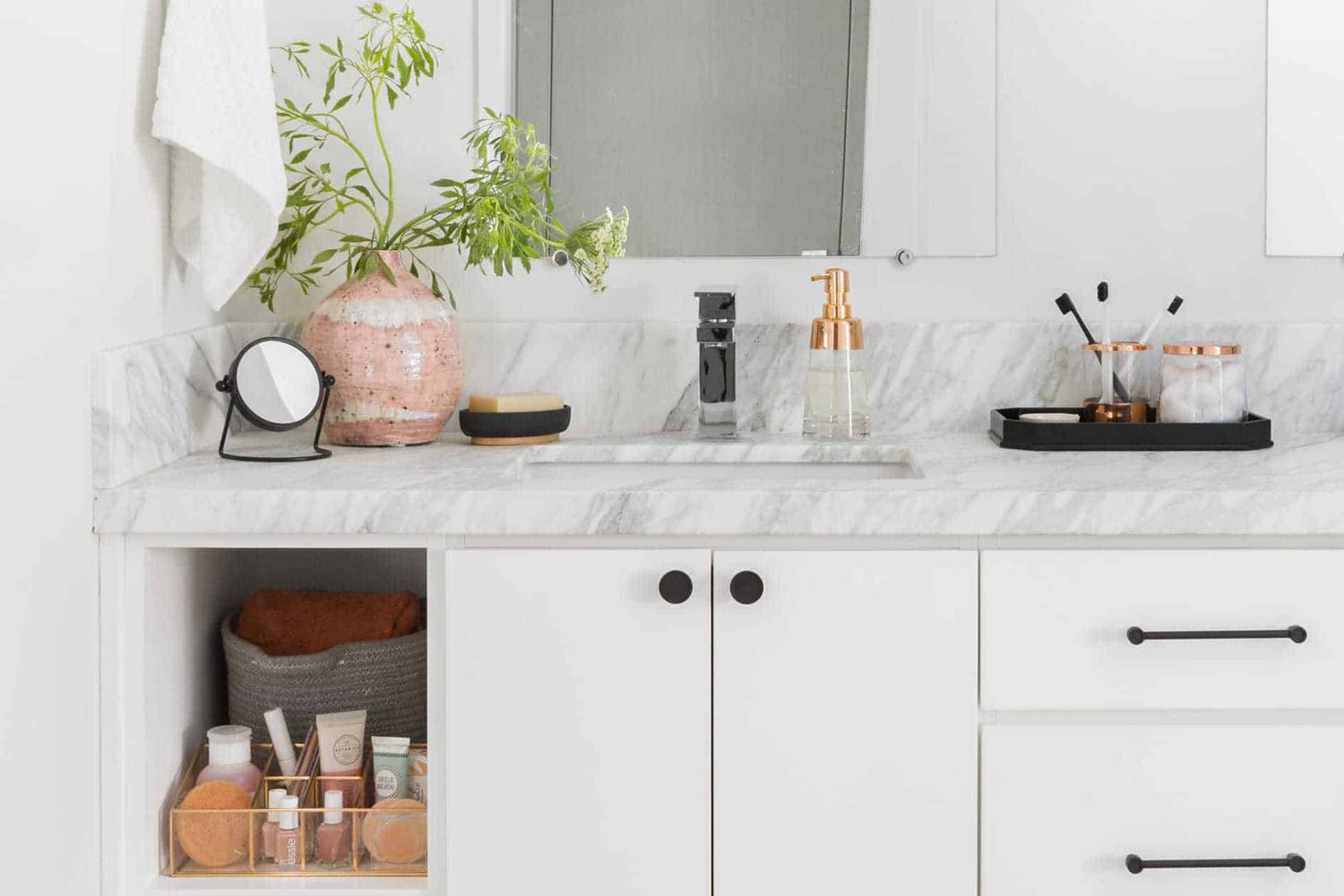
Replacing cabinet pulls and knobs is the fastest, cheapest, and most visually impactful single upgrade in a bathroom cabinet remodel. New hardware in brushed brass, matte black, or brushed nickel instantly modernizes dated cabinets without any construction, plumbing, or countertop work. A full set of pulls and knobs for a standard bathroom vanity costs $30 to $150 depending on the finish and manufacturer. The installation requires only a screwdriver and 30 minutes. No other bathroom upgrade delivers that much visual change for that little money and time.
It is cheaper to reface bathroom cabinets than to replace them in nearly every scenario. Refacing costs 40 to 60% less than full cabinet replacement because the labor-intensive steps of demolition, plumbing disconnection, wall repair, and new cabinet installation are eliminated entirely. The existing cabinet box stays mounted to the wall. New doors and drawer fronts attach to the existing box. A new veneer or laminate covers the visible exterior surfaces of the box to match the new doors.
OptionTypical Cost RangeTimelineBest ForPaint existing cabinets$200 - $6001-2 daysStructurally sound cabinets that need a color refreshReface (new doors + veneer)$1,000 - $3,0002-4 daysGood cabinet boxes with outdated door style or finishReplace with stock vanity$500 - $1,500 + labor1-3 daysDamaged boxes, wrong size, or complete style changeReplace with semi-custom$1,500 - $4,000 + labor3-6 weeks (lead time)Non-standard dimensions, specific storage needsReplace with custom$5,000+ including labor6-10 weeks (lead time)Exact sizing, premium materials, full customization
Refacing makes the most financial sense when the existing cabinet boxes are structurally sound, level, and properly secured to the wall. Cabinets with water damage at the base, warped shelves, or delaminating particleboard panels need replacement rather than refacing because the structural problems will persist behind the new doors. A quick test is to open the cabinet, press firmly on the bottom panel and shelf edges, and check for soft spots, swelling, or flexing. Solid plywood boxes typically survive decades of bathroom humidity and reface well. Particleboard boxes in bathrooms with poor ventilation often deteriorate within 10 to 15 years and benefit more from full replacement with a bathroom vanity built from moisture-resistant materials.
Spend on the components that affect daily function, long-term durability, and the overall visual quality of the finished bathroom: soft-close hardware, quality cabinet pulls, a durable countertop, professional plumbing connections, and moisture-resistant cabinet material. These five areas deliver returns that outlast cosmetic upgrades by years.
Soft-close hinges and drawer slides prevent cabinet doors and drawers from slamming shut. Soft-close mechanisms use a hydraulic damper that slows the door or drawer during the last two inches of travel, producing a quiet, controlled close every time. Upgrading from standard hinges to soft-close hinges costs $3 to $8 per hinge, and a typical bathroom vanity has 4 to 8 hinges. The total cost of a full soft-close upgrade on a standard vanity runs $25 to $65 for the hardware itself. Soft-close hardware also protects the cabinet from the daily impact stress that standard slamming hinges produce. Over years of use, that impact stress loosens screws, cracks door edges, and weakens joints. Soft-close mechanisms eliminate that stress entirely, extending the cabinet's functional life by years. Buyers notice soft-close hardware immediately when touring a home, and its presence signals quality throughout the bathroom.
Cabinet pulls and knobs set the visual tone of the entire vanity. Cheap, lightweight hardware with visible seams and hollow construction makes even expensive cabinets look budget-grade. Solid pulls and knobs in brushed brass, matte black, or satin nickel feel substantial in the hand, resist daily wear, and photograph well for resale listings. Spending $5 to $15 per pull instead of $1 to $3 per pull produces a noticeable difference in weight, finish quality, and long-term durability. The total upgrade cost for a standard vanity is $40 to $120, a small investment that changes how the entire cabinet reads visually.
The countertop sits directly on top of the vanity and receives more daily contact than any other surface in the bathroom. Hands, water, soap, toothpaste, and cleaning products all land on the countertop multiple times a day. Quartz countertops resist staining, scratching, and moisture penetration better than laminate or cultured marble, and 39% of homeowners now choose quartz for bathroom countertops according to industry data from Houghton Contracting. Quartz costs $50 to $100 per square foot installed, compared to $10 to $40 per square foot for laminate. The higher upfront cost of quartz pays back in durability, appearance retention, and resale value over a 15-to-20-year lifespan that laminate cannot match.
Professional plumbing installation protects every other investment in the bathroom. A leaking supply line or improperly sealed drain connection behind the vanity wall causes water damage that destroys cabinets, flooring, and drywall. The cost of hiring a licensed plumber to connect supply lines and drain pipes during a vanity installation is a fraction of the repair cost when those connections fail. Water damage behind a custom bathroom cabinet wall often goes undetected for months, causing mold growth, structural rot, and repair bills that exceed the original remodel cost entirely.
Bathroom cabinets face more moisture exposure than cabinets in any other room. Steam from the shower, splashed water from the sink, and humidity from daily use all contact the cabinet surfaces repeatedly. Plywood cabinet boxes resist this moisture far better than particleboard, which absorbs water at exposed edges and swells irreversibly. Spending more on plywood construction at the time of purchase prevents the need to replace swollen, delaminated cabinets five to ten years later. For homeowners in humid climates like North Alabama, we recommend reviewing vanity material options carefully before making a final selection, because the wrong material in a humid bathroom is the most expensive "savings" a homeowner can make.
Update bathroom cabinets without replacing them by following these six steps in order, starting with the lowest-cost changes and building toward higher-impact upgrades as the budget allows.
These six steps, completed in sequence over a weekend, cost $300 to $800 total depending on the size of the vanity and the quality of paint and hardware selected. The result looks like a professionally remodeled vanity to anyone who did not see the "before" version.
Make a cheap bathroom look expensive by focusing on three high-visibility details: consistent hardware finishes, quality lighting, and a clutter-free countertop. These three elements control more of the bathroom's perceived quality than the cabinet material or tile pattern.
Consistent hardware finishes across the faucet, cabinet pulls, towel bar, and light fixture create a coordinated look that signals intentional design. A bathroom where the faucet is chrome, the cabinet pulls are brushed nickel, the towel bar is oil-rubbed bronze, and the light fixture is polished brass looks disjointed regardless of how much each individual piece cost. Choosing one finish family and repeating it across all visible metal elements makes the entire bathroom feel cohesive and considered.
Quality lighting lifts the perceived value of every surface in the room. A single overhead fixture produces flat, shadowless light that makes even premium materials look dull. Adding a pair of sconces flanking the mirror provides task lighting that flatters the face, illuminates the vanity evenly, and adds a layer of warmth that overhead light alone cannot create. LED sconces in a warm-white color temperature (2700K to 3000K) deliver the most flattering and expensive-looking light at a low energy cost.
A clutter-free countertop makes the bathroom feel larger, cleaner, and more organized. Limiting the counter to two or three items, such as a soap dispenser and a small tray, signals restraint and intentional design. Storing everything else inside the vanity keeps the surface open and the room visually calm. Homeowners who invest in well-organized custom closets and bathroom vanities with divided drawers find that keeping counters clear becomes automatic rather than effortful.
A bathroom looks dated when it features builder-grade hardware, honey-toned oak cabinets, brass fixtures from the 1990s, a single overhead light, and a cluttered countertop. These five elements together communicate "original builder install" more than any single material or color choice.
The fix does not require a full remodel. Painting the oak cabinets white or soft gray eliminates the dated wood tone instantly. Replacing the old brass hardware with matte black or brushed nickel pulls updates the entire vanity. Swapping the single overhead light for a pair of wall sconces adds the layered lighting that modern bathrooms use. Clearing the countertop and adding one or two coordinated accessories, like a matching soap dispenser and a small plant, replaces visual chaos with intentional design. These changes cost under $500 total and convert a bathroom that feels like 2005 into one that feels current. The home value impact of an updated bathroom is significant. Midrange bathroom remodels deliver 70 to 85% return on investment at resale, according to the 2025 Zonda Cost vs. Value Report, and even minor cosmetic refreshes increase buyer interest by making the bathroom photograph better for online listings.
The most common bathroom cabinet remodel mistakes are skipping waterproofing behind the vanity, choosing the cheapest cabinet material available, cutting costs on plumbing labor, ignoring ventilation, and not budgeting a 10 to 15% contingency for unexpected issues.
Skipping waterproofing behind the vanity backsplash allows water to seep into the wall behind the cabinet, causing hidden mold growth and structural damage that does not become visible until the repair cost far exceeds the original waterproofing investment. Choosing the cheapest particleboard vanity saves $200 to $400 upfront but creates a cabinet that swells, warps, and delaminates within a few years in a humid bathroom environment. Cutting costs on plumbing labor by hiring unlicensed help or attempting DIY connections risks leaks that damage the new vanity, the flooring beneath it, and the wall behind it.
Ignoring ventilation is one of the most consequential and overlooked mistakes. An undersized or poorly positioned exhaust fan allows moisture to collect on cabinet surfaces, inside drawers, and behind closed doors. Over time, that moisture degrades wood finishes, loosens adhesives, and promotes mold. Upgrading to a properly rated exhaust fan sized to the bathroom's cubic footage costs $150 to $400 installed, according to Reico Kitchen and Bath, and protects the cabinets, walls, and ceiling from long-term moisture damage.
Not budgeting a contingency means any surprise during demolition, such as water damage behind the old vanity or outdated plumbing that does not meet current code, forces a choice between fixing the problem with money that was already allocated elsewhere or leaving the problem in place behind the new cabinets. Setting aside 10 to 15% of the total budget as contingency before the project begins prevents that costly decision. Avoiding these mistakes starts with planning the project carefully with the help of an experienced cabinetmaker who understands the specific demands of bathroom construction.
The least expensive way to remodel a bathroom is to keep the existing layout, paint the current cabinet boxes and doors, replace the hardware with modern pulls and knobs, upgrade to soft-close hinges, and replace the countertop with a durable material like quartz or solid surface. This approach avoids plumbing, demolition, and new cabinet installation costs entirely while producing a dramatic visual update for $500 to $2,000 depending on the countertop material selected.
DIY bathroom remodel ideas on a budget include painting cabinets with moisture-resistant paint, replacing pulls and knobs, installing a new mirror, adding wall-mounted shelves for storage, replacing the light fixture with LED sconces, and adding peel-and-stick backsplash tile behind the vanity. These projects require basic tools, no plumbing or electrical changes, and can be completed over a weekend. Professional help is recommended for any work involving water connections, electrical wiring, or waterproofing.
Budget-friendly ways to upgrade a bathroom include swapping outdated cabinet hardware for modern finishes, painting the vanity a fresh color, replacing the faucet with a water-efficient model, adding a framed mirror to replace a plain builder-grade mirror, installing a new toilet seat, and decluttering the countertop. Each of these changes costs under $200 individually, and combining three or four of them produces a noticeably refreshed bathroom for under $600 total.
The best material for budget bathroom cabinets is plywood with a moisture-resistant finish. Plywood costs more per panel than particleboard but lasts significantly longer in a bathroom's humid environment. For homeowners on the tightest budgets, a stock vanity with a plywood box and MDF doors provides the best balance of affordability and durability. Particleboard vanities cost the least upfront but often need replacement within 5 to 10 years due to moisture damage, making them more expensive over the cabinet's lifetime.
Yes, soft-close hinges add value to a bathroom by signaling quality construction, protecting the cabinet from impact damage, and improving the daily experience of using the vanity. Buyers notice soft-close hardware during home tours, and its presence contributes to the overall perception that the bathroom has been updated with care. The upgrade costs $25 to $65 for a full vanity and takes less than an hour to install on existing bathroom cabinets.
A stock bathroom vanity is the better choice on a strict budget because it delivers a modern appearance, functional storage, and soft-close hardware for $500 to $1,500, compared to $5,000 or more for a custom vanity. Custom vanities make sense when the bathroom has non-standard dimensions, requires specific interior configurations, or needs premium moisture-resistant construction that stock options do not offer. Semi-custom vanities at $1,500 to $4,000 bridge the gap by offering more sizing flexibility than stock at a lower cost than full custom.
A bathroom cabinet remodel on a budget is not about spending less on everything. It is about spending less where it does not matter and spending more where it does. Keep the layout. Reface or paint the boxes. Choose stock or semi-custom when the dimensions allow it. Then direct the savings toward soft-close hinges, quality hardware, a durable countertop, professional plumbing, and moisture-resistant construction. That combination produces a bathroom that looks and functions like a high-end remodel at a fraction of the full replacement cost.
At Classic Cabinetry, we help homeowners make these decisions with clarity, whether the project is a $2,000 cabinet refresh or a complete custom vanity installation. If you are planning a bathroom cabinet remodel and want guidance on where your budget will produce the strongest return, reach out to our team for a free estimate and design consultation.