.png)


.png)




.png)

.png)


.png)
Commercial Kitchen Traffic Flow Optimization
link desc


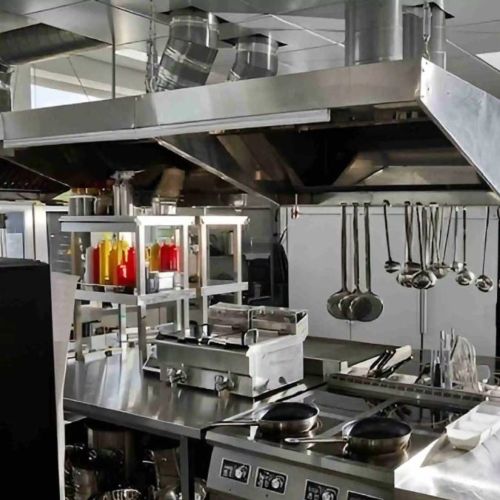
Commercial kitchen traffic flow optimization is the process of designing and arranging a professional kitchen so that food, staff, and dishes move in smooth, logical paths with no wasted steps, no collisions, and no bottlenecks. A well-optimized kitchen flow reduces ticket times, prevents injuries, cuts labor costs, and keeps food quality consistent. According to the National Restaurant Association, U.S. restaurant industry sales are projected to reach $1.55 trillion in 2026, and the restaurants that consistently deliver fast, safe, high-quality service are the ones with itchens built around smart traffic flow. This blog covers the rules, methods, and layout strategies that restaurant owners and commercial builders across North Alabama need to create kitchens where everything moves the way it should.
The flow of a commercial kitchen is the path that food, staff, and equipment follow from the moment ingredients arrive at the back door to the moment finished plates reach the dining room, and then back again as dirty dishes return for washing. A good kitchen flow moves in one direction, like a river, with no currents pushing against each other.
The standard flow follows this sequence: receiving, storage, preparation, cooking, plating and service, and then dishwashing. Each stage feeds into the next without backtracking. The FDA Food Code reinforces this concept by requiring that food move in one direction, from raw to ready-to-eat, to minimize contamination risks. This regulatory requirement also happens to support operational efficiency.
In a busy restaurant in Huntsville, Alabama, poor traffic flow shows up fast. Cooks bump into each other. Servers wait at the pass. Dirty dishes cross paths with clean plates. Orders back up. Stress rises. According to the U.S. Bureau of Labor Statistics, full-service restaurants recorded 93,800 nonfatal injuries and illnesses in 2019, and many of those incidents trace directly to cramped layouts and poor workstation organization.
When the flow works, everything changes. Cooks stay at their stations. Ingredients arrive at the right place at the right time. Plates leave the kitchen hot. And the dishwashing zone never runs dry. Restaurants that invest in commercial cabinetry built for professional kitchens gain a significant advantage because every tool, ingredient, and piece of equipment has a dedicated, accessible home that supports the one-way flow.
The eight stages of workflow in the kitchen are receiving, storage, preparation, cooking, plating, service, dish return, and cleaning. Each stage represents a step in the lifecycle of food and equipment as they move through the commercial kitchen.
Receiving is the first stage. Deliveries arrive at the back door, get inspected for quality and temperature, and move into storage. This area should sit close to the delivery entrance to minimize the distance staff carry heavy boxes. According to food safety best practices, every delivery should be logged into inventory immediately upon arrival.
Storage is the second stage. Ingredients split into dry storage, refrigerated storage, and frozen storage. Proper FIFO (first in, first out) rotation keeps older items up front so they get used first. The USDA reports that bacteria can double every 20 minutes in the temperature danger zone between 40 and 140 degrees Fahrenheit, so cold storage must hold at or below 41 degrees per FDA standards.
Preparation is the third stage. Raw ingredients get washed, chopped, portioned, and organized for the cooking line. This zone needs ample counter space, good lighting, and quick access to cold storage. The National Kitchen and Bath Association recommends a minimum prep countertop of 36 inches wide by 24 inches deep.
Cooking is the fourth stage and the heart of the kitchen. Ranges, ovens, fryers, and grills transform prepped ingredients into finished dishes. Traffic flow around the hot line must be carefully managed because this is where burns, slips, and collisions are most likely to happen.
Plating is the fifth stage. Finished dishes are assembled, garnished, and inspected by the expeditor at the pass. The plating station should sit near the exit to the dining room so plates travel the shortest possible distance to the table.
Service is the sixth stage. Servers pick up finished plates and deliver them to guests. A clear, dedicated pickup area prevents servers from crowding the cooking line.
Dish return is the seventh stage. Used plates, glasses, and silverware come back to the kitchen through a separate path from the food-forward flow. This separation prevents dirty items from crossing paths with clean food.
Cleaning is the eighth and final stage. The dishwashing zone processes all returned items through a one-way system of scraping, washing, drying, and restocking. If this zone backs up, the entire kitchen slows down because cooks and servers run out of clean supplies.
Restaurant owners in the Huntsville metro area who map out all eight stages before construction begins avoid the costly mistakes that come from fitting workflow around equipment instead of the other way around.
The 3x4 kitchen rule is a simplified guideline for kitchen dimensions that states an efficient kitchen needs a minimum of 3 feet of walking space and 4 feet of workflow radius around appliances and work areas. This rule helps designers make sure staff have enough room to move safely and work comfortably at every station.
In commercial kitchens, the 3x4 rule translates to specific aisle width requirements. Industry standards recommend a minimum aisle width of 42 inches for a single cook and 48 inches when multiple cooks share a workspace. These minimums prevent collisions, give staff room to carry hot pans safely, and allow two people to pass each other without turning sideways.
The 3x4 rule is especially important in high-traffic zones like the cooking line and the plating pass. During a dinner rush at a busy Huntsville restaurant, the space between the stove and the prep counter is one of the most heavily traveled paths in the entire building. If that gap is even a few inches too narrow, it creates a bottleneck that slows every ticket.
Cramped aisles do not just slow service. They also increase the risk of burns, slips, and strains. According to data from the Bureau of Labor Statistics, food service workers experience cuts, lacerations, and thermal burns at rates higher than workers in most other private industries. Thermal burns in food service occurred at a rate more than four times the private industry average. Adequate aisle width is one of the simplest and most effective ways to reduce those numbers.
Custom-built cabinetry and storage solutions that are designed to fit the exact dimensions of a commercial kitchen help maintain proper aisle widths. Off-the-shelf cabinets often waste space or protrude into walkways. Custom kitchen cabinets built to precise measurements keep everything flush against walls and under counters, preserving every inch of aisle space.
The best flow for a kitchen is a one-way, linear flow where food moves forward from receiving to storage to preparation to cooking to plating and out to service, while dirty dishes return through a separate path to the dishwashing zone. Food and waste should never cross paths.
This one-way flow principle is sometimes called the "clean to dirty" or "forward only" concept. It means that at no point in the process does food move backward. Raw chicken never passes over a station where salads are being plated. Dirty dishes never travel through the prep area. This separation is the foundation of both food safety and operational speed.
According to a guide published by The Restaurant Warehouse, a better kitchen layout can boost productivity by up to 50 percent. That gain comes from eliminating the wasted steps, detours, and wait times that pile up when traffic patterns conflict with each other.
The best flow also considers vertical movement, not just horizontal paths. Ingredients should move from low storage (floor-level bins) to mid-height prep tables to cooking equipment without requiring staff to bend, stretch, or climb repeatedly. Ergonomic flow reduces fatigue, which is critical in an industry where staff stand for 8 to 12 hours per shift.
For restaurants in Ardmore, Madison, and Decatur that are building new commercial kitchens, establishing the flow pattern before selecting any equipment is the single most important design decision. Every piece of equipment, every cabinet, and every counter should support the forward flow, not interrupt it.
A kitchen should flow from back to front, following the natural progression of food production. Deliveries enter at the back. Ingredients move forward through storage and prep. Cooked food exits at the front through the plating pass to the dining room. Dirty dishes return along the sides or through a separate corridor to the dishwashing zone at the back.
This back-to-front flow creates a natural circuit. Think of it like a racetrack where every car moves in the same direction. When someone tries to drive the wrong way, crashes happen. The same is true in a kitchen. Cross-traffic between clean and dirty paths, or between raw and cooked food zones, creates safety hazards and slows everything down.
The flow should also minimize the number of times staff cross each other's paths. In a well-designed kitchen, a prep cook can work an entire shift without ever stepping into the cooking zone. A dishwasher never needs to walk through the plating area. A server picks up plates at the pass and returns dirty dishes to a separate drop-off window. Each person has their own lane.
According to CDC EHS-Net research, food workers wash their hands only about 1 in 3 times when they should. A layout that naturally separates raw food handling from ready-to-eat zones adds a physical barrier that compensates for human lapses in hygiene practices.
Commercial kitchens across North Alabama benefit from working with cabinetry partners who build storage solutions that support the flow. Custom pantries and cabinetry placed in the right zones keep dry goods organized and accessible without forcing staff to leave their stations.
The 60/30/10 rule for kitchens is a space allocation guideline that recommends dedicating 60 percent of total restaurant square footage to the dining area, 30 percent to the kitchen, and 10 percent to storage, office space, restrooms, and other support areas.
This ratio provides a starting point for restaurant owners who are planning a new build or major renovation. According to a study of 722 restaurants cited by Avanti Restaurant Solutions, the average commercial kitchen is roughly 1,000 square feet, though sizes range from 500 to 1,375 square feet depending on the concept. The 60/30/10 split gives the dining room enough seats to generate revenue while giving the kitchen enough space to produce food efficiently.
Quick-service restaurants often flip the ratio, with the kitchen and storage taking up 55 percent or more of the total floor plan. Ghost kitchens, which serve only delivery and takeout with no dining room, typically operate in spaces as small as 200 to 300 square feet.
For full-service restaurants in Huntsville and across North Alabama, the 30 percent kitchen allocation needs to be used wisely. Every square foot should serve the flow. According to Toast's 2026 restaurant data, the average commercial kitchen supports an operation where the average profit margin for full-service restaurants sits at about 9.8 percent. That thin margin means wasted kitchen space is wasted money.
Smart cabinetry design maximizes the usable area within that 30 percent allocation. Vertical storage, pull-out shelving, and custom-fit cabinets keep ingredients and tools organized without eating into aisle space. Custom laundry room cabinetry principles, built around maximizing storage in tight spaces, apply directly to back-of-house storage areas in restaurants.
The 5S method in the kitchen is a workplace organization system borrowed from lean manufacturing that stands for Sort, Set in Order, Shine, Standardize, and Sustain. It was originally developed as part of the Toyota Production System in Japan, and it has been adopted by restaurants and food service operations worldwide to improve efficiency, safety, and cleanliness.
Sort means removing everything from a work area that is not needed for daily operations. Expired ingredients, broken tools, duplicate utensils, and unused equipment all get removed. A cluttered station slows cooks down and creates hiding spots for contamination.
Set in Order means giving every remaining item a designated place. Knives go in one spot. Seasonings line up in a specific sequence. Pans hang in order of size. According to 5S principles, any item should be findable within 30 seconds.
Shine means cleaning every surface, tool, and piece of equipment until it looks new. This goes beyond wiping down counters. It includes deep-cleaning behind equipment, inside storage bins, and underneath prep tables.
Standardize means creating written procedures and visual guides so every shift maintains the same organization. Photos of the "ideal look" for each station help new employees understand expectations immediately.
Sustain means building the first four steps into daily routines through audits, checklists, and team accountability. According to Food Safety Magazine, over 80 percent of food safety issues in a facility are generally associated with poor Good Manufacturing Practices, which the 5S system directly addresses.
According to Kaizen Institute benchmarks, initiatives focused on standardization and layout improvement typically deliver average productivity increases of 25 to 30 percent. For a restaurant in Huntsville operating on slim margins, that kind of efficiency gain can mean the difference between profit and loss.
Applying 5S to a commercial kitchen starts with the right infrastructure. Purpose-built cabinetry with labeled compartments, dedicated tool storage, and organized shelving makes it far easier to maintain 5S standards day after day.
The four types of workflows in a commercial kitchen are linear (assembly line), circular (island), modular (zone), and parallel (galley). Each type controls how staff and food move through the space, and the right choice depends on the restaurant's menu, size, and service style.
Linear workflow moves food in a straight line from one end of the kitchen to the other. Ingredients enter at one side, pass through prep, cooking, and plating, and exit at the other. This is the fastest workflow for restaurants with limited menus and high volume, like sandwich shops and fast-casual concepts.
Circular workflow uses an island layout where the cooking equipment sits in the center and support stations wrap around the edges. Staff move in a loop around the island. This promotes communication and makes it easy for a head chef to oversee the entire kitchen from one position. It works well for fine dining and chef-driven concepts.
Modular workflow divides the kitchen into zones, each with its own mini workflow. A salad station has its own prep-to-plate path. A grill station has its own storage-to-service path. Each zone operates semi-independently. This works best for restaurants with diverse menus that need separate work areas, like hotel restaurants and catering kitchens.
Parallel workflow uses two facing walls of equipment with an aisle down the middle. Staff work on both sides without wasted steps. This galley-style workflow is the go-to for small kitchens, food trucks, and breweries where floor space is limited.
Many successful restaurants in the Huntsville area use a hybrid approach that combines elements of two or more workflow types. A kitchen might use a linear flow for the hot line and a modular flow for cold prep and pastry. The key is choosing a workflow that matches the menu and testing it on paper before committing to a permanent layout.
The five Ps of cooking are proper planning prevents poor performance. This phrase, borrowed from military and business strategy, applies directly to commercial kitchen operations. Every successful kitchen service starts with thorough preparation long before the first ticket prints.
Proper planning in a kitchen context means completing all prep work before service, stocking every station with the right ingredients and tools, briefing the team on specials and potential challenges, and testing equipment to make sure everything functions correctly. Restaurants that skip the planning stage pay for it during the rush with slow tickets, mistakes, and frustrated staff.
Planning also extends to the physical design of the kitchen. A kitchen that is planned around traffic flow, station placement, and storage access runs smoother from day one than a kitchen where equipment was placed based on what fit rather than what works.
According to a blind survey conducted by Toast, 35 percent of customers are more likely to return if their food hits the table faster. That statistic ties kitchen planning directly to customer loyalty and repeat business, two of the most important drivers of long-term profitability.
For restaurant projects across Huntsville, Decatur, and Ardmore, proper planning includes selecting cabinetry and storage solutions that support the workflow. Custom home office cabinetry principles, built around organizing complex workflows in a compact space, translate directly to the back-office and storage areas of a commercial kitchen.
The five steps of Kaizen are identify waste, analyze the process, develop solutions, implement changes, and standardize improvements. Kaizen is a Japanese word meaning "change for the better," and it is a continuous improvement philosophy that has been applied to commercial kitchens worldwide.
In a restaurant kitchen, waste takes many forms: wasted steps when a cook walks across the kitchen for a common ingredient, wasted time when the dishwasher backs up, wasted food when improper storage leads to spoilage, and wasted labor when two people do a job that one could handle with a better layout.
Analyzing the process means watching how food and staff actually move during a busy service, not how you think they move. Restaurant operators who stand in the kitchen during a Friday night rush and trace the path of a single ticket from order to plate often discover surprising bottlenecks.
Developing solutions might mean moving a reach-in cooler closer to the prep table, adding a second handwashing station near the cooking line, or installing overhead shelving to clear floor space. Each change should directly address a specific waste identified in the analysis.
Implementing changes should be done one at a time so the team can adjust and the impact can be measured. According to Kaizen Institute benchmarks, layout improvements in food operations typically deliver productivity increases of 25 to 30 percent and service level gains of up to 20 percent.
Standardizing improvements means writing down the new process, training the team, and auditing regularly to make sure the gains stick. Without standardization, kitchens tend to drift back to old habits within weeks.
The nine steps of service in a restaurant are greeting, seating, beverage order, menu presentation, food order, food delivery, table check, dessert and final course, and check presentation. Each step depends on the kitchen's ability to produce and deliver food on time.
The kitchen directly controls steps five through seven. When the food order goes in, the kitchen must receive it clearly, fire it on time, plate it correctly, and send it out at the right temperature. If the kitchen traffic flow is optimized, these steps happen seamlessly. If the flow is broken, delays ripple through every remaining step of service.
A slow kitchen does not just affect one table. It creates a cascade of delays across the entire dining room. Servers wait at the pass. Bussers fall behind on clearing tables. The host holds off on seating new guests. One bottleneck in the kitchen can reduce the entire restaurant's table turns for the evening.
According to OysterLink's 2026 industry data, the U.S. restaurant industry is expected to employ 15.9 million people by the end of the year. With that many workers in the industry, the restaurants that run the smoothest operations attract and retain the best talent. Nobody wants to work in a chaotic kitchen where the layout fights against them every shift.
Well-designed commercial kitchens in Huntsville and surrounding areas keep the nine steps of service running on time. The plating pass should be positioned where servers can see it without entering the cooking zone. The expo station needs clear sightlines to every cooking station. And the dish return window should be separate from the food pickup area.
The kitchen cabinet color that is considered most outdated in current design trends is honey oak. While honey oak was extremely popular in the 1990s and early 2000s, it has fallen out of favor in both residential and commercial settings. According to kitchen design trend reports, the shift has moved toward clean whites, warm grays, deep navy, forest green, and natural wood tones with matte or satin finishes.
In commercial kitchens, color choices are less about style and more about function. Stainless steel remains the dominant surface material for cooking equipment and prep tables because it resists bacteria, cleans easily, and meets health code requirements. However, the support areas of a commercial kitchen, including storage rooms, office spaces, and employee areas, benefit from updated cabinetry that looks professional and lasts for years.
Restaurants in Huntsville, Alabama that are remodeling their front-of-house or back-of-house spaces often update cabinetry as part of the renovation. Fresh, modern cabinet finishes create a more professional atmosphere that boosts staff morale and impresses visitors during health inspections. Classic Cabinetry works with business owners across North Alabama to select finishes that are durable, easy to clean, and aligned with current design standards.
The number one rule in any kitchen is cleanliness. Every other rule, from food safety to workflow efficiency, builds on the foundation of a clean workspace. A clean kitchen prevents foodborne illness, reduces injury risk, passes health inspections, and supports consistent food quality.
According to CDC research, contaminated hands account for 9 out of 10 foodborne illness outbreaks where food was contaminated by workers. Handwashing is the single most important hygiene practice in any kitchen. But cleanliness extends far beyond handwashing. It includes sanitized cutting boards, clean floors, grease-free ventilation hoods, organized storage, and properly maintained equipment.
A kitchen designed for easy cleaning supports the number one rule at every turn. Smooth, non-porous surfaces like stainless steel and sealed countertops resist bacterial growth. Adequate spacing between equipment allows staff to clean behind and underneath machines. Proper drainage prevents standing water. And organized storage keeps ingredients off the floor and in sealed containers.
CDC EHS-Net research found that 1 in 7 restaurants stored food in refrigerators above the FDA-mandated 41 degrees Fahrenheit. That kind of lapse is often the result of cluttered, disorganized storage where temperature checks get skipped. Good cabinetry and shelving make it easier to maintain organized cold storage zones where temperature logs are visible and accessible.
For commercial kitchens in the Huntsville area, investing in durable, easy-to-clean cabinetry from the start pays dividends in labor savings, health inspection scores, and food safety. Custom bathroom cabinets, designed to withstand moisture and daily cleaning, use the same durability principles that apply to commercial kitchen storage.
The golden rule in the kitchen is the work triangle principle, which positions the three most-used areas, the cooking zone, the cleaning zone, and the storage zone, in a triangular layout to minimize wasted movement. Each side of the triangle should measure between 4 and 9 feet, with the total perimeter between 13 and 26 feet.
This concept was developed at the University of Illinois School of Architecture in the 1940s. In residential kitchens, the triangle connects the stove, sink, and refrigerator. In commercial kitchens, the golden rule applies at each individual station. The grill cook's triangle connects the cooler, cutting board, and grill. The saute cook's triangle connects the lowboy, prep area, and range.
According to kitchen workflow experts, the path between the three points of the triangle should be unobstructed. If a cook has to cross another station's traffic path to complete one cycle, that is a design flaw that will cause problems during peak volume.
Many modern commercial kitchen designers layer the golden triangle concept with zone-based planning, creating multiple small triangles within a larger zoned kitchen. This hybrid approach gives restaurants the best of both worlds, station-level efficiency and whole-kitchen organization.
You optimize traffic flow in an existing commercial kitchen by auditing current movement patterns, identifying bottlenecks, eliminating cross-traffic conflicts, and making targeted changes to equipment placement, storage locations, and station assignments.
Start by watching a full service from beginning to end. Stand in a spot where you can see the entire kitchen and note every time a staff member has to wait, detour, or squeeze past another person. These friction points are the targets for optimization.
Common fixes include moving a reach-in cooler closer to the station that uses it most, adding a second handwashing station in a high-traffic zone, replacing bulky equipment with compact alternatives, installing overhead or wall-mounted storage to free up floor space, and creating a dedicated path for dish return that does not cross the food-forward flow.
According to ContekPro's commercial kitchen workflow guide, industry standards recommend a minimum of 48-inch aisles to allow two staff members to pass safely. If any aisle in the kitchen falls below that width, it is a bottleneck waiting to happen during a busy service.
Even small changes can produce big results. Rearranging a single prep table or adding a wall-mounted shelf can eliminate a bottleneck that has been slowing tickets for years. The key is making changes based on observed data, not assumptions.
Restaurants in Huntsville, Madison, and Decatur that are renovating existing kitchens benefit from working with custom cabinetry experts in Huntsville, Alabama who can build storage and shelving that fits the exact dimensions of the space, maximizing usable area without sacrificing aisle width.
The seven personal hygiene practices in the kitchen are handwashing, wearing clean uniforms, using hair restraints, avoiding bare-hand contact with ready-to-eat food, keeping fingernails short and clean, removing jewelry before handling food, and staying home when sick.
Handwashing tops the list because it is the most effective defense against cross-contamination. According to CDC research, handwashing can reduce diarrheal disease deaths by up to 50 percent. In commercial kitchens, hands must be washed after handling raw meat, after touching the face or hair, after using the restroom, and before switching between tasks.
Kitchen traffic flow directly supports hygiene practices. When handwashing stations are placed at the entrance to every major zone and at every transition point in the workflow, staff are far more likely to wash their hands at the right times. A kitchen where the nearest sink is 30 feet away is a kitchen where hands do not get washed often enough.
According to a study published by CDC, only about 1 in 4 food workers wash their hands after handling raw meat. That statistic underscores why kitchen design, not just training, is essential for food safety. The physical layout should make the right behavior the easy behavior.
The 2 2 2 rule for food is a simplified guideline for managing leftovers. It states that leftover food should be stored within 2 hours of cooking, can be kept in the refrigerator for up to 2 days, and can be stored in the freezer for up to 2 months. This rule helps both home cooks and restaurant workers remember safe food storage timelines.
In commercial kitchens, the FDA Food Code has more specific requirements. Cooked food must cool from 135 degrees to 70 degrees within 2 hours, and then from 70 degrees to 41 degrees within an additional 4 hours, for a total cooling window of 6 hours. According to CDC research, 504 foodborne illness outbreaks over a 10-year period were caused by food that was cooled too slowly.
Kitchen traffic flow supports proper cooling by placing blast chillers and ice bath stations near the cooking zone. When a cook finishes a large batch of soup or sauce, the cooling equipment should be just steps away, not on the other side of the kitchen. This proximity makes it easy to start the cooling process immediately rather than leaving hot food sitting at dangerous temperatures.
Organized storage with clear labeling and date marking also supports the 2 2 2 rule. When every container in the walk-in cooler is labeled with the item name and the date it was prepared, staff can quickly identify what needs to be used first and what has expired. Custom closet systems that use labeled compartments and organized sections apply the same organizational principles that commercial kitchens need in their storage zones.
Sources: ContekPro, TouchBistro, Restaurant Technologies, Toast
Traffic flow affects food safety in a commercial kitchen by controlling where raw and cooked foods travel, preventing cross-contamination, and making handwashing stations accessible. According to the FDA Food Code, food should flow in one direction from raw to ready-to-eat to minimize contamination risks. A kitchen in Huntsville, Alabama that separates its raw meat prep zone from its salad station with clear traffic lanes is far less likely to face a cross-contamination incident than one where these areas share the same path.
The biggest mistake in commercial kitchen traffic flow design is placing equipment before mapping the workflow. Many restaurant owners start by choosing appliances and then try to fit the traffic pattern around them. This approach creates bottlenecks, dead zones, and cross-traffic conflicts that cost time and money for the life of the kitchen. Industry experts recommend mapping the full eight-stage workflow on paper first, drawing arrows for every movement of food and staff, and only then selecting equipment that supports the flow.
Aisles in a commercial kitchen should be at least 42 inches wide for a single cook and 48 inches wide when multiple staff share the workspace. These industry-standard minimums allow two people to pass safely, give staff room to carry hot pans, and meet ADA accessibility requirements. Restaurants in the Huntsville and Ardmore areas that maintain proper aisle widths see fewer injuries and faster service during peak hours.
Yes, you can improve traffic flow without a full kitchen remodel by making targeted changes to equipment placement, storage locations, and workstation assignments. Moving a prep table closer to the cooking line, adding wall-mounted shelving to free up floor space, or creating a dedicated dish return path can eliminate major bottlenecks at a fraction of the cost of a full renovation. Many restaurants in Decatur and Madison have improved their ticket times simply by reorganizing storage and adding custom-built cabinetry that fits their exact space.
Kitchen traffic flow impacts staff retention because a poorly designed kitchen creates physical strain, frustration, and safety hazards that drive employees away. According to data from Toast, the average cost of replacing a restaurant employee is $5,864 per person. A kitchen that is designed for smooth movement, adequate spacing, and logical station placement reduces fatigue and stress, which keeps experienced cooks and prep staff on the team longer.
Cabinetry plays a critical role in commercial kitchen traffic flow by keeping tools, ingredients, and supplies organized and accessible at each station. Purpose-built commercial cabinetry fits flush against walls and under counters, preserving aisle width. It uses vertical space efficiently, keeping the floor clear for foot traffic. And it provides labeled, compartmentalized storage that supports the 5S organizational system. Restaurants in North Alabama that invest in durable, custom cabinetry from the start avoid the clutter and disorganization that slow kitchens down.
Yes, health inspectors evaluate the physical layout of a kitchen as part of their inspection. They check for proper separation between raw and ready-to-eat food zones, adequate handwashing station placement, sufficient aisle width for safe movement, and clear paths for waste disposal. A kitchen with optimized traffic flow is far more likely to pass inspection with a high score. According to CDC research, restaurants with certified food safety managers have fewer outbreaks and better inspection scores.
Commercial kitchen traffic flow optimization is not a luxury. It is the foundation of every fast, safe, and profitable restaurant operation. From the eight stages of workflow to the golden triangle, from the 5S method to proper aisle width, every detail of the kitchen layout should serve one goal: keeping food, staff, and dishes moving in smooth, logical paths with no wasted steps.
With Huntsville's dining scene growing rapidly, including a $240 million retail and restaurant development approved in late 2025, the competition for customers is only getting stronger. The restaurants that win will be the ones with kitchens built for speed, safety, and consistency.
Whether you are building a new commercial kitchen in Huntsville, renovating an existing space in Decatur, or opening a restaurant in Ardmore, the right cabinetry makes every zone work better. Classic Cabinetry has over 44 years of experience building durable, custom solutions for businesses across North Alabama. Their commercial cabinetry services are designed for the demands of restaurant kitchens, retail spaces, and professional environments. Call (256) 423-8727 today to schedule a free estimate and take the first step toward a kitchen that flows the way it should.