.avif)


.avif)


.avif)
Best Custom Closet Accessories You Did Not Know You Needed
link desc
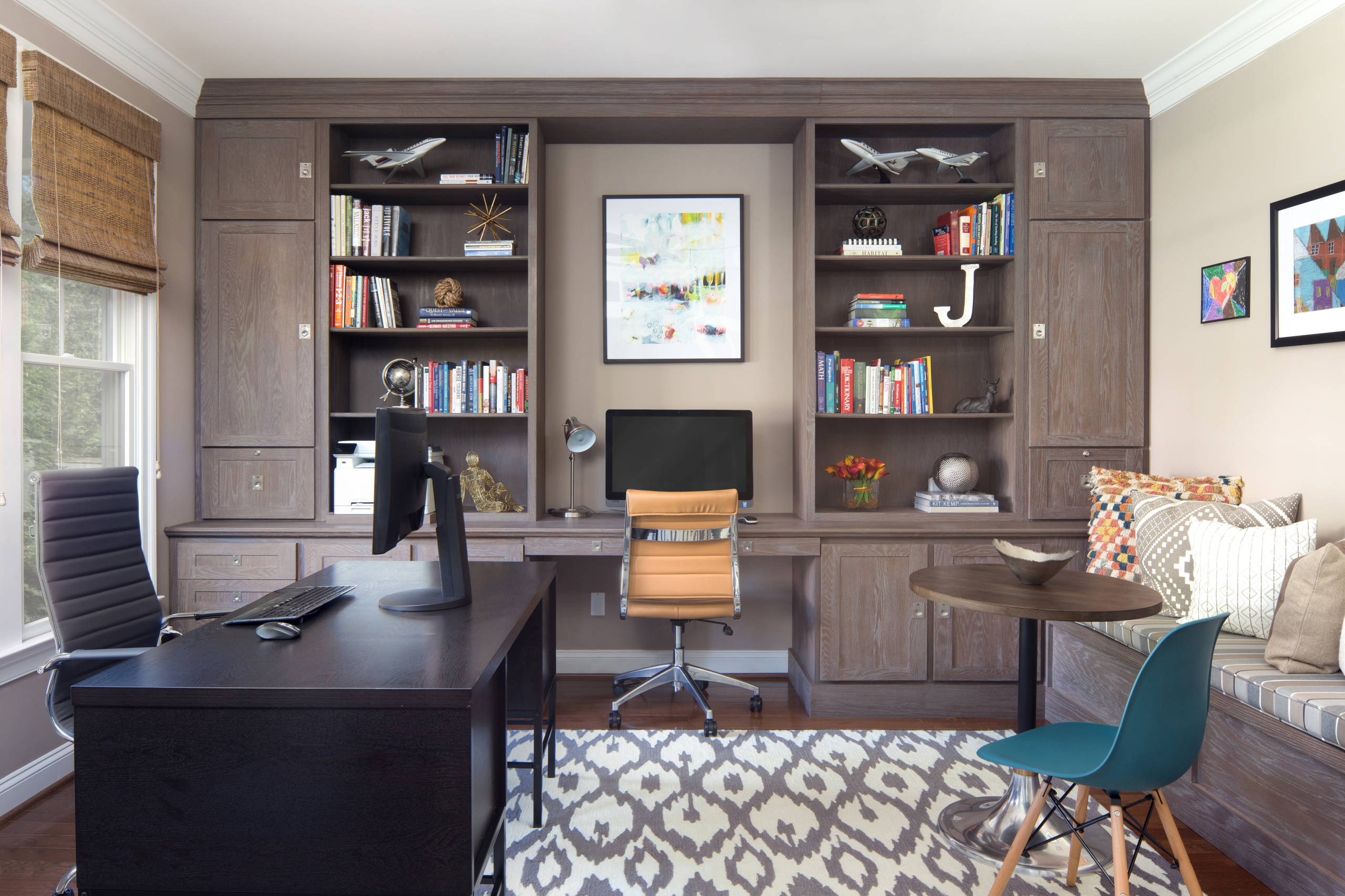


A built-in desk is better for a home office when you need maximum storage, integrated cable management, and a permanent workspace that adds value to the home. A freestanding desk is better when you need portability, a lower upfront cost, or the ability to rearrange the room. The U.S. Census Bureau reports that 34.6 million Americans teleworked in August 2025, and Gallup data shows 52% of remote-capable workers now operate on hybrid schedules. That workforce needs home offices that function as well as corporate ones, and the desk is the centerpiece of every layout. This guide compares built-in and freestanding desks on storage, cost, resale value, dimensions, and materials so you can choose the option that fits your room and your work style.
A built-in desk is a custom work surface permanently attached to the wall, floor, or surrounding cabinetry, while a freestanding desk is a standalone furniture piece that sits on the floor independently and can be moved to any location. Built-in desks become part of the room's architecture. Freestanding desks remain separate furniture.
Built-in desks integrate with wall-mounted cabinets, file drawers, and shelving to create a unified workstation where every component connects. Cable management channels route through the desk surface and down the cabinet interior, keeping wires invisible. Home office cabinetry that includes a built-in desk treats the desk, storage, and display shelving as a single system designed around the room's exact measurements.
Freestanding desks arrive as finished products that sit on the floor under their own weight. They connect to nothing. Storage comes from the desk's own drawers, a separate filing cabinet, or standalone bookcases placed nearby. The desk and its storage occupy different pieces of furniture, which creates gaps between components and leaves cables exposed between the desk, the wall outlet, and the peripherals.
The pros of a built-in desk are superior storage capacity, seamless cable management, space efficiency, ergonomic customization, and increased property value. The cons are higher upfront cost, permanent placement, and longer lead time for design and installation.
Built-in desks maximize storage because shelving, drawers, and file cabinets integrate directly into the same structure. A single wall of built-in cabinetry with an integrated desk can hold what would take three or four separate freestanding pieces to match. Workplace studies cited by Meet&Co found that organized environments improve focus by up to 40%, and a built-in desk with everything in one place creates that organized environment by default.
The cons center on permanence and cost. A built-in desk does not move with you when you sell the house. The design and installation process takes weeks rather than the hours a freestanding desk requires. Custom built-in desk systems require professional measurement, fabrication, and installation, which adds labor cost that freestanding furniture does not carry. Kitchen-to-office cabinet conversions sometimes reduce cost by repurposing standard cabinet dimensions for desk applications, which shortens lead time without sacrificing the built-in look.
The pros of a freestanding desk are lower cost, immediate availability, portability, and a wide range of styles. The cons are limited storage, exposed cables, gaps against walls, and no impact on property value.
Freestanding desks range from $200 for a basic writing desk to $2,000 for a premium executive model. You can purchase one today and set it up tonight. Renters, frequent movers, and homeowners who plan to sell within a year benefit from the portability because the desk leaves with them. Bravo London, a UK custom furniture firm, confirms that freestanding desks have "no direct impact on property value" because buyers do not consider removable furniture a permanent home feature.
The storage limitation is the freestanding desk's biggest weakness. A standard freestanding desk includes two to four drawers, which hold office supplies, a few files, and little else. Binders, reference books, printers, and bulk supplies need separate bookcases, filing cabinets, or wall shelves. Each additional storage piece takes up floor space that a built-in desk would capture inside its own structure. Built-in bookshelves flanking a freestanding desk add vertical storage but still leave the desk disconnected from its surrounding storage, creating the gap that built-in desks eliminate.
A built-in desk wins on storage, cable management, space efficiency, and resale value, while a freestanding desk wins on cost, flexibility, speed of setup, and portability.
FeatureBuilt-In DeskFreestanding DeskStorage CapacityCustom-designed, integrated cabinets and shelvingLimited to desk drawers; requires separate storageCable ManagementGrommets, channels, hidden outlets built into structureExposed cables between desk and wallSpace EfficiencyFills exact wall dimensions with zero gapsLeaves gaps between desk and wallsCost$3,000-$15,000+ depending on size and materials$200-$2,000 for most modelsPortabilityPermanent; stays with the houseMoves with youCustomizationFully custom dimensions, materials, finishesLimited to available sizes and stylesResale ValueAdds perceived value as permanent upgradeNo impact on property valueSetup Time2-6 weeks (design through installation)Same dayBest ForHomeowners, permanent offices, small roomsRenters, frequent movers, temporary setups
Sources: Bravo London (value comparison, storage capacity), Meet&Co (ergonomic standards: 28-30" desk height), Houzz (desk dimensions: 48-72" wide, 24-36" deep), HomeAdvisor (custom cabinetry cost ranges)
A built-in desk costs $3,000 to $15,000 or more depending on size, materials, and the amount of integrated cabinetry, while a freestanding desk costs $200 to $2,000 for most residential models. The price gap reflects the difference between custom fabrication and mass production.
Built-in desk cost breaks down into three layers: material (plywood, solid wood, laminate, or quartz surface), labor (design, fabrication, finishing, installation), and hardware (drawer slides, hinges, cable grommets, LED lighting). A simple wall-mounted floating desk with two flanking file cabinets sits at the lower end. A full-wall built-in with floor-to-ceiling shelving, an L-shaped desk, closed cabinets, and integrated lighting occupies the upper end. The global office furniture market is projected to reach USD 99.58 billion by 2032, according to Grand View Research, driven largely by the home office segment where built-in solutions are gaining market share over freestanding alternatives.
Yes, a built-in desk adds home value because buyers and appraisers classify it as a permanent, functional improvement rather than removable personal property. The Angi 2025 Home Report found that homes with custom built-in storage sell 20% faster and command 10% to 15% higher prices than comparable homes without built-ins. A 2025 Angi homeowner survey confirmed that 72% of buyers ranked built-in storage among the top three features influencing their purchase decision.
A freestanding desk, regardless of quality or cost, adds zero appraised value because it leaves with the seller. A built-in desk stays with the house and communicates to buyers that the home includes a dedicated, professionally finished workspace. Remote workers in north Alabama and across the country now evaluate home offices with the same scrutiny they apply to kitchens and bathrooms. Home value increases most when the built-in desk system uses quality materials and matches the home's overall finish level.
The best depth for a built-in desk is 24 inches for basic computer work and 30 inches for dual-monitor setups or tasks that require reference materials spread in front of the screen. Houzz's key measurements guide confirms that standard desk depths run 24, 30, and 36 inches, with 24 inches serving as the minimum for comfortable laptop use and 30 inches preferred for external monitors.
A 24-inch-deep built-in desk places the monitor at approximately 20 to 22 inches from the user's eyes, which falls within the ergonomic standard of 20 to 26 inches. A 30-inch depth pushes the monitor to 24 to 26 inches and leaves room for a keyboard, a mouse pad, and a writing area between the keyboard and the monitor. Built-in desks can be set to any custom depth because the cabinetmaker cuts the surface to the room's exact requirements. Office cabinets that support the desk surface should match or sit slightly inside the desk depth to create a flush or recessed front edge.
The best material for a built-in desk surface is 3/4-inch hardwood plywood with a durable laminate or lacquer finish for painted desks, and solid hardwood (maple, walnut, or white oak) for stained desks that showcase natural grain.
Built-in desk surfaces need to resist scratches from keyboards and mouse pads, support the weight of monitors and equipment, and maintain a flat profile over years of daily use. The most popular surface materials for built-in desks include:
Kitchen cabinets use the same laminate and quartz surfaces for countertops, and the durability performance translates directly to desk applications.
Pick a desk for a home office by evaluating five factors in order: room dimensions, storage needs, daily work tasks, budget, and whether the home is owned or rented. Each factor narrows the choice between built-in and freestanding.
The decision checklist follows this sequence:
Cabinet Corp reports that 78% of homeowners say improved storage is their top priority in home remodels. A built-in desk with integrated cabinetry satisfies that priority in the office the same way custom closets satisfy it in the bedroom and kitchen cabinets satisfy it in the kitchen.
Yes, you can add a built-in desk to an existing room without structural modification by building a cabinet-and-desk unit that attaches directly to wall studs. The unit sits against the wall, and face frames, crown molding, and baseboard close the seams to create a flush, built-in appearance. No wall demolition is required for surface-mounted built-in desk systems.
The installation requires identifying stud locations, securing a mounting cleat to the wall, and attaching the desk and cabinet components to the cleat and studs. Electrical outlets can be relocated or added behind the desk surface for power access. A built-in office desk system installed against an existing wall transforms a blank bedroom or spare room into a permanent workspace in one to two weeks.
The key consideration is ensuring the room still qualifies as a bedroom after the built-in is installed, if bedroom count matters for resale. A built-in desk along one wall does not reduce a room below minimum bedroom dimensions in most cases because the desk depth (24-30 inches) occupies a fraction of the room's total area. Garage cabinetry follows the same wall-mount installation method, and the structural approach transfers directly to interior rooms.
The best desk layout for a home office positions the desk so natural light enters from the side, with the user facing or angled toward the door. An L-shaped layout with the desk on one wall and a return on the adjacent wall provides the most work surface in a small room. A straight layout against a single wall works in narrow spaces or closet conversions. Leave at least 36 inches of clearance behind the desk chair for a comfortable push-back zone.
Standing desks offer the benefit of alternating between sitting and standing positions throughout the day, which can reduce back pain and improve circulation during long work sessions. A sit-stand desk with a height range of 26 to 48 inches accommodates both postures. Standing desks are not inherently "better" than seated desks; the benefit comes from movement and posture variation rather than standing alone. Built-in desks can incorporate hidden height-adjustable mechanisms within the cabinetry frame for a sit-stand option that maintains the built-in aesthetic.
Alternatives to a standing desk include a desk riser or converter that sits on top of a standard desk and lifts the monitor and keyboard to standing height, a treadmill pad placed under a standard desk, and a drafting-height stool paired with a 36-inch counter-height desk that allows a semi-standing posture. Each alternative provides posture variation without replacing the desk itself.
Instead of a traditional desk, you can use a wall-mounted floating shelf at 28-30 inches high with a pull-out keyboard tray, a fold-down desk (also called a Murphy desk) that stows flat against the wall when not in use, or a built-in countertop spanning a closet niche or alcove. Each option saves floor space while providing a functional work surface for laptops and light office tasks.
A standing desk makes a measurable difference in reducing sedentary time and alleviating lower back discomfort for workers who sit more than six hours per day. Research published in ergonomic journals shows that alternating between sitting and standing every 30 to 60 minutes reduces spinal compression load and improves energy levels. The difference depends on consistent use; a standing desk used only as a standing desk with no sitting breaks produces its own strain on the legs and feet.
The standard height for a home office desk is 28 to 30 inches from the floor to the top of the work surface, according to Houzz, LOOMLAN, and multiple ergonomic guides. That height accommodates most adults sitting in a standard office chair with elbows at 90 degrees and feet flat on the floor. Users shorter than 5 feet 4 inches or taller than 6 feet 2 inches benefit from an adjustable-height desk or a custom-height built-in set to their specific elbow measurement.
A built-in desk delivers more storage, cleaner cable management, stronger resale value, and a permanent workspace that becomes part of the home's architecture. A freestanding desk delivers lower cost, immediate setup, and the flexibility to move. Homeowners who plan to stay in their house benefit most from a built-in desk system because the investment pays back in daily function and long-term property value. Renters and frequent movers benefit from a quality freestanding desk they can take with them. With 34.6 million Americans working from home and 72% of buyers prioritizing built-in storage, a well-designed home office desk is no longer optional; it is a feature that shapes how you work and how your home sells.
At Classic Cabinetry, we design and build custom built-in desk systems for homeowners across north Alabama and middle Tennessee. If you are ready to create a home office that works as hard as you do, call us at (256) 423-8727 for a free 3D design consultation.