.avif)


.avif)


.avif)
Best Custom Closet Accessories You Did Not Know You Needed
link desc
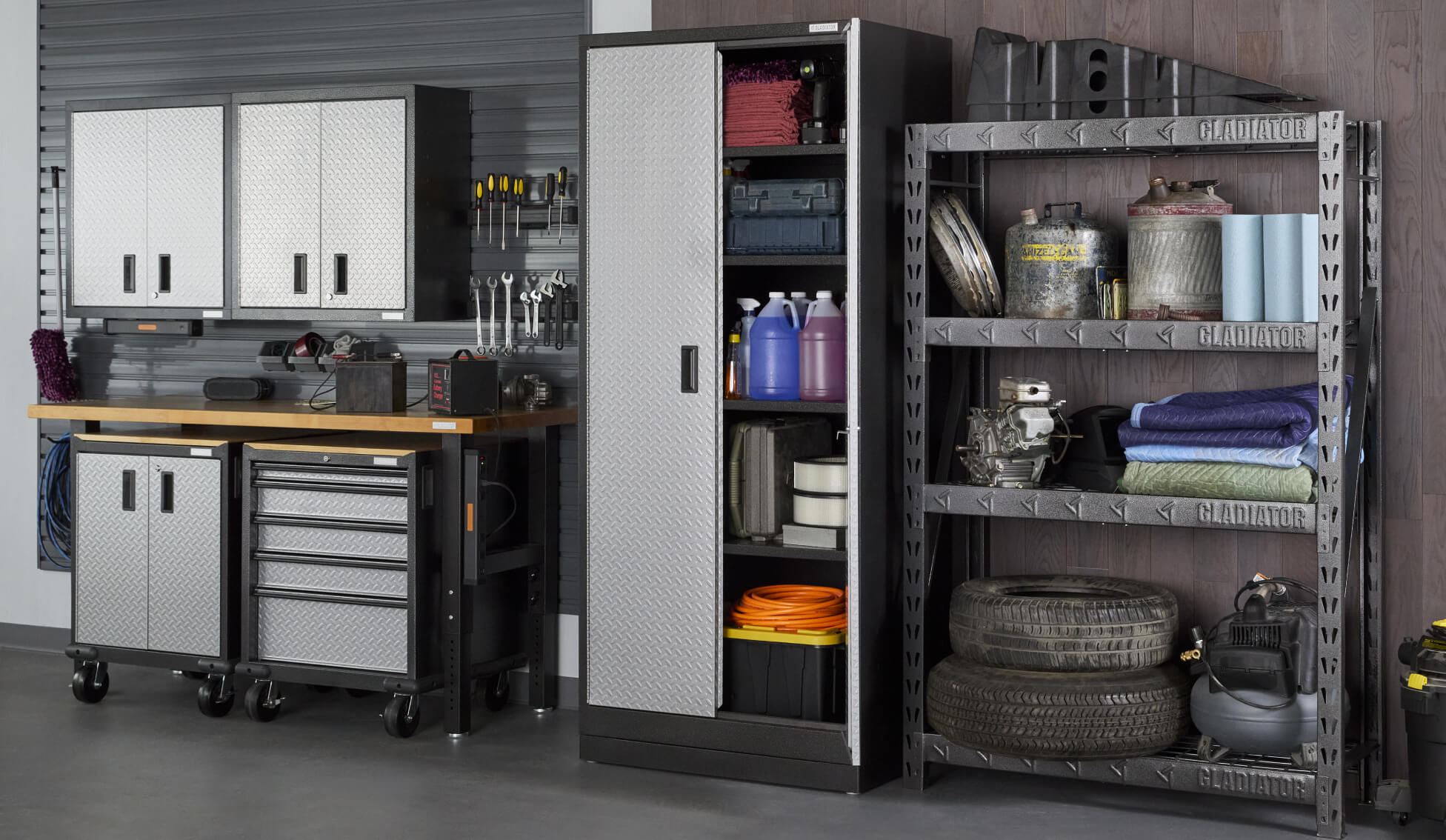


Powder-coated steel and marine-grade plywood are the top-performing materials for garage cabinets exposed to intense heat and high humidity. Steel is non-porous, completely unaffected by moisture or temperature swings, and supports 200 to 400 pounds per shelf when built with 18-gauge construction, according to industry data cited by Garage Kings. Marine-grade plywood uses waterproof adhesive bonding that resists delamination in humid conditions, making it the strongest wood-based option for unconditioned garages. Standard MDF and particleboard absorb moisture rapidly, causing the core to swell, crumble, and sag under weight in humid environments, which makes both materials poor choices for garages without climate control. This blog covers every material option, explains why garages destroy certain cabinet types, and helps you pick the right material for your space.
The best materials for garage cabinets in hot, humid conditions are powder-coated steel, marine-grade plywood, and high-density polyethylene (HDPE) plastic, because all three resist moisture absorption, temperature-driven expansion, and the chemical exposure common in garage environments. Custom garage cabinetry built from these materials holds up for years without warping, rusting, or losing structural integrity. The material you choose determines how long the cabinets last, how much weight the shelves support, and how much maintenance the system requires over its lifespan.
Garages are not indoor living spaces. They sit between the outdoors and the conditioned interior of the home, which means they absorb temperature extremes from both directions. A material that performs well inside a climate-controlled kitchen can fail completely in a garage that reaches 120 degrees on a summer afternoon and drops below freezing on a winter night. Choosing the right material from the start prevents costly replacements and keeps your tools, equipment, and stored items protected.
A garage differs from indoor spaces for cabinetry because it exposes cabinets to temperature swings of 50 degrees or more through the year, humidity levels that regularly exceed safe ranges, chemical fumes from vehicles and stored products, and pest activity that indoor rooms rarely see. According to Builders Surplus, unconditioned garages can swing 50+ degrees Fahrenheit between summer highs and winter lows. That swing causes wood-based materials to expand in heat and contract in cold, producing cracks, warps, and joint failures over repeated seasonal cycles.
The specific challenges break down into four categories:
These four factors together create an environment that is far more demanding than any room inside the home. The material that handles all four factors simultaneously is the material that lasts in a garage. A material that handles only one or two will fail at the weakest point, and that failure usually shows up as swollen edges, sagging shelves, or rust spots within the first two to three years. Homeowners across North Alabama deal with all four challenges because the region combines high summer heat with significant seasonal humidity.
The ideal humidity level for a garage is between 30% and 50%, according to multiple sources including the Department of Energy and Trusscore. At this range, moisture levels stay low enough to prevent mold growth, rust formation, and wood swelling, while avoiding the excessive dryness that can crack certain materials. A study published in the Building and Environment journal found that maintaining garage humidity below 60% reduced the risk of mold growth by over 80% compared to garages with humidity levels consistently above 70%, according to data cited by GarageWorld360.
Most unconditioned garages exceed the 50% threshold regularly, especially during seasonal transitions when warm, humid air meets cool concrete surfaces and produces condensation. Attached garages experience 15-25% less humidity fluctuation than detached structures, according to a Building Science Corporation study, because the adjacent conditioned living space moderates the air. Detached garages and garages with poor insulation face the worst humidity conditions, which is exactly where material choice matters most. Knowing how your garage handles high humidity determines which cabinet material will survive long term.
Powder-coated steel performs best in extreme garage conditions because it is non-porous, completely immune to moisture absorption, unaffected by temperature swings, resistant to chemicals and pests, and capable of supporting the heaviest loads of any cabinet material. Steel does not expand, contract, warp, swell, or crack in response to heat, cold, or humidity. Unlike every wood-based alternative, steel maintains its exact dimensions and structural strength regardless of how extreme the garage environment gets.
The load capacity of steel cabinets far exceeds wood-based options. According to data from Garage Kings, 18-gauge steel shelves hold 200 to 400 pounds per shelf under evenly distributed loads. Heavy-duty 16-gauge models rated for industrial use can support even more. By comparison, entry-level MDF cabinets typically support 50 to 100 pounds per shelf, and that capacity decreases as the material ages, according to Ceha Canada. For homeowners storing heavy power tools, automotive parts, paint cans, and bulk supplies, steel is the only material that handles the weight without shelf deflection over years of use.
18-gauge steel is the best gauge for most residential garage cabinets because it provides enough thickness to hold 200 to 400 pounds per shelf without denting or bowing under load. Steel gauge measures the thickness of the metal sheet. Lower gauge numbers indicate thicker, heavier, stronger steel. According to data from WellWhisk, steel at 0.8mm thickness (approximately 20-gauge) holds 150 to 180 pounds per shelf without noticeable bowing. Thin 20-gauge steel can dent in a busy workshop, according to Garage Kings. Thicker 16-gauge steel, which is approximately 1.5mm, offers the highest strength for very heavy gear but costs significantly more and is typically found in commercial or industrial applications.
The gauge of the steel matters more than the brand name on the cabinet. A 22-gauge cabinet from a premium brand will still dent and bow more easily than an 18-gauge cabinet from a lesser-known manufacturer. When comparing garage cabinets, ask for the gauge specification first. That single number tells you more about the cabinet's long-term performance than any marketing description.
Yes, powder coating prevents rust on garage cabinets by sealing the steel surface with a thick, electrostatically applied finish that is oven-cured at high temperatures to form a hard, continuous barrier against moisture and oxidation. Powder coating is not the same as liquid paint. Liquid paint sits on the surface in a thin layer that can chip, peel, and allow moisture underneath. Powder coating bonds to the steel through an electrostatic charge and then cures in an oven at 350 to 400 degrees Fahrenheit, creating a finish that is thicker, harder, and more resistant to scratches, chips, and chemical contact than any spray-applied paint.
The powder-coated finish is what makes steel practical for garage use. Without it, bare steel would rust within weeks in a humid garage. With a quality powder coat, steel cabinets resist rust, corrosion, and surface damage for 15 years or more under normal garage conditions, according to Ceha Canada. The finish also resists staining from motor oil, gasoline, and cleaning chemicals, which makes powder-coated steel the most maintenance-friendly option for a working garage. Understanding the differences between cabinet finishes helps you evaluate what you are getting at each price point.
Yes, marine-grade plywood is a good alternative for garage cabinets because it uses waterproof phenol formaldehyde (WBP) adhesive between its veneer layers, which prevents delamination in prolonged moisture exposure. Standard interior plywood uses adhesives that break down when exposed to sustained humidity. Marine-grade plywood, manufactured to standards like BS 1088, uses weather-and-boil-proof bonding that holds the veneer layers together even under direct water contact, according to Chesapeake Plywood and Vinawood. This waterproof adhesive is what separates marine plywood from every other wood-based cabinet material in a garage environment.
Marine-grade plywood also uses higher-quality veneers with fewer voids and defects in the core layers. Fewer voids mean fewer weak points where moisture can penetrate and cause internal swelling. The result is a panel that stays dimensionally stable through humidity cycles that would swell, warp, or delaminate standard plywood within a few seasons. A 3/4-inch marine plywood shelf supports 50 to 100+ pounds depending on span length, and it holds that capacity consistently over years because the cross-laminated layers resist the sagging that affects MDF and particleboard under sustained loads.
The tradeoff is cost. Marine-grade plywood is significantly more expensive than standard cabinet-grade plywood, MDF, or particleboard. A 4x8 sheet of marine plywood costs roughly $80 to $150 depending on species and grade, compared to $50 to $90 for standard cabinet-grade birch plywood and $30 to $45 for MDF. For homeowners who want the warmth and workability of wood without the moisture vulnerability of standard materials, marine plywood is the strongest wood-based investment for garage cabinetry. Choosing the right cabinet materials always starts with matching the material to the environment it will live in.
Standard MDF cabinets will not hold up in a hot, humid garage because MDF absorbs ambient moisture rapidly, causing the core to swell, crumble, and sag under weight. MDF (medium-density fiberboard) is manufactured by compressing wood fibers with resin under heat and pressure. The resulting panel has a smooth, uniform surface that takes paint beautifully, but the dense fiber core acts like a sponge when exposed to moisture. Cut edges and unsealed surfaces absorb water especially fast, and once the core swells, the damage is irreversible. Swollen MDF cannot be dried back to its original dimensions.
Moisture-resistant MDF, identified by its green-colored core, performs better than standard MDF in moderately humid environments. The green core contains a moisture-repellent additive that slows water absorption at cut edges and surfaces. Coating moisture-resistant MDF with a melamine laminate or thermofoil layer adds another barrier. Melamine is a heat-fused resin surface that seals the MDF panel against moisture penetration, stains, and abrasion. This combination of moisture-resistant MDF core plus melamine surface is the minimum viable wood-based material for a garage cabinet, and even then, it performs best in garages with some level of climate control or ventilation.
Standard particleboard is worse than MDF in every measurable way for garage use. Particleboard absorbs moisture faster, supports less weight (maxing out at 50 to 75 pounds per shelf, according to Auto-Hydra), and loses structural integrity once the core gets wet. In humid garage conditions, particleboard shelves can sag visibly within the first year and may crumble at fastener points within two to three years. Both standard MDF and particleboard belong in the "materials to avoid" category for any garage that is not fully insulated and climate-controlled.
A moisture proof cabinet is a storage unit built from materials that do not absorb water, swell, warp, or degrade when exposed to sustained humidity, condensation, or direct liquid contact. True moisture-proof performance requires either a non-porous base material (steel, HDPE plastic, stainless steel) or a porous material that has been completely sealed on all surfaces including edges (marine plywood with full edge sealing, melamine-coated MDF). The distinction between "moisture-resistant" and "moisture-proof" matters. Moisture-resistant materials slow water absorption but will eventually fail under prolonged exposure. Moisture-proof materials block water completely and maintain their structure indefinitely.
High-density polyethylene (HDPE) plastic and heavy-duty resin cabinets fall into the moisture-proof category. HDPE is completely waterproof and immune to rot, mold, and chemical damage, according to Acme Plastics. HDPE cabinets handle damp environments easily and never need sealing, painting, or refinishing. The tradeoff is load capacity. HDPE and resin cabinets support lighter loads than steel or plywood, which makes them better suited for storing cleaning supplies, sports equipment, and seasonal items rather than heavy power tools. For laundry room cabinetry and other moisture-heavy utility spaces, the same moisture-proof principles apply.
The comparison table below puts all six common garage cabinet materials side by side across the five performance factors that matter most in a garage: heat resistance, moisture resistance, load capacity, cost, and maintenance demand.
MaterialHeat ResistanceMoisture ResistanceLoad Capacity (per shelf)Relative CostMaintenancePowder-Coated Steel (18 ga.)ExcellentExcellent200 - 400 lbsHighVery LowMarine-Grade Plywood (3/4")GoodHigh50 - 100+ lbsMid-HighLowStandard Cabinet Plywood (3/4")ModerateModerate50 - 100 lbsMid-RangeModerateMelamine-Coated MDFModerateModerate (sealed)50 - 75 lbsAffordableModerateHDPE / Resin PlasticGoodExcellent30 - 60 lbsAffordableVery LowParticleboardPoorPoor50 - 75 lbs (declining)Very LowHigh
The table makes the tradeoffs clear. Steel dominates every performance category except cost. Marine plywood offers the best balance of strength and moisture resistance in a wood-based material. Melamine-coated MDF works in semi-conditioned garages but carries risk in fully unconditioned spaces. HDPE excels at moisture resistance but cannot handle heavy tool storage. Particleboard is the cheapest option but the worst performer in every garage-relevant category, according to data from Garage Kings, GarageLiving, Ceha Canada, and Acme Plastics.
You choose the right garage cabinet material by matching the material's strengths to your garage's specific conditions, including whether the space is insulated, what you plan to store, and how much you are willing to spend upfront versus over the cabinet's lifespan. A fully insulated, climate-controlled garage with a dehumidifier can handle melamine MDF or standard plywood cabinets without problems. An uninsulated, unconditioned garage in a hot, humid climate demands steel or marine plywood to survive long term.
The cost-per-year calculation changes the budget conversation. A powder-coated steel cabinet system that costs $600 and lasts 15+ years costs $40 per year. A melamine MDF cabinet that costs $350 but needs replacement every 4 years in an unconditioned garage costs $87.50 per year, according to the cost-per-year analysis from Ceha Canada. The steel system costs more upfront but less than half as much per year of service. This lifespan math is the strongest argument for investing in steel or marine plywood even when the initial price is higher. The same long-term value thinking applies to commercial cabinetry projects where durability drives the material decision.
Yes, you can use kitchen cabinets in a garage if the cabinet boxes are built from plywood rather than particleboard, and the garage has at least basic insulation or ventilation to control humidity. Quality plywood-box kitchen cabinets are the same construction used in garage-specific cabinetry, and they often cost less than products marketed specifically for garages. The key is confirming that the cabinet boxes are plywood, not particleboard. Particleboard kitchen cabinets will fail in a garage within one to two humidity seasons.
Repurposing kitchen cabinets into a garage setup also gives you access to a wider range of door styles, finishes, and interior accessories than most garage-specific lines offer. A paint-grade shaker-style cabinet looks polished in a garage, provides the same closed storage, and integrates with a workbench countertop the same way base cabinets integrate with a kitchen counter. The cabinet construction is identical. The only difference is the environment, and plywood construction handles that difference.
You protect garage cabinets from moisture by sealing all exposed surfaces, elevating cabinets off the floor, controlling garage humidity with ventilation or a dehumidifier, and avoiding placement against exterior walls where condensation collects. Even the most moisture-resistant materials benefit from these protective steps, and for wood-based cabinets, these steps are the difference between a 10-year lifespan and a 3-year replacement cycle.
Following a consistent cabinet maintenance routine extends the life of any material. Regular inspections of edges, joints, and fastener points catch early moisture damage before it spreads. Wiping down steel cabinets with a damp cloth and mild soap removes chemical residue that can degrade even powder-coated finishes over extended contact periods.
You can tell if garage cabinets are high quality by checking the steel gauge or wood thickness, the joint construction method, the finish type, and the hardware grade. Cheap cabinets cut costs in all four areas, and those shortcuts show up as dents, sagging shelves, rust spots, and broken hinges within the first few years. High-quality garage cabinetry holds up under daily use because the materials and construction methods are built for the environment.
For steel cabinets, look for 18-gauge or thicker steel with fully welded joints rather than riveted or snap-together assembly. Welded joints distribute load across the entire seam. Riveted joints concentrate stress at individual fastener points, which can loosen over time. The finish should be a true powder coat, not liquid spray paint. Ask the manufacturer or installer to confirm.
For wood-based cabinets, look for 3/4-inch plywood construction with dado-joint shelving rather than shelves resting on plastic pins alone. Dado joints are grooves cut into the side panels that the shelf slides into, distributing weight across the full depth of the panel rather than at two small pin contact points. A mudroom or garage sees heavier daily use than most rooms, so the construction method matters more than the surface finish. Edge banding on all exposed plywood or MDF edges is another quality indicator. Unsealed edges absorb moisture and telegraph the raw material underneath, which signals a cost-cut construction process.
Hardware quality separates cabinets that feel solid from cabinets that feel flimsy. Soft-close hinges, full-extension drawer slides rated for 75+ pounds, and reinforced handle mounting points are signs of professional-grade construction. Stamped-metal hinges, partial-extension slides, and plastic drawer runners are signs of budget construction that will wear out faster in a high-use garage environment. Knowing the difference between materials built for utility rooms and materials built for display rooms helps you set realistic expectations for performance and longevity.
The three grades of cabinets are stock, semi-custom, and custom. Stock cabinets are mass-produced in fixed sizes and finishes, offering the lowest cost but the least flexibility. Semi-custom cabinets allow modifications to standard sizes, materials, and finishes at a moderate price increase. Custom cabinets are built to exact specifications for a specific space, using the homeowner's choice of material, dimensions, finish, and hardware. For garage applications where unusual wall dimensions, ceiling heights, or storage needs exist, custom cabinets deliver the best fit and the longest useful life because every component is sized for the actual space.
MDF cabinets last 10 to 15 years in climate-controlled indoor environments with normal humidity levels. In an unconditioned garage with humidity regularly exceeding 50-60%, standard MDF cabinets can begin showing swelling, edge degradation, and shelf sag within 2 to 4 years. Moisture-resistant MDF with a melamine or thermofoil coating extends that timeline to 5 to 8 years in moderately humid garages, but it still does not match the 15+ year lifespan of powder-coated steel or marine plywood in the same conditions.
Moisture-resistant cabinet options include powder-coated steel, marine-grade plywood with sealed edges, melamine-laminated moisture-resistant MDF (green core), thermofoil-wrapped MDF, HDPE (high-density polyethylene) plastic, and stainless steel. Each option offers a different balance of moisture protection, load capacity, and cost. Powder-coated steel and stainless steel provide the highest level of moisture resistance with the heaviest load capacity. HDPE provides the highest moisture resistance at the lowest weight capacity. Marine plywood offers the best moisture resistance within the wood-based category.
You can put wood cabinets in an unconditioned garage if the cabinets are built from marine-grade plywood or exterior-grade plywood with all edges and surfaces fully sealed against moisture. Standard interior plywood, MDF, and particleboard should not be installed in unconditioned garages because the humidity and temperature swings cause irreversible swelling, warping, and structural degradation. Sealing exposed edges with waterproof primer, maintaining garage humidity below 50% with a dehumidifier, and elevating cabinets off the concrete slab all extend the life of wood cabinets in unconditioned environments.
The best way to maintain garage cabinets is to wipe surfaces regularly with a damp cloth and mild soap, inspect edges and joints for early signs of moisture damage at least twice per year, address spills and chemical drips immediately, and control garage humidity with ventilation or a dehumidifier. For steel cabinets, check for chips in the powder coating that could expose bare metal to moisture. For wood-based cabinets, reseal any exposed edges or scratches with primer or edge sealant before moisture can penetrate the core material.
Garage cabinets face conditions that no other room in the home produces. Heat, humidity, chemical exposure, and heavy loads combine to destroy materials that work perfectly well in kitchens, bathrooms, and closets. Powder-coated steel handles all four challenges without compromise and lasts the longest. Marine-grade plywood offers the best wood-based alternative for homeowners who prefer a warm, natural finish. Melamine-coated moisture-resistant MDF works in semi-conditioned garages with active humidity management. Standard MDF and particleboard belong indoors, not in a garage.
If you are planning a garage cabinet project and want materials that match your space's specific conditions, Classic Cabinetry builds custom solutions with over 44 years of craftsmanship behind every project. Call us at (256) 423-8727 for a free consultation.